
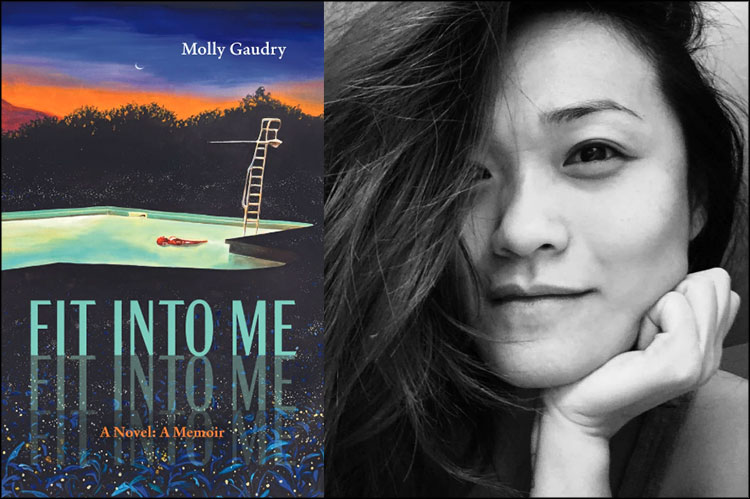
“Fit Into Me”
Molly Gaudry
Rose Metal Press, $17.95
Most viscerally experienced as the building of a fragile construction, “Fit Into Me: A Novel: A Memoir” declares itself a hybrid work from its title onward. The two forms share the pages of the volume by turns, producing a complexity of voice and structure as a fictional narrative and a multifaceted memoir progress, interact, take turns, push each other around, and join, double jointed. The work has been brought out by the 20-year-old nonprofit Rose Metal Press, which commits itself to “hybrid genre publishing.”
The formal structures of the book are a scaffolding of rules and regulations — systems, formats — invented and implemented by Molly Gaudry, in just the way that free-verse poets must invent their own particular forms, poem by poem (e.g., Gaudry details deriving what she terms a “word bank” — a word list — for “Fit Into Me” from Anne Carson’s translation of Sappho’s text “If Not, Winter”). She is a poet as well, with substantial publication credits across poetry, fiction, and nonfiction, and her cross-genre muscles are in ample evidence here.
The volume earnestly follows its own layered, patterned systems. Though sometimes the systems are interrupted. And other times they are explicitly broken. Does Gaudry ever break her rules but not confess? Are we always given fair flag if a portion of the memoir is, for example, invented? Invented to embody the fabric of feeling and experience. But isn’t that what the fiction sections are for? Yes, but. Trading places. Memoir, fiction, fictionalized autobiography, autofiction, the blending — it’s a fascinating kick line Gaudry has choreographed — a dance featuring embodiments of truth, including metaphorical truth, or analogous truth, as she examines the very distinction between fiction and memoir.
Point of view is a helpful organizing factor here. It is used faithfully, like color coding on an event calendar, and the reader finds footing in a complex but highly guided reading environment.
The fiction sections are written in third-person narration to form a story about the tea house woman, a figure that appears in two of Gaudry’s previous works (“We Take Me Apart” and “Desire: A Haunting”). The tea house woman is dealing with love interests, work concerns around her inherited family business (the tea house), and her father, who is dying. This thread does not fully inhabit the scope of a novel, but can be understood as a novelette or long-form short story, or perhaps more expansively as a fragment of a complex but unknown whole.
The memoir sections are written in the first person to form an account of Gaudry’s recovery from a traumatic brain injury caused by a roller-skating accident, detailing her progression toward healing from severe vision and sensory processing issues while pursuing an academic career. These sections also take up her experience as a transnational Korean adoptee, make reference to childhood trauma and the resurfacing of it, look into her episodes of romance, and thread in a wealth of material related to the writing process — often inside-outing her own process of writing the very work at hand. She also delves into her deeply held identity as a reader.
Within the memoir sections, as a kind of subset, certain passages take on the form of a litany, each entry beginning with the word “because.” These passages create an implied yet disembodied logic, one removed, under water, of a separateness that seems to echo Gaudry’s experience of struggling back to reading and writing following the head injury. The “because” material carries some of the most engaging writing in the volume, the litany of causation flowing in an associative stream, informative, revealing, at times shocking.
And then there is the matter of the footnotes. The entire work is extensively populated by footnotes, beginning with the table of contents, continuing through both the fiction and memoir portions of the book as they dance together, and persisting into the acknowledgements. Some of the footnotes contain direct address about the process of writing the book, explanations, or notes on the material. At one point, a lengthy footnote receives its own chapter name and goes on for several pages. This is strange and charming.
Most of the footnotes, however, are presented in the ostensibly voiceless language of academic notation, becoming a third major voice employed in the volume. Dry and succinct, these are meticulously formatted using the correct conventions. The footnotes provide references for writing that is taken directly, word for word, from other works by other authors and dropped, unannounced and seamlessly, into the prevailing narrative. No in-text quotation marks. Yes, sports fans, no quotation marks at all! Now, some readers may stoutly declare that she can’t do that — with respect to custom, or perhaps ethics.
However, she has done it. So we must move on to what doing that does. How does the abutment of Gaudry’s words with those of other writers engage the question of the essence of the writer’s voice? How does it engage the question of source material? How does it conflate reading and writing?
There is a streak of pragmatism in this arrangement: If another writer has written a line just as it is needed, why reinvent the wheel? If each discrete written expression, the sentence, the phrase, is a wheel on the cosmic, infinite semi-truck of literature, is Gaudry writing or is she driving?
Authors employed in the text include: D.H. Lawrence, Frances Hodgson Burnett, Marguerite Duras, Toni Morrison, Ray Bradbury, Sappho, Kathryn Harrison, Margaret Atwood, Wilkie Collins, Annie Dillard, Stephen King, and many more, too many to list, including James Joyce, from “Ulysses” (the word “yes” is footnoted during a sex scene found in one of the tea house woman portions of the text).
The book is an experiment — a bold one with real risk. It could sum up as disjointed; it could land with the reader as self-conscious, that underbelly to the masterful. Yet the volume could truly hum with the vibrations of truth.
We learn from Gaudry, and we learn about her, as a writer and as a reader both. She is generous, opening the door to her thinking process: “I wanted every word, every line, to make possible these questions: Which came first — the fiction or the nonfiction? The quotations or the nonfiction around the quotations? The words from the lists or the fiction around the words from the lists?”
“Fit Into Me” is complete at 190 pages, including liberal line spaces to delineate sections and plenty of space in the physical design, but this is not an airy or quick read. This is a dense read, dense with revelations, information, mechanics, an intricate study of delivery systems for honesty, for psycho/emotional truth be it invented, reported, or found. Gaudry has written an invitation to peek under the hood of the writing process, and she has sealed it with a question mark.
Molly Gaudry is an assistant professor at Stony Brook University, teaching nonfiction and poetry in the M.F.A. and B.F.A. programs.
Evan Harris is a writer and librarian living in East Hampton.