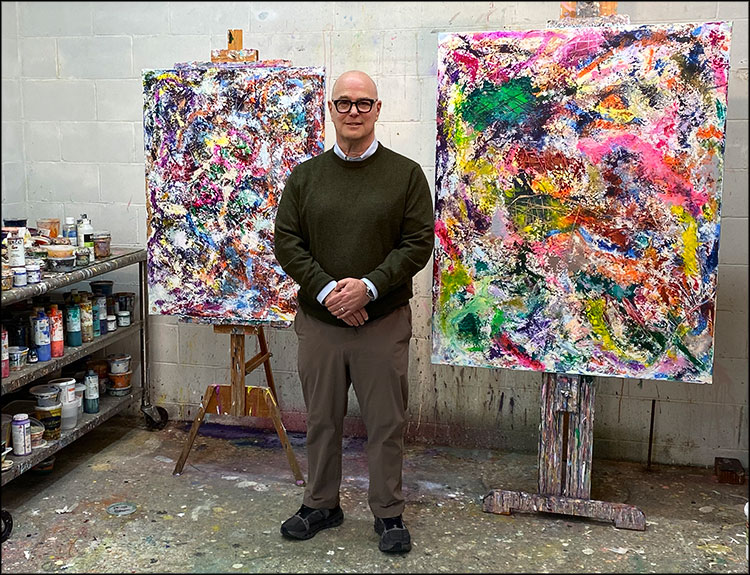
Succeeding in one career is challenging enough, but thriving in three is unusual. George Singer, a self-taught painter based in East Hampton, didn’t take up a paintbrush until 12 years ago, but flourished early on, first as a writer, then in the advertising industry, and finally as a master of digital technology.
Born and raised in Baltimore, Singer grew up with art. “My mom was a painter, but she wasn’t a recognized painter,” he said during a visit to his studio in Northwest Woods. “We had art books. My mom was a big fan of the Impressionists.”
An aunt was also an artist. When he was very young, and she and his mother were painting and drawing with pastels, “I would jump in, and they would let me do something off to the side. But as I got older, that didn’t stay with me. The writing did.”
Singer holds a B.F.A. from the University of California, San Diego, and an M.F.A. from the prestigious University of Iowa Playwrights Workshop. “I was at U.C. San Diego when I homed in on playwriting. I was fortunate as an undergraduate to be able to sit in on the graduate classes.”

The Iowa program, which lasted three years, was like “being part of a family,” he said, one that still exists 35 years later. A week ago, Singer traveled to Philadelphia for a gala celebration of the 90th birthday of Robert Hedley, who led the communications and theater program at Iowa when he was there.
The semester before graduation, the young playwright secured an internship at New York City’s Home for Contemporary Theater and wound up with his first production there. The play, “Syringe,” was a black comedy about Claus and Sunny von Bulow. (Von Bulow was convicted in 1982 of attempting to murder his wife by insulin injection. The conviction was later overturned.)
Singer returned to the city in 1990 after graduating. Needing a day job, he wrote to “the chief creative officers of all the major advertising agencies.” Three wrote back, but the jackpot came from the creative director at McCann Erickson.
“She’d applied to the Iowa Workshop many times, and the fact that I was from there really appealed to her.” He was hired as a freelance copywriter, with enough free time to write plays, and theatrical productions of his work followed in London, Washington, D.C., San Francisco, and Manhattan.
“I was kind of climbing — and then, at some point, I had a production that didn’t go well. The thing about playwriting is that it’s so hard to get a production and then you’re so reliant on all these different variables coming together to create magic. And when they don’t, it can be a huge disappointment.”
Singer turned to fiction. His short stories soon found publishers, including one in each of two collections of work by gay Southern writers. “Baltimore never considered itself Southern, but the stories were set in the South, so it was happenstance.”
Meanwhile he began moving up from one Madison Avenue agency to another, with increases in pay and prestige and better titles. “Mad Men” was on TV, and “I watched it back then, and Don Draper inspired me, he made me feel like I was doing something cool.”
That said, “When you reach a certain age in advertising, it’s ‘You’re too old.’ Ageism runs rampant.”
But Singer, who was good at digital technology, not only survived but thrived. Online, he began building websites and media units for top brands. His final day job, building and managing the website for AT&T, lasted for six years.
There was a downside, though: As he became more successful, the job became more demanding, and the writing, he said, began to suffer. “I’d get up at 5 or 6 in the morning and write for an hour, but it just started to feel like work. I decided to put it aside and maybe come back to it.”
Singer’s pivot to painting happened by chance, in a twist of fate. Twelve years ago he visited a gallery that was showing paintings by one Forrest Bess, a commercial fisherman who lived in a fishing camp in Texas and painted in his spare time. Bess, who’d been discovered and promoted by the noted gallerist and collector Betty Parsons, was “an eccentric character,” Singer said. “It was the first time I’d looked at someone’s art and thought I wanted to do that. It was a real weird epiphany.”
When he began to paint it was mostly color-block work — taking colors that are opposite on the color wheel and blending them to create complementary patterns. Singer has returned to the process throughout his artistic career.
He and his husband, Gus Yero, also an artist, are collectors as well as creators. Singer pointed to a painting they own by Etel Adnan, a colorist, who had a house near Mount Tamalpais, a San Francisco Bay area landmark that was for her what Mont Sainte-Victoire was for Cezanne: landscape as Muse. The work set the scene for a series of his own paintings, from 2020 — stripped-down color-block landscapes whose features are defined by contrasting areas of color.
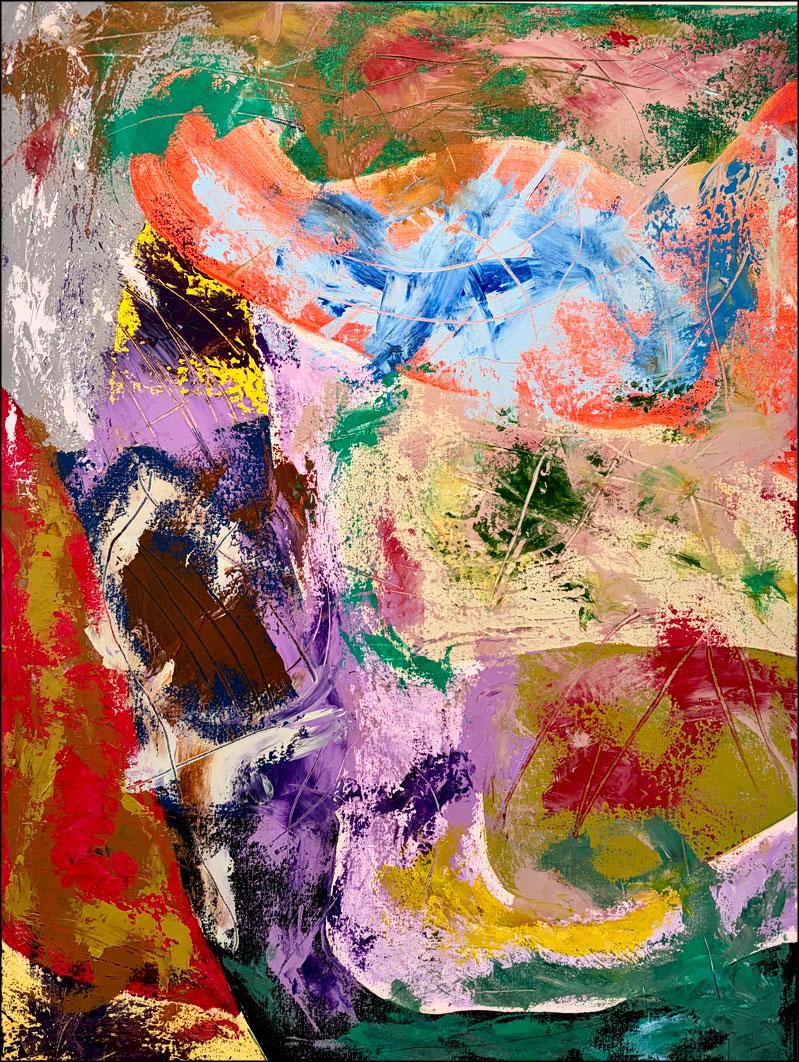
“Part of my learning process has been to paint like other painters and then somehow move on,” said the artist. A series of works from 2025 feature harder-edged areas of color and, in some cases, paint-scratching. They relate to the earlier works but are more abstract, with only the faintest succession of topography.
In his studio, Singer displayed his most recent paintings. While color is still key, rather than colliding blocks of color the canvases feature very active all-over compositions of swirling paint and slightly textured surfaces. “The challenge with these,” he said, “is to make them not feel like Abstract Expressionism. What are you doing to make it your own?”
One answer was to start with color block painting as the ground, and more intuitive brushwork above. “I feel it has to do with different layers of ourselves, the passions that kind of sit under the things we present to the world. The scratches represent those things breaking through.” He paused, apparently reluctant to speak at length of his painterly process, but then said, “I always have a sense of what I’m trying to do, but once I try to do it it’s really like feeling my way through the dark, hoping I don’t bump into something, and getting to the other side of something that feels good.”
Asked about living with another painter, Singer said it was helpful for two reasons. “For one, we had a studio with canvas and paints and brushes and a sink. I was able to hop right in.” Also, Yero was a big help with such technical things as glazes. “Gus was a good teacher for me, of basics. He also has a propensity toward color. That was really key, the color thing.” Together for 30 years, Singer and Yero moved to East Hampton in 1997 and to their house near Cedar Point County Park, which they share with two cats, three years later.