With exhibitions on view simultaneously at Guild Hall, the Madoo Conservancy, and the Petzel Gallery in Chelsea, Ross Bleckner is having a moment. Considering he had his first solo show with the Mary Boone Gallery in 1983 and a midcareer retrospective at the Guggenheim Museum in 1995, Bleckner has had a lot of moments over the past 43 years.
He is one of the most celebrated painters of his time, but after spending an hour with him in his Springs studio one comes away feeling what matters to him is not his reputation but his next painting. Or paintings, as the long walls of his studio are lined with large canvases, most of them in some state of incompletion, at least as far as he is concerned.
Before leading a visitor into the main space of his studio, he introduced three artists in residence who have been painting there over the summer. Regarding the residencies, he said, “I’ve been doing it informally for a few years. I find the artists by word of mouth, and it’s really worked out well. I have enough room here that I can have total privacy and they can, too.”
He pointed to a small house situated at some distance from the studio. He plans to demolish that and replace it with “a very simple two-bedroom, two-studio structure. What I’m looking to do is actually create a real residency with room for four people besides me. It’s something I want to do with this property in the future, when I’m not here.” He has a lawyer working on that plan.
Bleckner’s first house on the South Fork was Truman Capote’s former home in Sagaponack, which he bought in 1992. Asked why he moved he said he had zoning issues there that he doesn’t have in Springs. “My studio there was separate from the house. It turned out that if you have a separate structure, you can’t put in heat or water. There was no toilet.”
The late Eric Freeman, who was his life partner, and whose work is also in a solo show at Guild Hall, told Bleckner he heard that Denise Lassaw, the daughter of the sculptor Ibram Lassaw, was ready to sell her property in Springs, but only to an artist. “The house was derelict,” Bleckner said. “She hadn’t lived here for 10 years. She Googled me and told Eric I was acceptable. I drove out the next morning and made the deal. There was nothing here. I built the house and the studio I always wanted.” (In 2000 the Town of East Hampton authorized the purchase of 24 acres of the 30-acre property. It became the Lassaw Preserve. Bleckner owns the rest.)
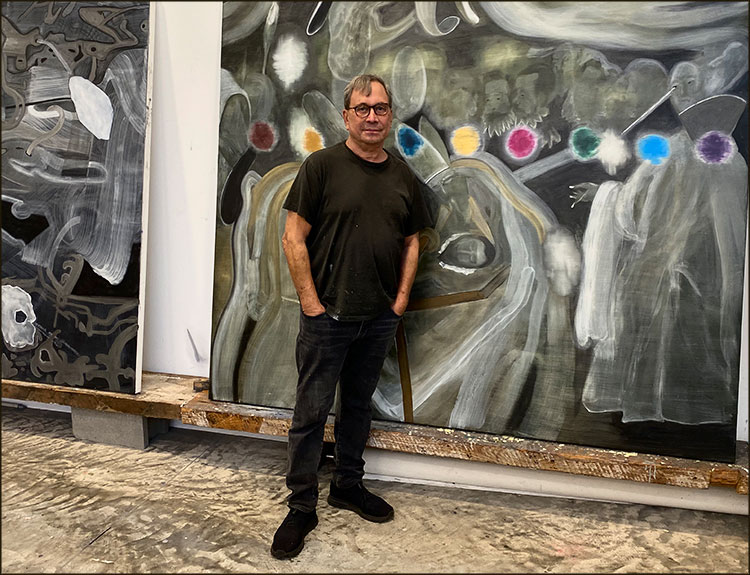
Once inside the main studio, Bleckner said, “These are not new paintings. These are just paintings from last summer and the winter that I want to keep looking at. Some are done, some aren’t.” He approached a painting on the far east wall he said was “an interpretation of my favorite painting in the world.” That painting is El Greco’s “The Burial of the Count of Orgaz.”
Bleckner’s is “kind of like a ghost of the El Greco, but it’s there. It’s fading in. What I wanted to do was bring it to me so we meet and have a dialogue.” In the El Greco there is a horizontal line of heads in the middle ground that are portraits of 16th-century nobles of Toledo. In Bleckner’s painting, which isn’t finished, the heads are ghostlike but legible, as is the head of the count, who is being lowered into the ground by two saints. Bleckner said he wanted to emphasize the horizontality of the faces “just to kind of make it my painting.”
“I like the idea of using other artists’ paintings. I love using them as a jumping-off point. For the flower paintings, I always use Manet as a reference. That idea of using references from history has to do with what we remember, what we bring with us, what we forget.” He paused before adding, “Because I forget a lot.”
Referring to a painting inspired by Matisse, he said, “I’m not a figurative painter but I’m trying to abstract it but create the movement. It’s really about movement, the light and the dark. A lot of my work is really about light.”
Many artists work in series, leaving one finished before moving on, while others, such as Chuck Close, have an even more narrow focus within which they work variations.
“I don’t really like the idea of having a trope that’s your brand,” Bleckner said. “I like the idea of painting as consciousness, and when you’re in your consciousness, it’s all about curiosity. When you’re painting it’s about making mistakes and making marks and those marks and mistakes lead to new tropes and new ideas, and for me that’s the reason to paint, to try to expand the vocabulary. To look for new ways to make paintings and to apply paint.”
On entering the gallery at Guild Hall, one is struck by the long south wall on which hang 180 10-by-8-inch paintings. Aside from the sheer quantity, while those paintings date from 1984 to 2026, as is the case with his larger works, the images give no clue to the dates. But there’s more to that than not wanting a brand.
Of those paintings, he said it was the idea of Melanie Crader, the show’s curator. “I never showed them, never sold them, that’s why I have so many. I always thought of them as on the private side, you just need to see the larger painting, you don’t need to see all the steps, all the thinking.”
At the same time, he said, “It’s also a way to build up my confidence, so I know what I’m doing when I put the paint down and I can feel it and it feels right to me. It’s getting the emotional tone instead of just starting on a large painting and not knowing where I’m going.”
The Guild Hall show includes two of his burn paintings. “I like the chemical reactions I get with the blowtorch,” he said, showing one spot on a canvas that had been burned. One might expect a charred area, but that area was white. “I just put the paint on and then I kind of draw into it with fire because the line of the fire breaks the seam of the paint, it opens it up.”
Of one painting he is still working on, he said, “It hasn’t decided exactly where it should be yet, but I’m having fun painting it. Sometimes I have to let them decide what they want to be, I don’t always know.”
He went on to say that not knowing is part of the Buddhist tradition. “It’s the way I organize my studio, I walk in and I want everything to be clean, organized, because I don’t want to start with the debris of the other day. I want to start with a clear mind, and for me that’s how I do the best work — if my mind is as clear as a mind can be. Consciousness, your perception, everything kind of changes and morphs and becomes other things as you’re looking.”
His show at Guild Hall, “Never the Less,” is on view through Oct. 25. “Octopus” at the Petzel Gallery is up through Oct. 24. “Mind Over Body” at Madoo closed on Sunday.