
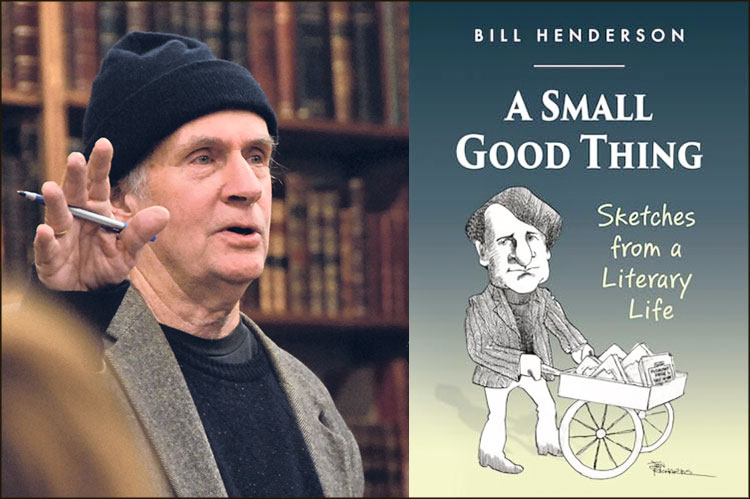
“A Small Good Thing”
Bill Henderson
Pushcart Press, $20
In celebration of the 50th anniversary of the Pushcart Prize, which recognizes writing that appears in independent presses, Pushcart Press has brought out a “A Small Good Thing,” a brief, dear volume by the stalwart, everlasting Bill Henderson, founder, defender/champion, and chief pencil sharpener of the press. Among many other credits, including authoring seven memoirs, he is founding member of the Lead Pencil Club and editor of “Minutes of the Lead Pencil Club.”
Henderson is not alone in the current book project, and is careful to say so, in print over the years and here as well, citing the fundamentally collaborative nature of the Pushcart Prize and defining the efforts of the press as a result of a meaningful literary community.
Part 1 of the volume delivers up Henderson’s progression from young, fervored, Paris-attic-dwelling writer of literary fiction — in search, according to his 2026 self, of “literary stallionship” — to the self-publishing venture, through Nautilus Books, conceived with his uncle Howard Galloway as financial backer, that in 1971 brought out his Great American Novel, “The Galapagos Kid, or the Spirit of 1976,” published under the pseudonym Luke Walton.
Note: The novel is held by a number of university libraries and also available through the sorcery of online booksellers. It is an absurdist coming-of-age romp with a maximalist, careening quality and revved-up speculative elements that speak satire and high-frequency existentialism. Kip, the ambitious, energetic, and misguided teen protagonist, schemes to better himself, communicate with his dead Grandpop, and woo his girl-love Mirabella — who, once profoundly ailing, becomes the surgically, genetically, and culturally altered object of his ambition. All the while, Kip attempts to puzzle out the edict of his Uncle Charlie — “Whatever works works” — and decode the wisdom of his grandfather.
Included in the material surrounding the publication of “The Galapagos Kid” is a gem of a profit/loss list, an honest appraisal featuring singular categories (e.g., “$20.00 — total doctor’s bill for spasmed back” and “$5.00 — hot water bottle for spasmed back”) and minute accounting — thank you to the archivist in the mix here. Those interested in more from this period may try pursuing Henderson’s papers, held by Indiana University.
Part 2 of the book describes Henderson’s time as an editor at Doubleday (a.k.a., in his parlance, “The Corporation”), a two-years-plus gambit. He lampoons the corporate ladder, the corporate attitude, and the corporate worldview, and, roguish, gives an inside skinny on the publishing world of the time.
Part 3 takes up Henderson’s publication, as editor, of “The Publish-It-Yourself Handbook: Literary Tradition and How-To Without Commercial or Vanity Publishers,” ringing in his arrival as Pushcart Press and Pushcart Prize founder, etc. He clearly describes self-publishing in contrast to vanity presses, defining it as a labor of “love and risk.” (If readers find that the self-published greats list — Walt Whitman, Anais Nin, Virginia Woolf — is beginning to age, consider the very contemporary efforts of Solvej Balle, brilliant author of the planned seven-book speculative time-loop narrative “On the Calculation of Volume,” who self-published the first six books in Danish via Pelagraf, a press she set up in 2011; translations into English of books one to four are available through New Directions — number five coming soon.)
“The Publish-It-Yourself Handbook” has been through four editions: 1973, 1980 (revised edition), 1987 (third revised edition), and 1998 (25th anniversary edition). It contains this, from the preface to the revised edition: “The right to publish what you believe in is an essential of any democracy. It is not to be denied by government, local censorship, or publishing conglomerates.” Perhaps we are due a new edition as the 21st century digs in, awash in social media and the consolidation of major publishing houses?
“A Small Good Thing” is Henderson’s short-form confession — he calls it just that, and it tracks just so, encapsulating the little bit embarrassing, definitely juicy sense of sharing, of intimacy, of revelation, of tell-all, and yes, he names names, exciting, famous names, yet not name-dropping, instead credit-where-credit-is-dueing — and perhaps a little rueful, witty, self-deprecating reverse name-dropping, e.g., a full list of writers who never responded at all to a request to read galleys for an advance review of “The Galapagos Kid.” Confessional quality notwithstanding, readers will not suffer the trashy, still hungry and thirsty sensation of consuming social media, primary vehicle of unchecked disclosure and bean-spilling today. Because Henderson is not looking for attention, he’s telling us what his intent has wrought, over time.
Finally, this tidy retrospective is marked by a sense of amazed triumph, most wholesomely distinct from smug self-congratulation. The small press will forever (so far) be the province of those brave and possessed by a fervor, compelled to strive with little reward, because: capitalism. “A Small Good Thing” is a charming look back — how fortunate that Bill Henderson remembers and shares in his warm, headlong style.
Evan Harris, a librarian and regular book reviewer for The Star, lives in East Hampton.
Bill Henderson lives in Springs. “A Small Good Thing” comes out on Tuesday.