The world of miniatures grows larger each day.In what has become a mass-produced world, Jonathan Steadman is creating something that can’t be replicated — tiny figures that bear the unmistakable mark of his own hand. Each piece he crafts tells a story and makes the ordinary extraordinary.
And in just two short days, he will transform a dollhouse through the magic of miniatures in a painstaking restoration project.
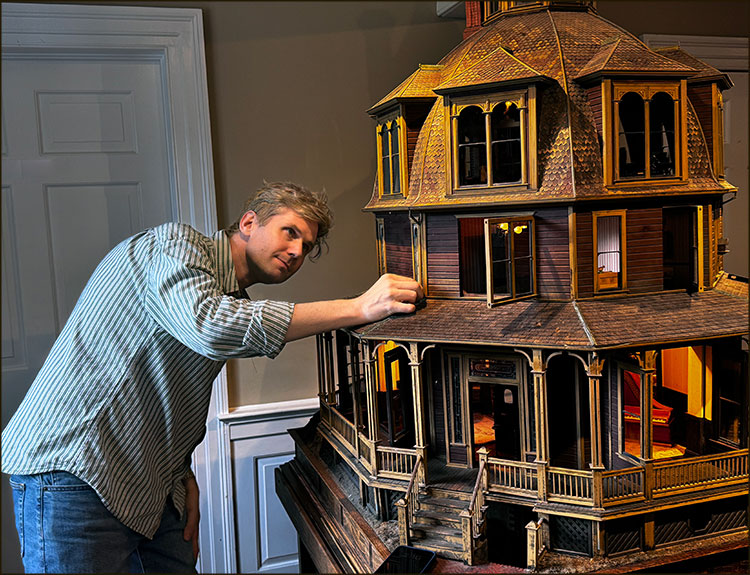
It’s not just any dollhouse though. This dollhouse has its own builder, painter, and restorer and sits in a position of distinction in the entry of the East Hampton Ladies Village Improvement Society’s Bargain Box thrift shop.
The Octagon House, as it is called, was donated to L.V.I.S. in 1990 by Deborah Ann Light, an Amagansett philanthropist. The house was designed and built to scale in 1981 by the famed dollhouse makers Noel Thomas and his wife, Pat Thomas, in Seaview, Wash.
Lined up on a small folding table in the entryway of the L.V.I.S. headquarters, Steadman had his tools — an X-Acto knife, an array of glues, and recognizable pieces of a house, shrunk to hand-held size.
He picked up a gutter downspout, saying, “there is only one person in the country who makes these.” Each of the gutters is handcrafted and hand painted a copper color complete with a green patina to indicate aging metal.
A bag of mini shingles sat on the work bench, ready to replace some of the time-worn roof tiles. But they will need work, Steadman said. They are too large so each one will have to be cut to size. He was able to source the correct size through one woman, but, “she would not part with them,” he said, smiling as if to indicate he would probably not have parted with them either had they been his.
Those shingles will be stained with a concoction he said is called bug juice.
Steadman, who recently designed and created a miniature replica of Bergdorf Goodman, the Manhattan department store, landed in East Hampton to work his magic on the Octagon House.
While the actual work at the L.V.I.S. would take only two days, many hours have been spent on preparation. “Lots of podcasts,” he said of the time it takes, “lots of true crime.”
While he is relatively new to the field, having begun only about five years ago, he said that in many ways he “has always been a miniaturist” even before he started to make a living doing it. For two years, Steadman has worked with Bergdorf Goodman on its scaled-down replicas. This year, for its 125th anniversary celebration, the department store reportedly paid $35,000 for the work.
It is on display at the flagship store, complete with its own security guard while it awaits its plexiglass box surround.
The L.V.I.S. dollhouse will soon have its own new glass housing to protect it from the wear and tear it has withstood since Light donated it 36 years ago.
“This is an iconic dollhouse in its scale and quality,” Steadman said last week. “The maker is very famous and well respected.”
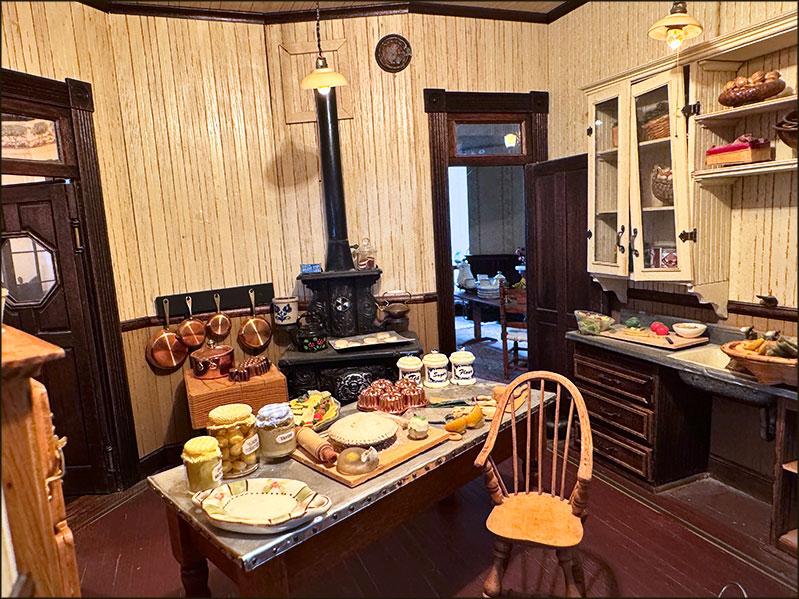
The devil is in the details in the 45-year-old house. Handmade furniture, some created by Roger Gutheil, a famed miniature artisan in the late-19th century. The breakfront in the house, crafted by Gutheil, is estimated to be worth several thousand dollars. The shelves of the piece are filled with individual miniature Staffordshire cottage houses.
It is said that Light’s own house was decorated with the life-size version of some of those items of furniture.
Speaking of shelves, the shelves of a bookcase are lined with books, each with inscribed pages. India Northrop Pratt, the chairwoman of the L.V.I.S. dollhouse committee, said the collection includes a miniature copy of the book “Jaws” by Peter Benchley.
Lights running through the house are electrical, not battery operated, and are wired into the base of the house.
While Steadman said he would be remiss in not mentioning the spectacular detail of bird poop staining the roof under a birdhouse, he said his favorite element is the floor in the sitting room, which is constructed of individual floorboards surrounded by a parquet-style trim.
Northrop Pratt pointed out two shadow boxes on the wall of an upstairs bedroom filled with pinned miniature butterflies.
A wear pattern on the front steps of the house shows a manufactured age meant to conjure the impression of generations of family coming and going from the manse.
The origins of a courting chair — a Victorian-era piece of furniture consisting of two connected chairs facing opposite directions — in the house’s living room are being researched now.
Much could be said about the heyday of dollhouse making and collecting, which Steadman identified as the 1970s and ‘80s. During that time, artisans like the Thomases dominated the field and the hobby was for both children and adults.
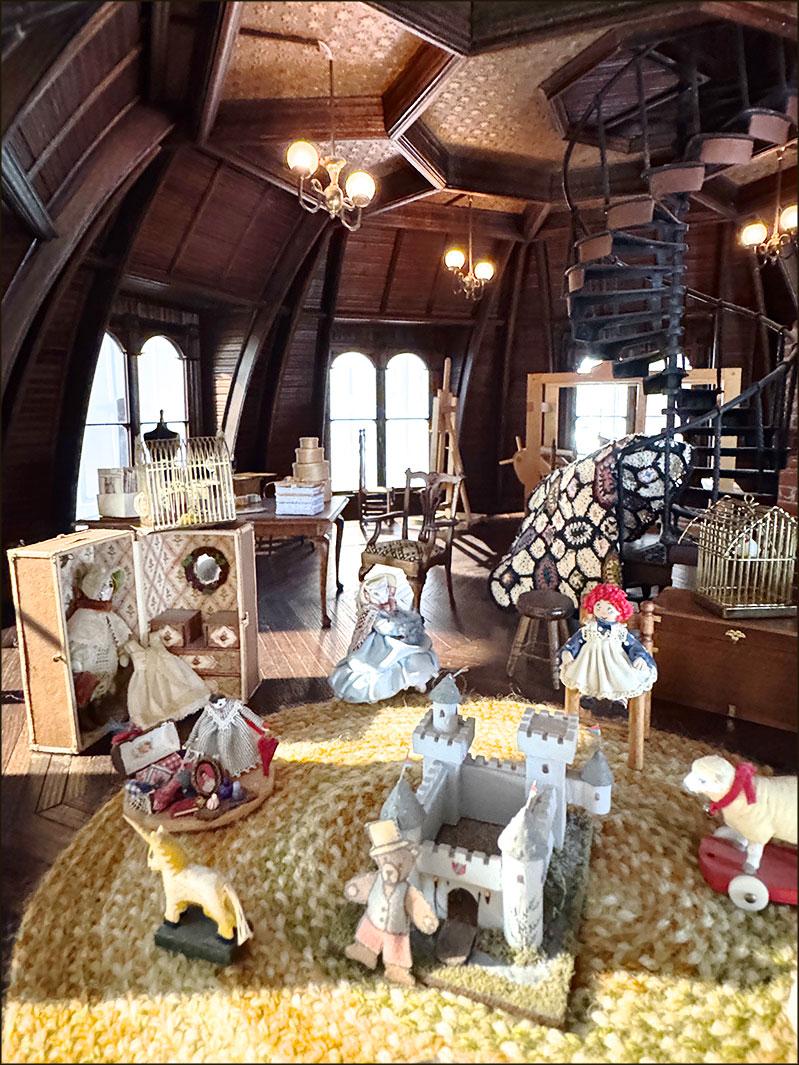
Steadman said that while such artisans still exist, there are far fewer these days than ever before, but the space is still vibrant, with international showcases of their works. He showed the work of a Japanese artist who specializes in miniature fish tanks, which include painstakingly crafted individual fish.
“It’s having a moment, especially with young people” he said of the world of miniatures. In fact, he, along with 200 other miniaturists, converge on the town of Castine, Me., every summer to take over the campus of the Maine Maritime Academy. There, the group takes part in dozens of crafting classes — all in miniature.
Two years ago, Steadman took a miniature embroidery class. This year, he did miniature metalworking and created a tiny copper kettle. He has also traveled to Belgium to learn how to carve miniature wooden chairs.
Is there a point when it all gets to be too painstaking? “No,” he replied simply.
“In a way, I have always been a miniaturist,” he said, although he used to be a home products designer. Along with a passion for the Christmas holiday season, Steadman said he first bought a dollhouse kit that he transformed into a gingerbread-style house. “That’s when I got hooked,” he said.
It was a bit of serendipity that brought him into the sights of the L.V.I.S. dollhouse committee. Northrop Pratt said she was shopping for seasonal decor for the dollhouse at the Tiny Dollhouse store in Manhattan when the owner mentioned Steadman, who had been selling miniature pizzas at the shop. The rest is history.
The L.V.I.S. decorates the dollhouse for Halloween, Thanksgiving, winter holidays, and spring. Although the details are always kept true to the Victorian era of the house itself, some features have been updated, including a relatively new menorah and Kwanzaa candles.
This year, Northrop Pratt bought a tiny turkey dinner and Steadman will be handcrafting a Christmas tree.
The dollhouse, as always, is on display at the entrance of the L.V.I.S. and can be seen any time during business hours.