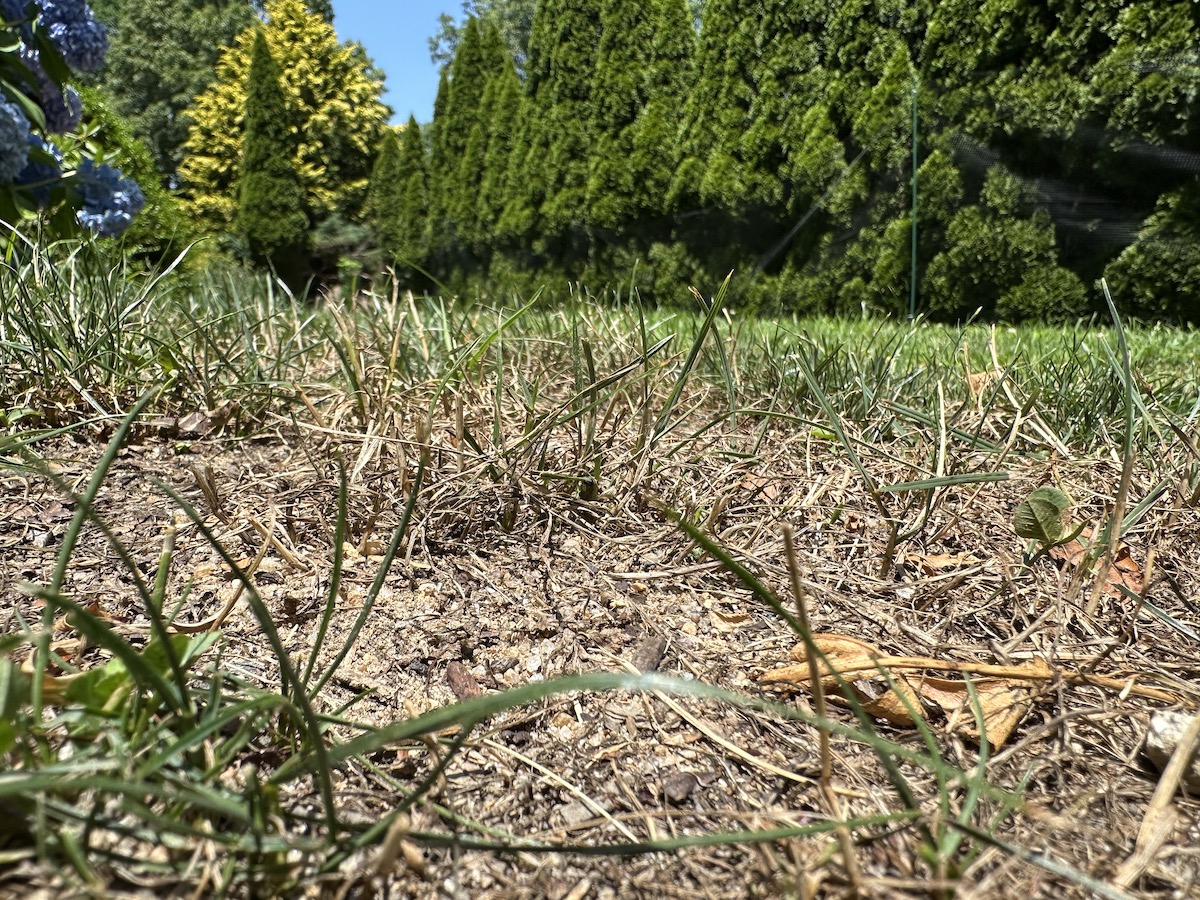
One of the worst early-season droughts in recent memory is hitting the East End just as a heat wave and July 4th crowds, expecting wall-to-wall greenery and willing to expend precious water resources to meet those expectations, converge on the area.
The Suffolk County Water Authority urged customers this week to reduce water usage, stating that “water demand is approaching record levels.”
“It is exceptionally early in the summer season to experience severe drought and near-record water demand,” said Charlie Lefkowitz, the water authority chairman. “Without immediate reductions in water use, pressure drops will occur, compromising emergency fire response.”
Complicating matters further is the fact that two water authority wells in East Hampton were recently taken offline after “forever” chemicals were discovered within them. Those two wells provide eight percent of production in what the water authority refers to as its “pressure zone.”
Two other nearby wells are operating on a greatly reduced schedule as officials continue to determine whether they were impacted by the same chemicals, alleged by the authority to have been released in a 2023 fire at the battery storage facility on Cove Hollow Road in East Hampton. That facility is located just north of a water authority well field.
A lawsuit between the water authority and the owners of the storage facility is ongoing.
“It’s a significant amount,” said Dan DuBois, director of communications for the water authority, of the production lost to the tainted wells.
For the first time since 2000, when the water authority began reporting statistics online, the United States Drought Monitor has reported that Long Island’s East End is in a springtime “severe drought.” The drought monitor uses a scale ranging from D0 to D4 to categorize drought intensity. A severe drought is D2 and indicates a severe environmental and economic impact.
The region does occasionally dip into that drought status, but it typically occurs in the autumn. Spring is usually a wet time of year.
“I can’t recall a situation where this early in the season we were this concerned,” said Mr. DuBois.
Mike Dwyer, a trustee of the Irrigation Association of New York and an irrigation contractor in Nassau County who knows his water levels, warned this week that more people are irrigating now than ever. “I’m an old-school guy, and so I open the newspaper every morning,” he said. “I recently looked at what our rainfall is for the month and year. When I saw the number, I said oh my god, we are pushing it early. We really are low.”
“Inefficiencies in installed irrigation systems make a bad problem worse,” he observed, noting that most of the time these systems are operating at only 30 to 40 percent efficiency. “If you have to keep increasing your watering and you’re not getting a green result, you have a problem.”
“The worst thing we see is that once people install irrigation, they think the solution to everything is to irrigate more,” Mr. Dwyer said. “Smart controllers,” he added, are “a wonderful tool” to help manage the water level of the soil, but putting in native plants that develop the root structure to deal with droughts is just as wise.
“Certain grasses have grown for millions of years and they got by in the droughts,” he said.
According to the Raindrop app, East Hampton is more than six inches below its average rainfall for the year, and would need about two months of average rainfall to get back to even. Unfortunately, the drought is forecast to persist.
In June, the town received only .69 inches, making it one of the driest Junes on record.
Given the ubiquity of irrigation systems up and down the North and South Forks, which pull water from the sole-source aquifer that we rely on for our drinking water, most residents are detached from the reality of the drought. Their lawns are green; their sinks are working; their pools are full.
Signs are clear in the woodlands, though.
Dai Dayton, president of the Friends of the Long Pond Greenbelt, said two ponds she monitors, Slade and Camps, are completely dry. “The others have about 30-foot shorelines,” she wrote.
“S.C.W.A. is aggressively stressing the importance of water conservation with our customers during the peak demand season,” said Mr. DuBois in a text. “It’s important that everyone follow the odd/even lawn watering schedule and install water-saving devices. If everyone does their part, we can ensure that our water resources are protected and we have an adequate supply for emergencies.”
The water authority, which is one of the largest groundwater suppliers in the nation, pulls 210 million gallons from the aquifer daily, with the average peak pumpage (generally between 4 and 7 a.m.) up at 470 million gallons per day. Countywide, the authority has 586 active wells at 237 well fields.
Its average customer uses about 130,000 gallons annually. In the Hamptons, however, there are some residential users who use tens of millions of gallons a year — more than Stony Brook Southampton Hospital, which uses about 14.5 million gallons annually.
“It’s obviously a situation that concerns us,” said Gerry Turza, East Hampton Village’s fire and emergency medical services administrator. “We have good communication with the S.C.W.A. regarding any potential needs for increased water pressure. Like any other drought period, we ask the public to be mindful with domestic water usage.”
On Tuesday afternoon, five separate water-tanker trucks were filling up from hydrants along Long Beach Road in Sag Harbor. Each tanker carries approximately 7,000 gallons of water. A 40-by-20-foot pool with an average depth of six feet holds about 36,000 gallons, meaning that filling 30 pools requires about a million gallons of water.
Mr. DuBois said the water authority issues permits to these companies to use the hydrants. The permit cost is tied to the size of the truck.
“Generally, these trucks are filled during the day and not during peak demand hours,” he said. “There is not an impact on pressure. However, during water alerts we have limited the use of hydrants in the past.”
East Hampton Town Supervisor Kathee Burke-Gonzalez, in a social media post on Tuesday, announced that outdoor watering at town facilities has been suspended until after the weekend, when temperatures are expected to moderate.