
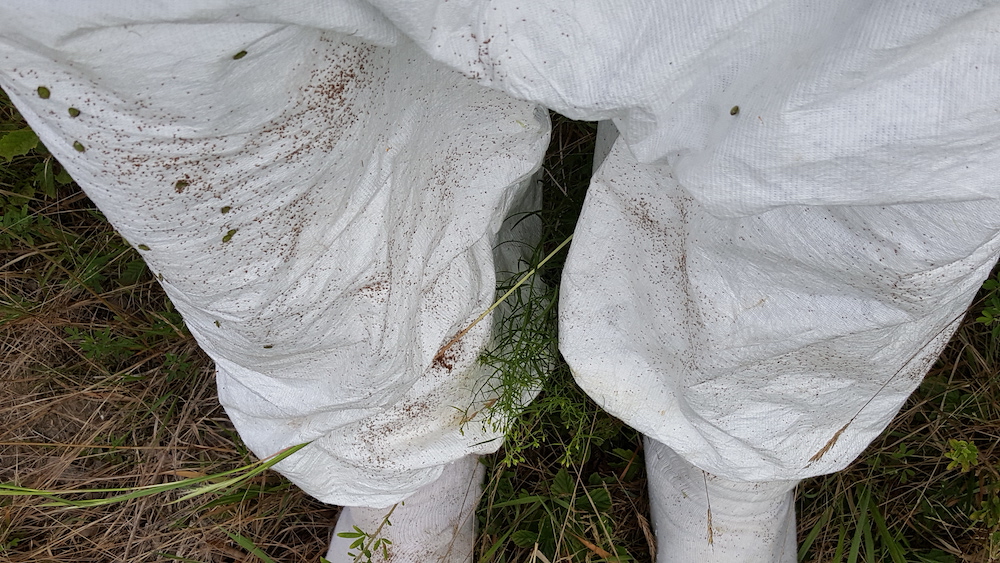
Is there anything worse than a larval tick attack? Turns out, not really.
“I’ve been bitten by bullet ants, leeches, hookworms, and flesh-eating botflies,” Noah Strycker, the best-selling author of “Birding Without Borders: An Obsession, a Quest, and the Biggest Year in the World,” wrote in an email this week. “But those larval ticks on Long Island were definitely my worst bug experience ever.”
Generally, larval tick bites come dozens, or hundreds, at a time. Bites are usually concentrated, like around the socks or a waistline. They itch for weeks, forming hard pustules that pop and ooze and then harden again to gush and ooze some more.
And pay attention: Larval tick season is here. Local allergists, dermatologists, and urgent care facilities have all reported patients experiencing attacks this summer.
Mr. Strycker traveled through 41 countries, often slogging through tropical jungles, to encounter his collection of bites (and set the birding world record while he was at it). However, on the East End, larval ticks hang in less exotic locations like that park at the end of your block, the grass outside, or that dog in your bed.
Often misidentified as chiggers, larvals are so small they’re difficult to see. They’re often encountered in the hundreds because they’re the result of a female tick dropping off her host, usually a deer, and laying thousands of eggs (up to 8,000) in a small area.
During the months of August, September, and even into October, “tick bombs,” these concentrated groupings of larval ticks, could be pretty much anywhere.
“The larva that feed on people are almost always lone star ticks,” said Dr. Erin McGintee, an allergist and immunologist with ENT and Allergy Associates in Southampton and a medical adviser for the Stony Brook Southampton Tickborne Disease Resource Center. “When I was a kid and the lone star tick wasn’t here, nobody was getting larval bites. They’re all over the place this time of year. If you’re hiking or going in the woods that’s almost a guarantee you’ll encounter them.”
Of the three stages of a tick’s infernal life, the larval stage comes first.
For a while, as bad as larval tick bites were, the idea was: “Well, at least they don’t carry disease,” because you won’t catch the well-known tick-borne illnesses, like Lyme disease, ehrlichiosis, or babesiosis, from them. However, they are likely a main cause of the increasingly prevalent alpha-gal allergy, first identified around 2009 and colloquially known as the “meat allergy.”
“A lot of times, people think the height of the summer is over, and they can stop worrying about ticks, because you don’t see as many adults and nymphs,” said Dr. McGintee. “They let their guard down. But larvae are the worst. They don’t transmit tick-borne disease, but if you get 100 larval tick bites and you’re someone who is prone to developing the alpha-gal antibody, that’s bad for your numbers.”
Antibody numbers. It’s one of those numbers you want fewer of, at least in this case.
Dr. McGintee explained that only 24 percent of people who are bitten by a lone star tick (in any of its life stages) will make the antibodies that can lead to an allergic reaction to meat or other mammalian products (she says less than 10 percent of patients react to cheese and dairy, and she doesn’t routinely recommend avoidance). However, with each bite, the antibody numbers go up. “The higher it goes, the more likely you are to react to meat if you have the allergy,” she said.
That’s why mass bites from larval ticks are concerning.
False positives are common, she said. “The reflex shouldn’t be, I have lone star tick larval bites so I should go get tested for the antibody. You test if you show an allergic reaction to eating meat.”
The timeline between bite and allergic reaction isn’t clear, though Dr. McGintee said that patients are usually most reactive in the first few weeks to a month or two after a bite. It’s also not clear how long a tick must be attached to pass the alpha-gal sugar molecule that causes the antibodies to form to its victim, but “It is certainly not like Lyme disease, where the tick needs to be attached for 48 to 72 hours to transmit. Even if a tick is removed very soon after the bite it can still impact alpha-gal immunoglobulin E [antibodies].”
So, if you encounter a “tick bomb” in these next few weeks, start paying attention to how your body reacts after you eat meat. If you get stomach cramps or hives hours after a meal, it’s time to visit an allergist and get tested. Fatty meats, like burgers or sausages, tend to lead to worse alpha-gal reactions.
Better yet, try to avoid the bombs altogether. If you must work in a wooded area or hike in the woods, spray your clothing with a permethrin-based pesticide like Sawyer (sold at the South Fork Natural History Museum). Another good idea is to carry a lint roller with you or keep it in your car. That way, if you do encounter larval ticks, you can quickly roll a majority off.