
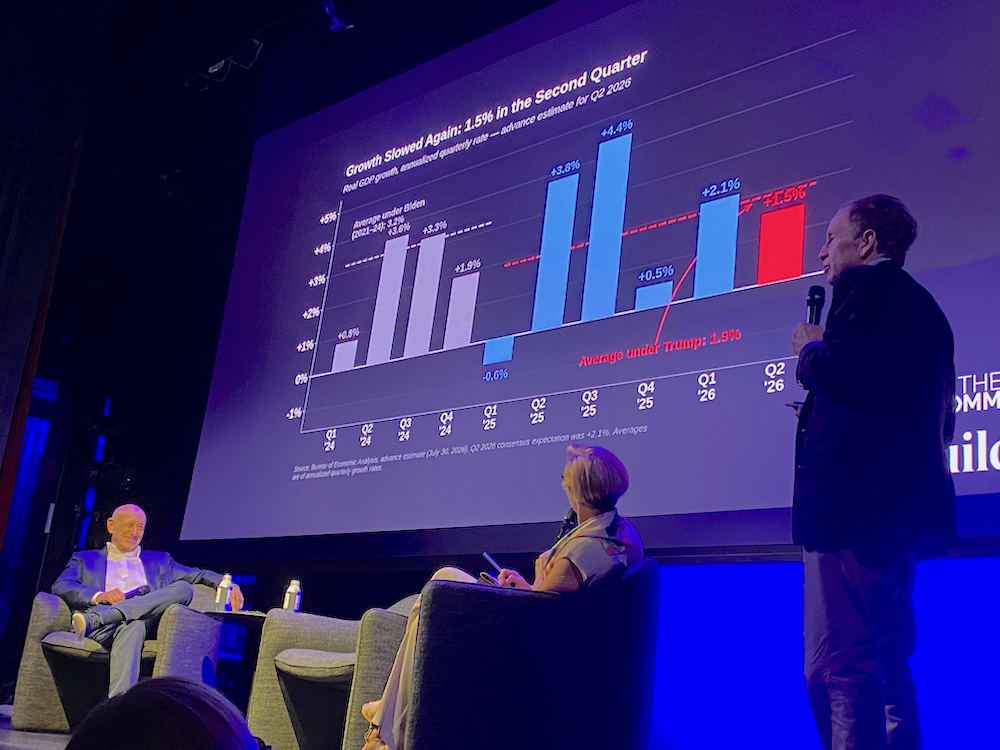
According to many metrics, the American economy is doing extraordinarily well, yet most voters say they are worse off under President Trump. Artificial intelligence is driving a strong bull market, but it could also kill us all.
These opposing outlooks were among the topics explored at Monday’s installment of the Hamptons Institute at Guild Hall in East Hampton. “The Global Economy: Where Is It Headed?” saw a lively discussion among Lloyd Blankfein, senior chairman of the Goldman Sachs Group, Steven Rattner, chairman and chief executive officer of Willett Advisors, and the moderator, Gillian Tett, a columnist and member of the editorial board of The Financial Times.
Inflation, interest rates, and geopolitical tensions are moderately high. Corporate earnings are soaring. Trillions of dollars are being invested in development of artificial intelligence and its massive physical infrastructure, while A.I. itself appears to be outpacing humankind’s efforts, if any, to maintain control over it. What does it all mean for the global economy? Opinions offered at Monday’s discussion, presented by Guild Hall and the Common Good, were many, but usually came with caveats.
“What can we do to explain this extraordinary juncture between the raw numbers and voter sentiment?” Ms. Tett asked. “Is it all down to A.I.? Is it all down to politics, or is there something else going on?”
Job growth has slowed, Mr. Rattner noted, citing the economy’s loss of 23,000 jobs in July and the downward revision of the previous two months by a combined 103,000. Tariffs and the war in Iran are among the causes, he said, “but it’s also a result of an aging population. People are dropping out of the labor force, a reduction in immigration — these are all connected — and a declining birth rate.” This, he said, “is potentially a challenge for us going forward.”
The state of the economy and its outlook are debatable, he said, but one thing that is not is the shift in the share of gross domestic product that goes to corporate profits versus workers’ wages. From the 1950s to the early 1970s, “which we look back on now as a kind of halcyon era when everybody was doing well,” wages were about half of G.D.P. and corporate profits were in the 3-to-6-percent range. Starting in the 1990s, this has reversed itself, he said. “Today, wages and salaries are at a record low, 41 percent, and corporate profits are at 12.4 percent, a record high.”
Also undeniable, he said, is the dramatic disparity in the growth rates of the technology sector versus the rest of the economy.
Ms. Tett referred to the “K-shaped economy,” in which high-income individuals thrive on rising stock and property values while those in the middle and below are under increasing pressure to make ends meet.
That, Mr. Blankfein said, “is certainly responsible for a lot of polarization that we’ve seen.” But, he added, apart from the Covid-19 pandemic, “we’ve had a 17-year bull market. I’m saying that in the stock market terms, but it’s also in economic terms.” Financiers are part of the system that is supposed to create wealth, he said, while “it’s really the political sector that’s supposed to figure out how to distribute it, in a lot of ways. . . . I think we’re looking at, mostly, a failure of the political sector.”
While growth has slowed, Mr. Blankfein said, in the global context economic growth in the United States remains stable if not spectacular. “But against the context of the other developed economies of the world, it kind of is.”
From a macro point of view, the economy is strong, Mr. Rattner agreed, “but you also have this incredible pessimism on the part of Americans” as seen in consumer confidence surveys. Historically, the stock market and consumer confidence have “tracked reasonably closely,” he said. “They have completely diverged now.”
The biggest problem, Mr. Blankfein said, is that “we haven’t had a crisis in a long time,” likening the economy to wildfires that have burned more than seven million acres in the United States this year. People seek the cause, he said, be it lightning, a discarded cigarette, or a campfire that wasn’t fully extinguished. “It’s inevitable that something will happen.” Instead of “controlled burns” like the federal intervention after the 2023 collapse of Silicon Valley Bank, “eventually there’ll be a live one, and then that will get out of control and you’ll have a systemic problem. We’re kind of overdue for that.”
“We wish that things wouldn’t get out of control,” he said. “We wish that people would stay disciplined, but when the market is doing so well, you lose your discipline. . . . That’s why there’s a business cycle and an economic cycle and historical cycles. You do need these, inevitably. You do need wake-up moments, reckonings.”
“If you look back in history,” Mr. Rattner said, “every time you’ve had this kind of a change — and this one is heavily technological and financialization of the economy — you’ve had a certain amount of social unrest, discomfiture.” While A.I. is “a potentially huge positive game-changer,” it could come with an equally seismic disruption.
At the moment, however, the “hyperscalers” — Microsoft, Alphabet, Amazon, and Meta — are heavily invested in A.I., “which has had a major positive effect on the economy,” and not just for investors. “If you go into places where they’re building these data centers, try to find an electrician, try to find a plumber. There are a lot of good jobs out there that are being filled by this capital spending.”
The A.I. company Anthropic is far ahead of its own stratospheric revenue projections for 2026. “I have personally, in my career, never seen a business adoption at this rate,” Mr. Rattner said. “This is very much what is fueling the economy now. If you don’t believe A.I. is going to change the world — and I do — then you should be worried about the economy. If you think this really is a game-changer, then you should be reasonably bullish about the economy.”
The C.E.O.s of these companies have their own wealth tied up in their firms, Mr. Blankfein said, but are often young and inexperienced, “and they have a tiger by the tail, so they have to keep going. Some of them have expressed a lot of misgivings about the possible viral consequences of this thing, which could make Wuhan look like nothing as these things escape and get out,” he said, referring to Covid-19. But “they’re all in with both feet.”
For his part, “I’m kind of scared about it.” He would like to see an agreement between the United States and China akin to the Strategic Arms Limitation Talks, held with the Soviet Union during the Cold War, “until we know we can get our grip on this.”
“I wouldn’t say that A.I. is existential to our future,” Mr. Rattner said, “but I think it is the best thing I can see for getting growth and common prosperity out of this economy.”
A.I. is revolutionizing gene splicing, and that may cure many diseases, Mr. Blankfein said, “but I worry that a virus will get out and kill us all. . . . I’m fully invested in this stuff,” he said, but he does not believe that the often young technology C.E.O.s will responsibly manage “the existential risk to society.”
He is right to be concerned, Mr. Rattner said, “but the solution is not, as the Luddites did, to smash the looms. The solution is to regulate it, supervise it, manage it properly.”
Mr. Blankfein does not foresee a recession in the short term unless “something escapes from the lab, they shut down all this stuff, and now all of a sudden you don’t think you can have the revenue to pay back all this debt that’s been accumulated.” Nonetheless, “I don’t see what’s going to deflate this bull market right now.”
“But you don’t see it till it happens,” Mr. Rattner said. “It’s really hard to predict this stuff.”