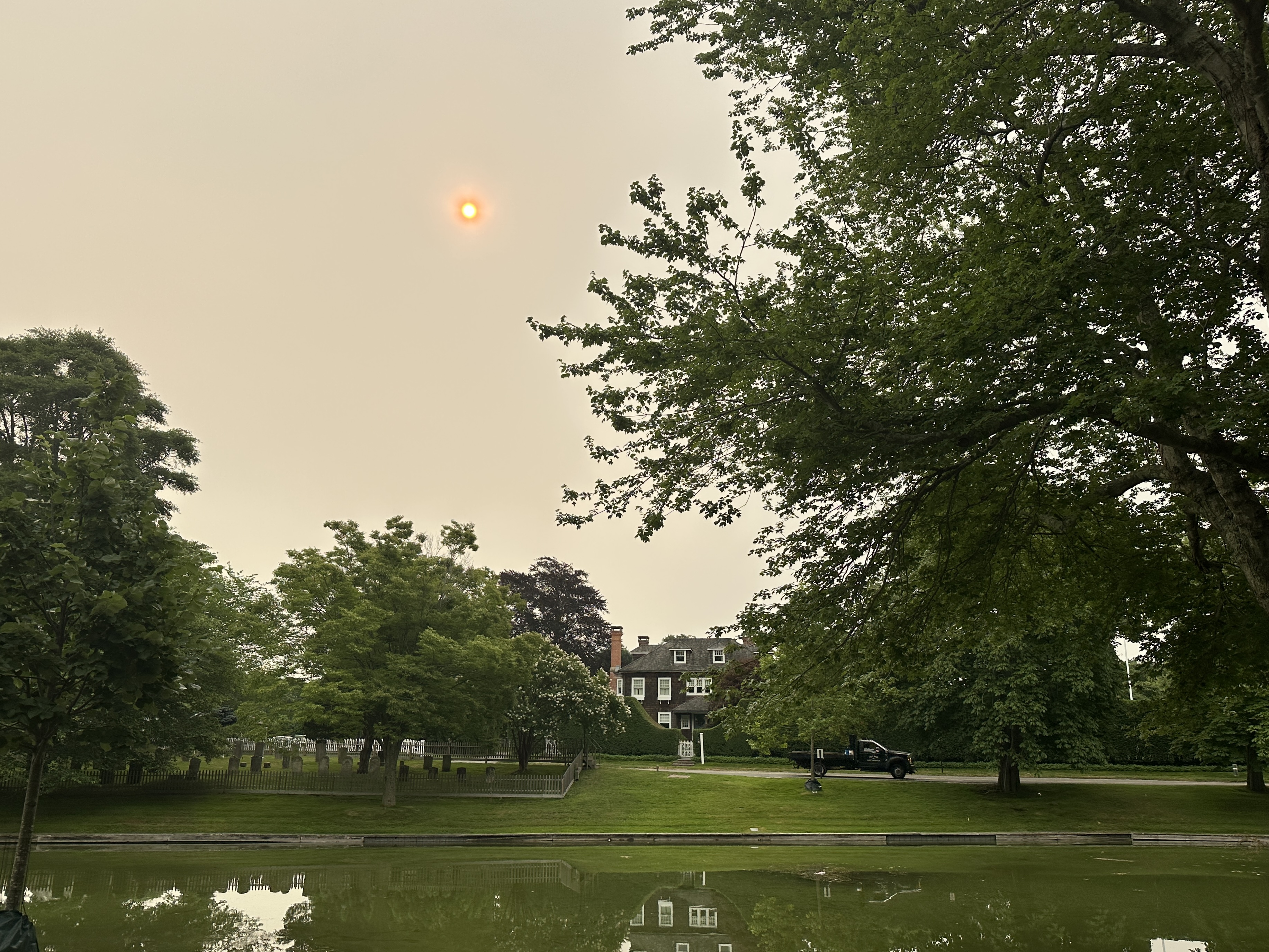
It felt like a storm was coming all day Wednesday and Thursday, but there was no rain in the forecast. The sky was sepia-toned, and just weird looking.
Instead, it was a storm of smoke covering Long Island and most of New York State. It had traveled thousands of miles from its source: hundreds of wildfires in Canada and the Midwest. By Thursday afternoon, it had settled over the Island, leading to multiple air quality alerts for PM 2.5.
The "PM" stands for particulate matter, and the 2.5 indicates the size of the particles. In short, they're microscopic.
According to the federal Environmental Protection Agency, about 30 PM 2.5 particles could fit across the diameter of a human hair. They can cause eye, nose, and throat irritation and lead to more serious effects concerning the brain and heart. They can get deep into your lungs and can even get stuck in your bloodstream.
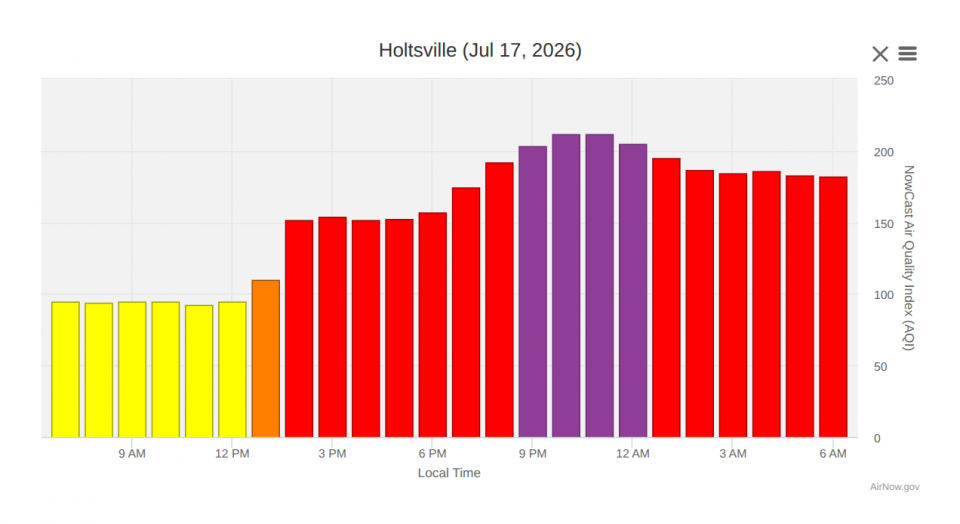
"All of New York is going to see and smell smoke today and tomorrow," Gov. Kathy Hochul said in a Thursday morning update on air quality. "There'll be times when it reaches the purple — a very unhealthy range."
She was referring to the color-coded Air Quality Index legend. On Wednesday, it was red, indicating an A.Q.I. between 151 and 200 — unhealthy air. Purple means an A.Q.I. between 201 and 300, or very unhealthy air.
If so, the readings would be on par with the worst air quality ever measured on Long Island since continuous monitoring for PM 2.5 began in 2010. That ignominious record was set on June 7, 2023, when readings spiked over 200.
At 1 p.m., according to AirNow.gov, Buffalo had a reading of 272. That air was headed our way.
"Any A.Q.I. over 100 is a concern for me," said Minghao Qiu, an assistant professor at Stony Brook University who studies the human effects of wildfire smoke. "If I don't need to go outside, I won't. Anything from 150 to 200 is really alarming. I would reschedule almost anything or wear a mask."
"I remember back in 2023 when we had the wildfires up in Quebec, asthma-related emergency department visits increased by 82 percent, so we're expecting a spike," Governor Hochul said. She added that those experiencing shortness of breath or chest pain should call a doctor.
"There are so many things we don't know about the health impact of wildfire smoke," Dr. Qiu said. "It's definitely not going to do anything good for you in the short term. Whether there are longer term impacts, that's unknown."
"I'm going to say this over and over between now and tomorrow, if there's any way you can possibly stay indoors, please do not venture out," Governor Hochul said. "Shorter dog walking. Please keep the babies inside. Senior citizens, just hold on and stay home for another day and a half. Exercise is really not a smart thing to be doing when this is — this smoke is going to fill your lungs. It's very dangerous, and people with heart or breathing problems, older adults, children, teens, pregnant women, pretty much everybody. And if people who work outdoors, and we're creating some flexibility here with our state work force, we encourage the employers to make sure that if your employees do not have to be outdoors, just today and tomorrow, let's get through this, let's be smart. We encourage you to let them stay indoors."
Some people, like lifeguards, have no choice but to be in the unhealthy air as long as beaches remain open.
"When they say limit your time outdoors, and you're a lifeguard, how do you do that?" asked John Ryan Jr., the chief lifeguard for East Hampton Town. "This morning we made the decision to close the camps. Nippers were supposed to take place at Albert's Landing. We canceled that because of the air quality. Air quality definitely affects our operations. We're limiting all training activities."
The town also closed the Youth Park in Amagansett for the day and canceled all outdoor youth programs. The program in Springs was moved indoors for the day.
In East Hampton Village, yoga on the beach, which often attracts hundreds, was canceled at Main Beach.
"For people in the Northeast, we always thought this wasn't our problem," said Dr. Qiu. "That perception really changed in 2023, when Canadian wildfire smoke briefly made New York City one of the most polluted places in the world. This is an extreme event. It didn't happen before, but now it's becoming a yearly thing. Every year now there will be big wildfires."
Why? What's changed?
"Climate change is the biggest reason," he said. "It's drier and hotter. Those are the conditions that create fires. In 2023, Canada was hotter and drier than the historical baseline. A similar thing has happened this year as well. Going forward, I'm only expecting this to get worse."
Long Islanders have perhaps become inured to warnings about ozone. Dr. Qiu says ozone is less of a risk, primarily because of dosage.
"PM 2.5 is a much higher risk to humans compared to ozone. Ozone is secondary pollution. A chemical reaction needs to be involved. PM readings can be quite high and they're often complex. Ozone is just one pure chemical. PM can be complicated. It depends on its source. It can be from a fire, but there could also be heavy metals involved."
He said there is an underappreciated and complex relationship between wildfires and ozone. "You could have a very high wildfire ozone day, but PM 2.5 isn't that high. If you base your actions on just one of the readings, you may be missing the other part of the picture."
Governor Hochul urged people to be patient. Treat it like a storm. "This is a day, just stay indoors," she said.