Eastern Long Island has a long history of whaling, with the Shinnecocks and Montauketts showing expert hunting knowledge long before English settlements. They used whales for food and offerings to their deities. When the English settled on Long Island, they saw the value of whales and created their own enterprises surrounding the practice.
John Ogden (1606-1682) and John Cooper (1594-1689) pioneered the shore-whaling industry on Long Island, establishing a whaling port named Feversham in the 1650s on North Sea Harbor on Peconic Bay. In East Hampton, James Loper (1648-1691) and Jacob Schellinger (1625-1693) organized their shore-whaling enterprise in 1668. Both companies hunted North Atlantic right whales, which swam close to shore and were plentiful off the coast.
Long Island’s whaling industry was so successful that it left the right whale on the verge of extinction. Listed as endangered since the 1970s, its population has shown signs of increasing in recent years, according to the National Marine Fisheries Service.
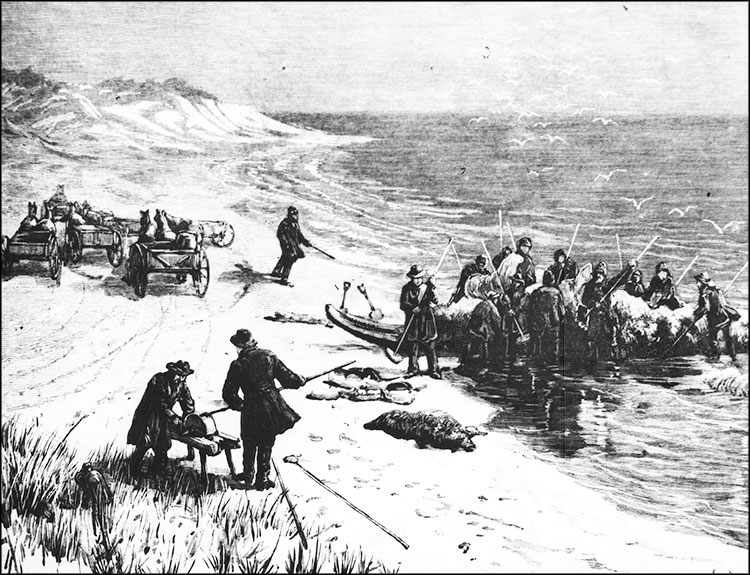
The image seen here, from the Amagansett Historical Association’s collection, was published in Harper’s Weekly on Jan. 31, 1885, with an article about the capture of a whale off Southampton on Jan. 15 of that year. By this time, offshore whaling voyages from Long Island had ceased due to the development of alternatives to whale products and declining whale populations.
The article details how a lifesaving crew led by Capt. George Hubert Burnett (1823-1893) spotted a whale near their Southampton station, and the fight they had to bring it to shore. Crew members harpooned the whale and were dragged for several miles before they brought it ashore. This image shows the aftermath of this hunt. The article mentions that other whales were also captured in the area and estimates the profit from capturing one at $1,000 to $1,500, around $34,000 to $51,000 today.
—
Kristen Ahearn is a librarian and archivist in the Long Island Collection.