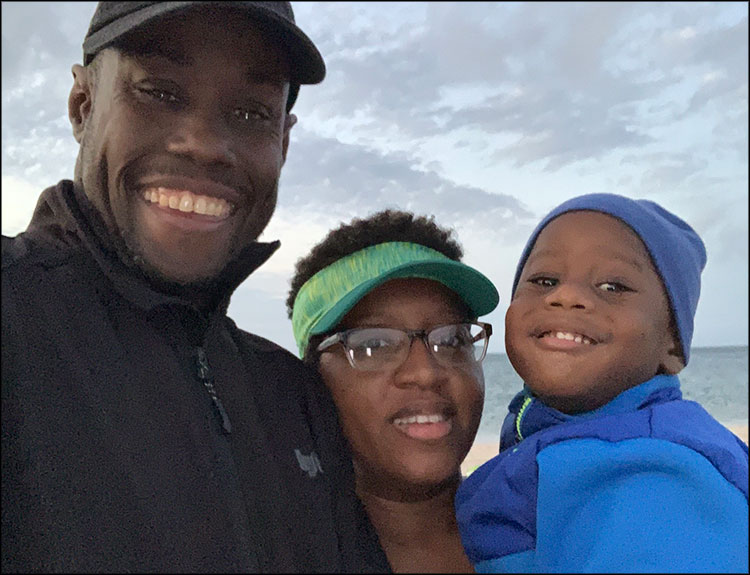
Sickle cell anemia. Odds are, if you live on the East End, you don’t have it and likely do not know anyone who does.
It’s prevalent in sub-Saharan Africa, but also in the Caribbean. In Jamaica, one in every 150 children is affected at birth. Spanish-speaking populations in the Western Hemisphere account for roughly 10 percent of sickle cell cases in the United States, according to the Centers for Disease Control.
The disorder, caused by a genetic mutation, is progressive, resulting in distorted red blood cells that are unable to adequately oxygenize the blood, and then die. Anemia is the result.
“Imagine your body is on fire and you feel like your bones are crushing,” said Damian Carty, 49, of Patchogue, describing an attack. He has been suffering from the disease since he was 3. “The pain emanates from the joints, elbows, knees, and spinal cord. If you look at some ‘sicklers’ they can’t even stand straight. The pain is unbearable.”
“In between attacks, you do feel okay,” he said. “Sometimes an attack comes on and you can overcome it, but other times you have to go to an emergency room for treatment.” Hospital stays during a severe attack can extend for weeks because dangerous complications, including organ failure, can occur. The average life span for a male with sickle cell is only into the early 50s.
Mr. Carty is often unwell and cannot continue his work as a Lyft driver. Between 80 and 90 percent of his blood cells are sickled. In the last few years, he said, he has had to be in the hospital once every three or four months for a blood transfusion. This past year, it’s been more.
“His hemoglobin is not holding up very well like it did before,” said his wife, Michal Walton, who has worked at Provisions, a natural foods grocery store in Sag Harbor, for the last 20 years. “When it drops, his chest gets tight and he hardly can breathe. He feels chest pain and gets extremely weak to the point where he can pass out.”
The couple met 19 years ago. Ms. Walton does not have sickle cell, though she is a carrier of the mutation.
“I married Mica and we both knew what the circumstances were,” said Mr. Carty. “We knew she had the trait, but by that time we were in love, and it was hard to turn back. We made a conscious decision to stay together even though we knew.”
They decided to have a child despite the math, which said there was a 50-percent chance he would be infected.
Their boy, Devansh, now 8, does have the disease. He is in the second grade and attends Eagle Elementary School in Medford. He often needs to be tutored at home, as he is susceptible to viruses.
Here, however, is where the story turns hopeful.
While Mr. Carty is too old to be cured of his illness, except for gene therapy (approved in late 2023 and very expensive, costing $2 million to $3 million per patient), Devansh could be fully cured through a bone marrow transplant.
Ms. Walton’s sister proved a match, and Devansh’s surgery is now planned for mid-April, though that may change.
“It’s a debilitating disease,” said Mr. Carty. “If I could go back and change things for my son’s sake, I probably would have made different decisions. To have to watch him deal with this, trying to find a solution, has been very difficult.”
With no health insurance, the couple relies on Medicaid. A GoFundMe set up by a friend in 2023 has proven quite successful, bringing them over $109,667 to help with medical and hospital expenses.
Still more is needed, however, as Devansh undergoes treatment, and the target has now been upped to $200,000. “It’s been a lifeline for us,” said Mr. Carty of GoFundMe. “I am not able to work full time. It’s been very difficult to pay our bills and day-to-day expenses. One of the toughest things has been coming up with rent at the end of each month.”
“Other nonprofits have helped us as well. It’s never been a situation where we were all well and good with just the donations.”
Mr. Carty is unable to work much, and Ms. Walton will spend most of the next months in the hospital with their son, who will need blood transfusions, followed by chemotherapy, in April, May, and then June.
“They have to remove the majority of blood that are sickled,” said Ms. Walton.
Devansh has 67 percent of his blood sickled. After the third round of treatment and the transplant, he will undergo more chemo to suppress his immune system lest it reject the new bone marrow.
“You only know how strong you are when you have no choice but to be strong,” Mr. Carty said. He has told the family’s story, he said, in hope of spreading awareness of the disease. On the East End, where the Latino community is growing, he knows a couple whose child has had “full-blown” sickle cell. The woman is Latina; her husband is white.
Donations to the family’s GoFundMe page can be made here.