The winter of 2026 will be remembered for many things: ICE enforcement, the war in Iran, a record-breaking blizzard, and, oh, piles of dog poop.
Scores of municipalities from New Hampshire to Pennsylvania have tightened enforcement and strengthened so-called pooper-scooper laws after the brown stuff, like, bloomed out of the melting snow, causing public outcry.
Locally, the issue was first raised in January, even before the big snowstorms, at a Sag Harbor Village Board meeting. Donna Brooks Flores called in to observe that the dog population has increased, and that owners have taken to using longer leashes, giving their dogs more freedom to roam, but also infringing on others out for a walk.
“We pedestrians have the right of way,” she told the board. “Not the dogs, taking up the sidewalk with a long leash.”
“Also, I’m don’t know if many of you noticed, but there’s more and more fecal matter on the sidewalk,” she continued. “I feel as time goes on there’s less respect. There’s more a sense of entitlement. Shop owners have told me fecal matter is brought into their shops on shoes.”
“I would agree with you that we need to look at the code and do a better job enforcing the code with the picking up after your dog,” said Mayor Tom Gardella. He also suggested adding a leash length into the code.
East Hampton Village, for example, tightened its dog laws in 2023, requiring that dogs within village limits must be leashed and leashes must be no longer than six feet.
“We’ve always had the problem at the beaches,” said Village Mayor Jerry Larsen, speaking of abandoned dog waste. “We realized in the rest of the village there was no law on the books. When dogs are off-leash or on very long leashes, it’s less likely the owners will pick up after their pet since they may not notice the dog is going to the bathroom.”
On the beaches and trails of the East End, dogs are largely left to run free, despite regulations.
After Ms. Flores’s initial complaint, the problem only got worse.
“I am writing to express my dismay and growing anger at the amount of dog feces littering our village streets this winter,” began a letter to The Sag Harbor Express from Aidan Corish, a village trustee, in mid-February. “When waste is left on our streets, it does not simply disappear. It is washed by rain and snowmelt into our storm drains and ultimately into our local waters — the very waters we are spending millions of dollars to help preserve and protect.”
Sag Harbor does have a code section pertaining to dog waste, clearly pinning the responsibility on the owner “or any other person with custody or responsibility for a dog,” who is subject to a minimum fine of $200 if they don’t pick up after their pets. (In Hoboken, N.J., which recently updated its dog laws, the fine has been increased to $2,000.)
Despite Sag Harbor’s code, not a single ticket has been issued there.
“When it comes to violations, we would have to observe them,” Sag Harbor Village Police Chief Robert Drake said over the phone last week. “We can’t look at a camera and write a summons based on footage. It’s hard to enforce when we have no knowledge. If people aren’t reporting it, it’s hard to enforce.”
The chief stressed that officers seek “voluntary compliance.” However, dozens of photos of feces taken around the village on Main Street and Long Wharf in just the last month prove that not everyone is voluntarily complying.
“Enforcement is a big one,” said Sag Mayor Tom Gardella. “We all know it’s disgusting and has to be fixed. The problem is we have one person doing code enforcement. I’m all for getting the police involved and have them writing citations.”
Sag Harbor has even invested in little dog-poop stations, offering free bags, removing at least one lame excuse for not picking up. The same stations are often found at trailheads. But even when the bags are used, they are often left behind.
“I can’t tell you how many disregarded poop bags I come across left on the ground or trails,” texted Jeff Robinson, park manager of Mashashimuet Park in Sag Harbor. “The reason the park is dog-free is for the simple reason that we are a private park and have made the decision, for the health and safety of our children, dogs are not allowed. Dog poop certainly falls under this reasoning, since it’s a health concern, but it’s really more about preventing accidental dog bites.”
“The number of excuses and responses I get enforcing our rules are pretty incredible. I often think to write a book just on this subject: ‘No Dogs Allowed: A Park Manager’s Daily Encounters with Pet Owners,’ “ Mr. Robinson joked.
“Dog poop bags are an issue,” agreed Councilwoman Cate Rogers, the East Hampton Town Board’s liaison to the town’s litter action committee. “The dog’s human companions are bagging, but then leaving the bags at the beach, on the trails, in the parks, and on the streets.”
Scott Wilson, the town’s director of land acquisition and management, agreed. “Yes,” he said, “there is a higher incidence of random bagged dog waste at our ‘carry-in, carry-out’ parks.”
“I was just in the city,” said Christine Ganitsch, chairwoman of the litter committee. “It’s been a real step backwards there.”
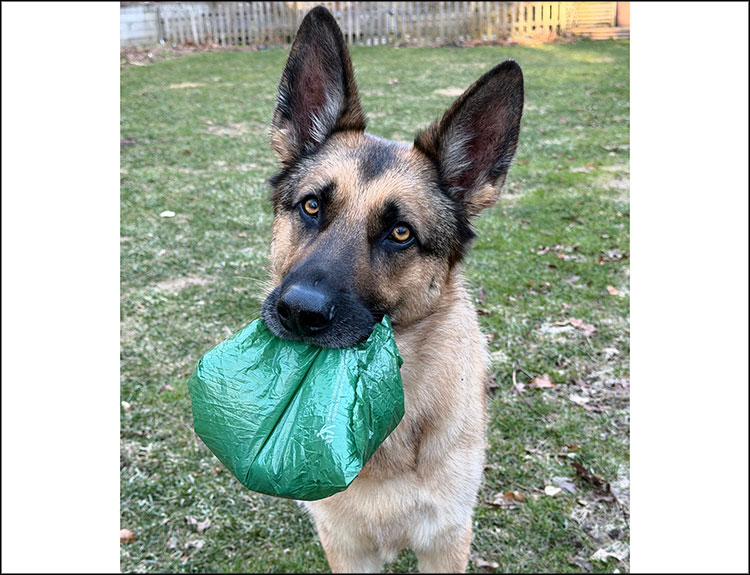
Her committee is at its wits’ end, she said, on how to get dog owners to pick up after themselves and to dispose of the green baggies. Its newest attempt, to be rolled out this spring, will use Sam the Dog as its mascot. Sam is a German shepherd trained to remove trash.
“If Sam can do it, you can do it,” is the message. Ms. Ganitsch’s committee plans to report on the issue at Tuesday’s Springs Citizens Advisory Committee meeting.
Loring Bolger, that committee’s chairwoman, wrote by email that “People don’t seem to realize that having dogs at the beach, in parks, and on trails is a privilege, not a right. I think we have to make clear that with privileges come responsibilities. Most dog owners know when their dog is going to ‘go.’ They should be paying attention at times when that is likely to happen. Covering it with sand or leaves is not dealing with it!”
She added that after trash cans were removed from Sammy’s beach, a popular dog walk area that is otherwise pristine, spiteful dog owners have been leaving piles of the green bags where the cans used to be.
“This winter it was worse,” said Ms. Ganitsch. “When they picked it up, they didn’t want to carry it home.”
In 2025, Assisted Living Magazine named Sag Harbor Village number six on their Top 100 Main Streets in the United States for walking. The article was glowing, and nostalgic.
“You’ll pass clapboard buildings with centuries behind them, and bookshops that still carry Steinbeck in the window. There’s clam chowder cooking and kids skipping stones just beyond the last cafe.”
And, in 2026 at least, there is dog poop.