Fear and worry continue to run high in the local Latino community despite the firing of Kristi Noem, head of the Department of Homeland Security, lately singled out by the Trump administration as a key architect of the controversial Immigration and Customs Enforcement activities.
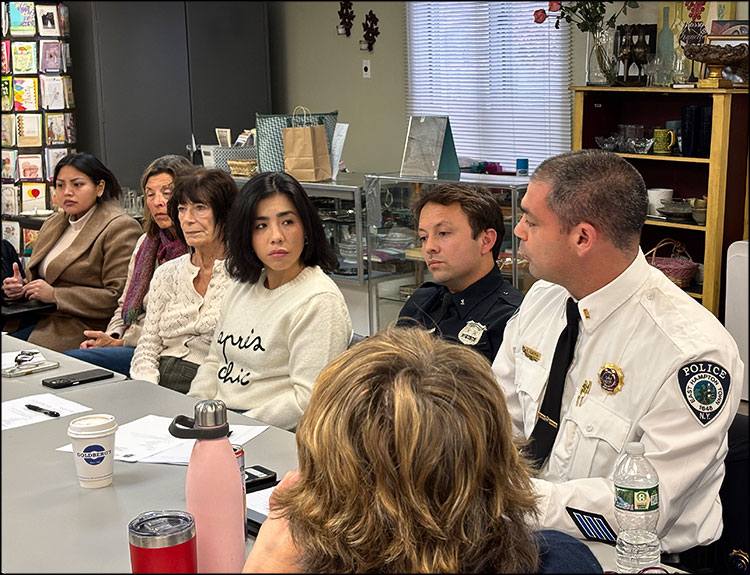
Two members of the East Hampton Town Police Department, Lt. Kenneth Alversa and Officer Daniel Munoz, joined the town’s Latino advisory committee meeting early Saturday morning in an attempt to assuage concern and to discuss the role local police may or may not play in easing tensions created by potential ICE actions.
The committee agreed to form a task force from within its ranks as recommended in the East End Public Safety and Accountability Law, legislation proposed by Minerva Perez of Organizacion Latino Americano, even while the legislation has yet to be discussed or adopted by the East Hampton Town Board.
The town board did however add six new members to the committee last week: Daniela Chavez, Jazmin Leon, Valeria Marin, Katherine Mitchell, Alicia Sullivan, and Nicole Velez. It now has 21 members, making it by far the largest town committee.
Town Supervisor Kathee Burke-Gonzalez serves as the town board liaison.
“This isn’t business as usual anymore,” said Yesenia Quichimbo, the co-chairwoman of the committee. She recalled her time as a traffic control officer, when she was told to advise community members fearful of unmarked cars to call 911.
“We told them you do not have to stop if you don’t feel safe. That option isn’t available to us right now. If you see ICE vehicles, people panic, whether they’re documented or not, a U.S. citizen or not. The fear is there because it’s not about legal status, it’s about skin color,” she said.
ICE tactics, for example, masked officers driving unmarked cars, have made it difficult to separate the lawful from the unlawful, a problem for residents and for local law enforcement.
Take, for example, an incident in Riverhead last week, cited by Anna Skrenta, the chairwoman of the committee, who is also the chairwoman of the East Hampton Town Democratic Committee.
Two children walking to school were approached by an unmarked vehicle. The charged environment caused community members to assume those in the vehicle were ICE agents. However, the police were able to ascertain that the vehicle was not ICE, easing at least some concern. Incidents like that highlight the need for local police to have the trust of the Latino community, said Ms. Skrenta.
Ms. Skrenta summarized the four tenets of the East End Public Safety and Accountability Law: It would require the town to prepare for immigration enforcement, ask the police to respond to enforcement activities so federal officers could be properly identified, document the interactions, and communicate to the community the results of the enforcement.
“The law is careful to lay out that the local police officers cannot interfere with the actions of the federal agents,” she said.
“A lot of what you’re talking about already occurs,” said Lieutenant Alversa, explaining it was part of normal police procedure. He added that if residents see anything that they are uncomfortable with they should call the police, who would then go, check on it, and report back to the board.
Ms. Skrenta pressed: “What if you see someone being violently apprehended in a way that doesn’t feel right?”
“There may be a justified level of force we may not have seen, and it would be hard to know. If we were to interject and end up interfering, we could put ourselves or the town in a difficult position,” he said, adding that the department has yet to come across a situation where someone was impersonating ICE.
He said that federal immigration agents can be asked to leave private property, a store, for example. Schools have layers of protection: doors, identification checks. “It would make it very difficult for something to get into one of these buildings, without being let in,” he said.
Johanna Sanchez, a committee member and immigration attorney, pushed for concrete action.
“We all know that sometimes advisory boards lack teeth,” she said. “We should at least know who was taken and where they were transported.” Privacy concerns shouldn’t get in the way. “I don’t need to know why they were taken, I just need to know where they are and I can handle the rest.”
Ms. Burke-Gonzalez agreed that among the criticisms lobbed at ICE, withholding basic information about detainees is inhumane.
“If I stop making my car payment and they came to repossess the car, the tow truck would pull up, take my car, stop at police headquarters, and give them the information, so if I called, the police would know my car wasn’t stolen, it was repossessed,” she offered, as an analogy. “At the very least, if a community member was removed, ICE should have to report back to our local police and say who was taken and where they were taken. You do it when you repossess a car, how can you not do it with a human life?”
She explained that Senate Democrats are negotiating with Republicans over funding of the Department of Homeland Security, and that they have a list of demands.
Reading off some of them, she said Democrats are pushing for targeted enforcement over random raids; prohibiting D.H.S. officers from entering private property without a judicial warrant; mandating enforcement without face coverings; requiring officers to display their agency name, unique identification number, and their last names; protecting sensitive locations like schools and churches from enforcement activities, upholding use-of-force standards, and allowing for local and state oversight.
Amid all the discussion about local laws and the national temperature, the big message from the local police was that they could be trusted.
“It’s extremely important that people don’t feel afraid to call us,” said Officer Munoz. “If you’re having a domestic dispute, or if you’re having a medical emergency, you still call us. It’s not going to turn into a situation where we ask you for documents. We want that trust. In order for us to do our job well, we need that trust.”
Finally, the committee debated how best to reach the Latino community. Is it best to spread the message at church? During sports events? On social media? In a humble newspaper article?
Social media, despite its ills, was recognized as the best method. As homework, the group was tasked with finding three videos that could be shared by the town and local police department, to spread the word.
The committee will meet next on April 11.