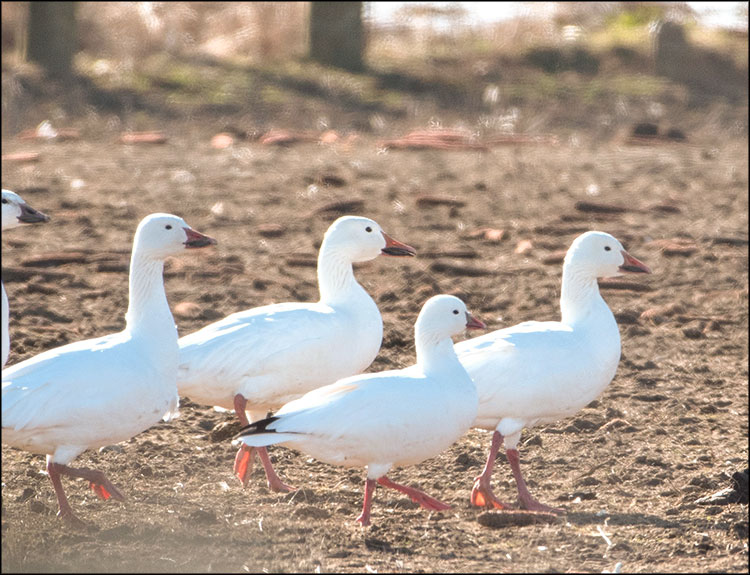
A rare Ross’s goose has been frequenting the farm field across from the Wolffer Estate Vineyard Wine Stand on Route 27 since Bruce Horwith first spotted it on Jan. 8.
“I always take a quick drive by to look at this field on my way to work, because it has been so productive the last few years,” said Mr. Horwith, who owns Wild Bird Crossing in the Bridgehampton Commons.
A sandhill crane visited the Sagaponack field, which is owned by the Foster family, in 2024, and a number of greater white-fronted geese have also been frequenting the patch, along with the more common snow goose and always cool horned larks.
“In this case, the white goose seemed small, so I got out my spotting scope and got excited when I saw the Ross’s round head and small bill,” he wrote in a text.
While East Enders are perhaps too familiar with Canada geese, which are frequently counted in the thousands at Hook Pond in East Hampton or on farm fields, small numbers of snow geese, typically half a dozen to a dozen per winter, are also spotted.
The Ross’s goose is similar in plumage to the snow goose, but the shape of its head and bill is different, and it’s smaller. It’s a difficult identification.
The goose breeds entirely in Canada on the remote Baffin Island and along the northern coast of the Beaufort Sea and Amundsen Gulf. It winters in the United States in the Great Plains south to Texas, but rarely moves east of the Mississippi.
According to the website allaboutbirds.org, in the winter Ross’s geese search out agricultural fields during the day and feed on barley, wheat, field peas, and wheat grass.
“The field is mainly corn stubble,” according to Marilee Foster, whose Sagaponack Distillery uses it. “There’s some winter rye, which means our whiskey is partly being eaten, and to a degree fertilized, by rare geese.”
The field is private. To try and view the goose, do not enter the gate. Instead, park across the street at the wine stand, which provides an elevated vantage point, and scan from there.