From Phoenix House, just down Industrial Road, to countries including India, Bangladesh, Pakistan, Kenya, and Barbados, Hamptons Church in Wainscott is quietly carrying out its mission near and far.
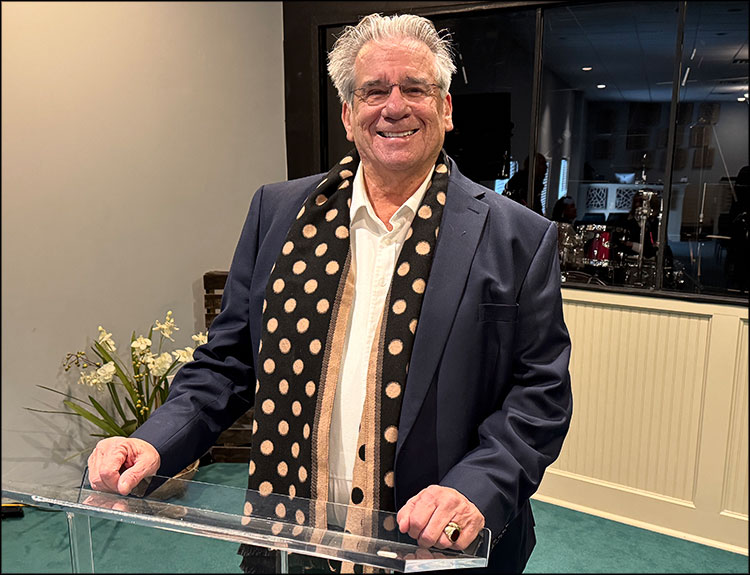
The Rev. Joseph Kelley of the nondenominational Hamptons Church is a builder. A builder of houses, he has managed On Site Builder Construction Co. for more than 40 years. He is also a builder of bridges: Building Bridges of Peace is a ministry that seeks to stop persecution of religious minorities in Pakistan, where the Building for Him worldwide ministry that he founded built a church and school in Okara.
In India, Building for Him has constructed a church building, a children’s home, a dental clinic, and an outpatient hospital. Building for Him has also helped to establish churches in Kenya and Bangladesh, and is actively engaged in leadership development, discipleship training, and the strengthening of local churches in Barbados. “I’ve preached the Gospel on five different continents and over 30 nations,” Pastor Kelley told a visitor to the church recently.
He was also instrumental in growing the congregation of Hamptons Church, which was formerly known as Living Water Full Gospel Church: during the Covid-19 pandemic, he and the Rev. Habacuc Vargas made the decision to merge the latter’s Latino congregation, which had been meeting at the Springs Presbyterian Church, with that of Hamptons Church. There are now English and Spanish-language services, along with a monthly combined service.
“He has such a sweet personality, and is so compassionate,” Pastor Vargas said of Pastor Kelley. “He has the same hunger to help people. This is what got us together — we have the same heart when it comes to community and the world, when it comes to missions, to helping children, people that need help right here, right now. I’m so glad to work with him.”
It has been a winding path for Pastor Kelley, taking him from his native Brooklyn to Santa Fe, N.M., to Shelter Island and the South Fork. “I grew up in the ‘60s, you know, ‘feel good, do it’ kind of thing,” he said. As a university student in New Mexico in the late 1960s and early 1970s, “there was a lot of disillusionment in America, especially in my generation. A lot of the heroes of my personal life were assassinated, and the civil unrest, with the war, the government — I think [President] Kennedy’s assassination was a turning point in the United States.”
He was an art history major at the University of New Mexico on May 8, 1970, when the New Mexico Army National Guard wounded 10 or 11 people with bayonets during protests against the Vietnam War and the killing, four days earlier, of four students at Kent State University in Ohio.
“Out of this whole cultural transition, the church missed opportunities, I think, to be accepting of people,” he said, “and I think it opened up a lot of disillusionment and isolation that we see in the world today — the divide in our nation, all the political turmoil that we’re living through. I think we’ve lost a lot of our bearings as a nation, and understanding of history. That creates a sort of post-Christian worldview. So how do you appeal to a community that wasn’t really raised with a lot of knowledge of Christ?”
In New Mexico, owning an art gallery and starting a family, he was “pretty successful as a young guy” and “a denier” of biblical teaching, he said. “At best, I was agnostic.” His marriage ended, he returned to New York, driving across the country in a 1949 International pickup truck with his 2-year-old son and dog, “and started my life over.” He became reacquainted with a woman he had known as a child, who had also gone through a divorce and had children. They married, living at her house in Shirley. “It was the antithesis of anything I would have ever imagined living,” he said, “but it’s where I found this tremendous sense of opportunity to have a new life and a new start.”
A neighbor “came and told us about Christ, and I was like, ‘mm-hmm, okay,’ ” he remembered. “But one day she asked if our children could come to church with her.” They were gone for five hours. “I thought, well, this is great. It’s free babysitting.”
Later, as the family sat down to a meal, “our children said, ‘Daddy, we should pray before we eat,’ “ he said. They were 4 years old, “and they said, ‘there’s so many things that we can thank you for but God, the thing we want to thank you for the most is that you made us a family.’ “
“I didn’t know anything about the Bible,” he said. “But I felt like a sword went into my heart at that table and pierced all the calcification of my resistance. When it went in, it felt like it wounded me. But when it came out, I felt like it healed me. My life was changed at that table.” It was only several months later, home alone on Christmas Eve while his wife and children were at a midnight Mass, that “I still felt like there was something missing in my heart.” The family had bought a house in Sag Harbor and were about to move. “I’m a builder, I had two jobs I was going to start. I had this beautiful wife, I had a second chance for a family. I got on my knees in my living room, and I just cried out to God.”
At the same moment, he said, his wife was having the same thoughts. “We both came to that same place on the same night, in different places,” he said. “That was 47 years ago. We’ve been walking with God ever since.”
The “post-Christian worldview” he speaks of “is not consistent with the concept of ‘there is a truth,’ “ he said. “We’ve come into a postmodern worldview of ‘all roads lead to Rome,’ that kind of thing. There’s been a lot of moral relativism that has become the main thrust of our Western culture.” Quietly, or not — “we have a very upbeat worship service in the morning and in the evening,” he said — the congregants at Hamptons Church carry out their mission, from feeding 40 to 50 families weekly through its food pantry, to conducting Bible study with residents of Phoenix House, which offers treatment for substance abuse disorders, to the worldwide work of the Building For Him ministry.