
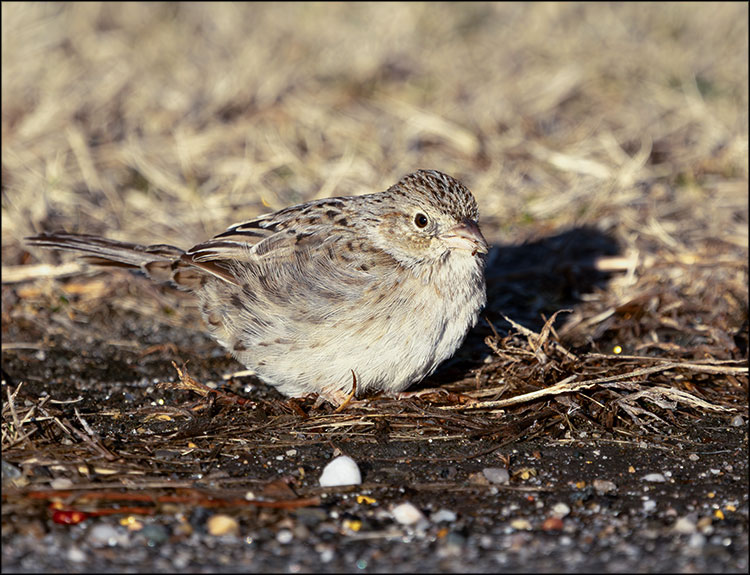
The 96th annual Audubon Montauk Christmas Bird Count was held on Dec. 20, when 45 participants found 127 bird species despite a morning wind chill of 16 degrees.
At least it wasn’t raining.
“While the species total was typical” — 124 species were found last year — “the counts of many species were lower than usual,” wrote Brent Bomkamp, who along with Angus Wilson co-compiles the count. “This was likely due in part to the below-freezing temperatures that prevailed in the region in early December. Strong northwest winds also kept totals low for many species, particularly in exposed areas like Gardiner’s Island and the northern edges of the Montauk peninsula.”
The big question at the start of the day was whether an ultra-rare Cassin’s sparrow, first spotted at Montauk Point State Park on Dec. 6 by Max Epstein, would stick around to be counted. To everyone’s surprise and pleasure, it did.
By 8 a.m. a dozen birders were observing and photographing the sparrow.
Mr. Epstein told the story of how he found the bird in a phone call this week. It was partly an accident, as he had no plans to search for sparrows in early December.
He lives in Brooklyn and had organized a one-night weekend getaway in Montauk with his girlfriend. He hoped to scan the waters around the Lighthouse for winter sea ducks using his high-powered spotting scope but left it in his apartment.
“My attention shifted to land birds and scanning edges and bushes. We pulled into the parking lot around 3:30 p.m., and I almost immediately noticed what I thought was a song sparrow. But when I got my binoculars on it, I was like, ‘What the hell is that?’ I couldn’t immediately place it,” he said. “It was making my head hurt.”
That’s because most would be challenged to avoid the word “plain” in describing the Cassin’s sparrow. It’s a bird you might not think to place on your bucket list. Its page in field guides is likely not often dog-eared. Its secretive habits make it easily overlooked even within its usual range.
It belongs in the scrublands of northern Mexico, southern Texas, and New Mexico. It’s a short-distant migrant and rarely leaves those places. (Some will venture as far north as Nebraska during the breeding season.)
Perhaps the most remarkable feature of the Cassin’s sparrow is its song, which is full of high quivering notes that descend into a somewhat sad but beautiful melody. However, breeding season won’t start for months. Minus a chip note or two, the Montauk bird has been silent.
For all these reasons, no one would expect to see, much less identify, a Cassin’s sparrow in December in Montauk.
With the sun going down, Mr. Epstein grew anxious to confirm the identification of his mystery bird.
He had almost no cell service. He snapped photos and drove up the road where he had a single bar, which allowed him to post them to the New York State rare bird channel on Discord. “I got immediate feedback from people who thought it could be a Cassin’s,” he said. He went back and was able to capture audio of the bird’s chip note, which was strongly suggestive of Cassin’s.
“That’s when everyone got excited,” he said. A Cassin’s sparrow hadn’t been seen in New York for 25 years. And Mr. Epstein’s bird was the first ever found in Suffolk County.
(Coincidentally, the birder who found the first, Tom Burke, was in charge of the Montauk Point South territory for the bird count and was one of a very small number of people able to see his second state Cassin’s that day.)
“With these rare birds, you never know if they’re going to be in view for another minute, week, or month. There was only an hour of daylight left, and I became conscious of trying to get the word out,” he said.
His efforts paid off. For the last few weeks, the bird has drawn hundreds of observers. On the day of the count, a man exited his car and announced he had driven six hours from Pennsylvania just to see the Cassin’s.
No other bird on this year’s bird count came close to matching its status.
Perhaps the second “best” bird, a barn owl, was found dead on Gardiner’s Island the week prior to the count.
Another frustratingly plain bird found on the count, a cackling goose, which looks like a tiny Canada goose, was located on the pond at Montauk Downs State Park, only the second time it has appeared in Montauk.
Other count highlights included three blue-winged teals on Little Reed Pond, seven harlequin ducks in the waters off the Lighthouse, two long-eared owls at an undisclosed location, a vesper sparrow at Hither Hills State Park, and a yellow-breasted chat at Montauk Point.
Numerous birds that are usually found on the count, including the Northern pintail, Virginia rail, American woodcock, Wilson’s snipe, pied-billed grebe, rough-legged hawk, snowy owl, brown creeper, chipping sparrow, and common yellowthroat, were absent.
Only one new high count was set: 20 common raven were recorded.
Common ravens are larger than the much more numerous American crow (174 American crows were counted), but what really sets them apart in the field is their deep croak of a call. They have made great progress on the East End in the last few years, with a pair even nesting behind East Hampton Town Hall.
For those interested, the 2026 count will take place on Saturday, Dec. 19, 2026.