
A few minutes before 7 in the evening on May 9, 2025, a deputy in the Johnson County, Tex., sheriff’s office sat at a computer seeking information about a missing resident’s car.
In the spot where officers were required to give a purpose for their requests, the deputy typed, “had an abortion, search for female.”
In seconds, the query for the woman’s location raced through the Flock Safety license plate reader system, sifting information collected by more than 83,000 cameras coast to coast — including at least 11 in East Hampton Village.
The Texas deputy’s search was one of more than 5.4 million times license plate data collected by East Hampton Village cameras were accessed by outside law enforcement during the 12 months that ended in February.
Johnson County deputies made 37 national searches of Flock Safety data in May 2025, mostly investigations involving drugs or other routine matters, but the one that evening, first reported by 404 Media and confirmed by The East Hampton Star through a Freedom of Information request, was different. Within weeks, the deputy’s request ignited a wide debate about law enforcement’s abuse of the Flock system.
Sheriff Adam King of Johnson County told 404 Media that the woman being sought had self-managed a medical abortion, “and her family was worried that she was going to bleed to death, and we were trying to find her to get her to a hospital.” But a timeline that emerged later indicated Sheriff King’s explanation had not been accurate.
The deputy’s initial request crawled through information collected by about 6,800 camera networks. According to 404 Media’s subsequent review of Flock data, the sheriff’s office continued to check for hits on the woman’s license plate for about a month.
Johnson County is part of the Dallas-Fort Worth area and had a population of about 180,000 in the 2020 Census. It occupies a mostly flat landscape, divided by a branch of Interstate 35. It is a red county in a red state, having voted for Donald Trump in 2024 by 75 percent.
After news of the Johnson County Sheriff’s Office Flock search broke, the Illinois secretary of state asked for an investigation of whether it had violated a state law banning the distribution of license-plate data to track women seeking abortions or to find undocumented immigrants, according to The A.P.
Illinois was the first state to adopt a law restricting this kind of data sharing, following the United States Supreme Court’s overturning of Roe v. Wade. Abortion is also legal in New York State and in Washington State, the data of which were also tapped in response to the deputy’s query.
Several months after the search was first reported, the Electronic Frontier Foundation obtained court documents showing that Johnson County deputies had, in fact, launched a “death investigation” of a “non-viable fetus,” collecting evidence of the woman’s self-managed abortion, and had consulted prosecutors about charging her before eventually dropping the case.
The documents cast doubt on the sheriff’s office statement that the Flock search was related to a medical emergency because the abortion had occurred more than two weeks before deputies were called to investigate.
Johnson County, Tex., may be an outlier in terms of international attention regarding the Flock Safety system, but it is far from the top law enforcement agency to have accessed data collected by East Hampton Village.
Of the 5.4 million requests made between March 2025 and February of this year, a wide variety of local, state, and federal officials queried information collected by the East Hampton Village cameras.
During that period, authorities in Florida made the most use of the village’s data, with the Hillsborough County Sheriff’s Office leading the way with nearly 87,000 searches.
Together, Florida and Georgia accounted for more than 20 percent of all Flock Safety searches of East Hampton Village data.
Yet the Hillsborough Sheriff’s Office ranked just fourth nationwide in total requests, trailing the California Highway Patrol; the Houston police, and Kentucky’s Louisville Metro Police Department.
At least 65 of the outside requests found in the 12 months of East Hampton Village Flock data obtained by The Star included keywords related to immigration or “illegal aliens.”
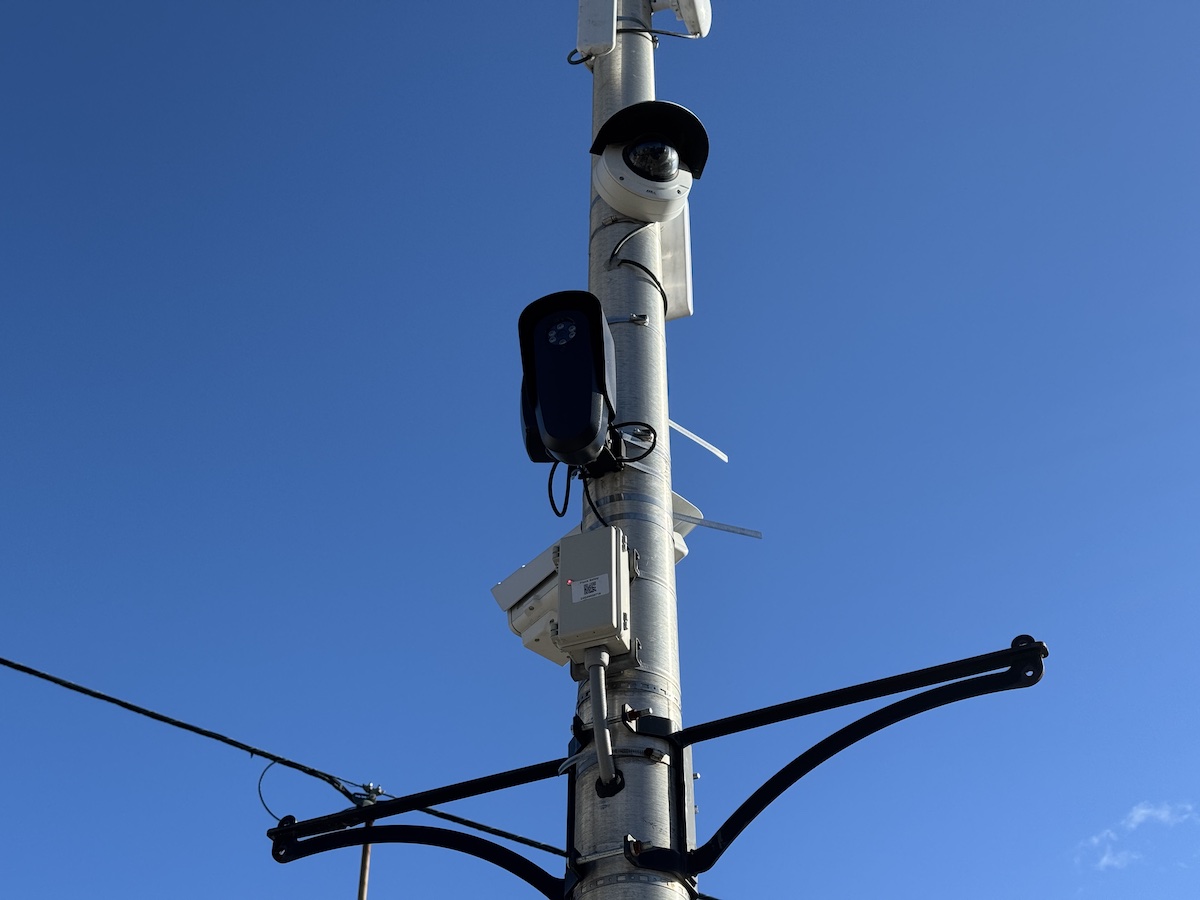
The Flock cameras arrived in the village in late 2024, paid for with $30,000 from the East Hampton Village Foundation, a nonprofit established at the behest of Village Mayor Jerry Larsen. The cameras were capable not only of recording license plate numbers, but distinguishing features of vehicles as well, including color, stickers, and, according to several sources, visible rust or dents.
Local governments, businesses, homeowners’ associations, and the like do not own the Flock cameras in their jurisdictions. Rather, the systems are installed on a subscription basis — about $2,500 per camera per year, plus a one-time $250 installation fee. This is in line with the $30,000 in Flock Safety’s initial agreement with East Hampton Village.
Subsequent subscriptions with Flock Safety were paid for as part of the annual police budget, said Marcos Baladron, the East Hampton Village administrator.
In an early success, the cameras were used to track down a shoplifting suspect who had struck the Louis Vuitton and Gucci shops in the village. “Our detective searched for ‘Red Jeep Trump bumper sticker,’ and Flock was able to locate the plate. We ran the plate, got their address, and had a cop there in a half-hour,” Village Police Chief Jeff Erickson said at the time. Mr. Erickson did not respond to requests for comment for this article.
In a more recent arrest, a Flock camera alert tipped off police to a car with a suspended registration. An East Hampton Town officer soon stopped the driver, who police said showed signs of drunkenness; he was later alleged to have had a small amount of cocaine in his wallet.
There are security concerns. Late last year, a technology researcher discovered that at least 67 Flock cameras had allowed unencrypted live video access to anyone on the internet, as well as to about a month’s worth of recorded data. In the researcher’s analysis, security gaps left in the system could have allowed attackers to locate and target specific Flock cameras.
At about the same time, a different researcher discovered U.S. law enforcement Flock logins for sale on a Russian-language dark web cybercrime forum. Access to the system by default is by easily shared, low-security usernames and passwords.
In November, Senator Ron Wyden of Oregon and Representative Raja Krishnamoorthi of Illinois released a joint letter to the Federal Trade Commission demanding answers. Among their concerns was that Flock did not require even basic multi-factor authentication to keep law enforcement accounts secure.
They wrote, “Flock’s surveillance data can reveal Americans’ movements over time, including trips to doctors and therapists, support group meetings for alcohol or drug addiction, as well as places of worship and protests.”
“Flock has needlessly exposed Americans’ sensitive personal data captured by the company’s surveillance cameras to theft by hackers and foreign spies, and unauthorized access through multiple documented instances of unauthorized password sharing.”
Flock pushed back, issuing a statement in January that its cloud platform had never been hacked and no customer data was compromised. It noted that it is up to its camera subscribers to decide whether or not to participate in data sharing. This includes who can access their data, how the data can be used, how long data is retained, and whether it is shared with another agency or organization.
“Federal, state, or neighboring agencies cannot access data unless a customer explicitly approves it,” the company said. Questions about East Hampton Village’s policy regarding its cameras were not immediately answered.
Flock Safety has not been universally accepted. Bend City, Ore., turned off its four cameras in January after they had been in use for just seven months, and voted not to renew its contract with the company.
Mountain View, Calif., unplugged its cameras in February after officials learned that its data had been viewed by Bureau of Alcohol, Tobacco, and Firearms offices in Kentucky and Tennessee, the federal Inspector General, Air Force bases in Virginia and Ohio, and officers with the Lake Mead National Recreation Area, among others.
In April, the East Hampton Village Board prohibited village personnel and equipment — including the Flock cameras — from assisting federal Immigration and Customs Enforcement unless ordered to do so by a judge or compelled by law. Critics of the Flock system have cited incidents in which local law enforcement has made data requests on behalf of ICE and other federal agencies.