Dan Budnik, a photographer whose subjects ranged from artists of the 1950s to the civil rights movement to Native American culture to the baymen of the South Fork, died at an assisted living facility in Tucson, Ariz., on Aug. 14. The cause was metabolic encephalitis and dementia. He was 87.
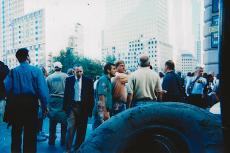
Mr. Budnik was perhaps best known for his coverage of three important marches of the civil rights movement: the 1958 Youth March for Integrated Schools, the 1963 March on Washington, and the 1965 protest march from Selma to Montgomery, Ala.
Images from those seminal events were collected in his book "Marching to the Freedom Dream," which was published in 2014 with an introduction by Harry Belafonte and launched with book signings at the Photographers' Gallery in London and the International Center of Photography in New York City.
Dan Budnik was born in Mineola on May 20, 1933, to Maxim Budnik and the former Tessie Lesniak. He moved to Los Angeles when he was 17 but returned to New York after graduating from high school to study painting at the Art Students League. Charles Alston, one of his teachers, was the first African-American to teach at the League and the inspiration for Mr. Budnik's interest in documentary photography and the civil rights movement.
After service in the Army from 1953 to 1955, he returned to New York and began to photograph Abstract Expressionists and Pop artists, among them Willem de Kooning, Lee Bontecou, Roy Lichtenstein, Helen Frankenthaler, and Mark Rothko. His portraits of postwar artists, initially inspired by the work of Cartier-Bresson, were published in 2007 as "Picturing Artists (1950s-1960s)."
He began working at Magnum Photos in New York in 1957, assisting such notable photographers as Cornell Capa, Burt Glinn, Ernst Haas, and Elliott Erwitt. In 1958 he traveled to Havana to live for six weeks with the underground during the Cuban revolution. He became an associate member of Magnum in 1963 but left the following year to specialize in photo essays for leading national and international magazines.
He began to work with the Hopi and Navajo tribes in 1970 and settled in Arizona later in that decade. His connection to Native American culture found expression in his photographs for "The Book of Elders: The Life Stories of Great American Indians," compiled and edited by Sandy Johnson and published in 1994.
In addition to grants from the National Endowment for the Arts (1973) and the Polaroid Foundation (1980), he received the Honor Roll Award of the American Society of Media Photographers in 1998.
Doug Kuntz, a contributing photographer for The Star, worked with Mr. Budnik on "Men's Lives," the Peter Matthiessen book about the haulseiners of the South Fork. Mr. Kuntz initiated the project when he started taking photos of fishermen here, "and Adelaide de Menil funded it under the condition that she could hire more photographers," he said.
"Dan was the first one she hired. He was here for a long time, and he became really good friends with Stuart Vorpahl," the bayman, fishermen's advocate, and town trustee. "I spent a lot of time with him. He was a nice guy; his heart was in the right place."
Elena Prohaska Glinn, an East Hampton art appraiser and adviser, first met Mr. Budnik in the 1960s, when her job at the Museum of Modern Art involved accompanying photographers at opening receptions. "We became friendly," she said. "It was only much later, when I married my husband, Burt, that I learned he and Dan were old friends from Magnum. He always dropped in on us when we were in East Hampton. He was like family."
His son, Aaron Budnik, a rare-books dealer in London, a nephew, Kim Newton, a photographer and professor at the University of Arizona's School of Journalism, and a grandson, Riley Budnik, survive him. His marriages to Toby Gemperle and Kirsten Williams ended in divorce.
He was buried at Camp Navajo, which is west of Flagstaff, Ariz., where he had lived.