
I was on top of my house with my blower, relocating the leaves from the gutters to the roof and then back again, when a curious question wafted into my mind. What is it about acquiring the deed to a house that makes a lifetime desk-job guy become a Bob the Builder wannabe?
We’ve all seen this happen. It happened to me. Before buying a house, the closest I’d come to tools was drinking a lot of screwdrivers and getting hammered. Then, bang — the day after closing title, my new garage is chock-a-block in Black & Decker, Stanley, Snap-On, Stihl, and DeWalt. The question interested me, so I wanted to drill down on it further.
Men — and by “men” I mean many men and many women — have gotten self-satisfaction from using tools to maintain and improve their homes since the cave-dwelling days. Back then, it was about starting and stoking fires, arranging the entrance boulders to keep out carnivorous mega-fauna, and booby-trapping the place against rival tribes. Today, it’s all that and much more.
Nowadays, you have to change motherboards on smart appliance master panels, replace fan motors on heat pump compressors, unclog septic leaching panels, insulate the attic crawlspace after ejecting the resident micro-fauna, the list goes on. Most folks have the common sense to know their limits and the good judgment to hire professionals for these jobs.
The exception is right after people buy a house. Many new homeowners hand over common sense and good judgment, along with their life savings, at the title closing. And right there is the first insight into this phenomenon. After being relieved of all the money they had, and even more that they didn’t have, new homeowners naturally feel the pinch. They become, how shall we say . . . pecuniarily judicious. Liquidity retentive. Fiscally circumspect. Okay, they become total cheapskates.
As this newly minted cheapskate quickly learns, your house is in a constant state of falling apart. At any given time, something is making a funny noise, or leaking, or flickering, or loose, or functioning on only Wednesdays and Thursdays. And every day, Mother Nature is playing the long game of helping your home become a matter of only archaeological interest. Into this breach strides the house-poor novice, with his Father’s Day toolbelt and his safety goggles from freshman chemistry, thinking D.I.Y. is A-O.K.
This brings me to a second reason for the blue-collar cosplay we’re talking about: your neighbor. By your first weekend as a new homeowner, you notice the neighbor working out back with power tools all day. By the second weekend, you stride out to your backyard with a power tool or two of your own and a project. The neighbor comes over and introduces himself.
“Hey, I’m Ned, your neighbor.”
“Hi, I’m Pete. Nice to meet you. What’ve you been working on back there?”
“I’m building a geothermal-powered, solar-heated guesthouse out of reclaimed wood and all sustainably sourced materials. How about you?”
“Assembling some IKEA shelving.”
It’s a conversation that would incite even the hard-core slacker to up his game.
But I suspect there’s something even deeper than the dollar, or neighbor Ned, that results in scenes like you frantically trying to remove the caulk that you got all over the bathroom, and yourself, before it sets. Guys — and by “guys” I mean many guys and many gals — just have a deep-seated desire to be handy, mechanically inclined, builders. This compulsion is no less powerful in those of privileged upbringing or intellectual bent. Think Teddy Roosevelt the rancher or Winston Churchill the bricklayer.
Churchill went so far as to apply for a union card. He was awarded one, but the union official wrote to him that “I was aware you would not be sufficiently competent to carry on the work of a fully qualified bricklayer, but I think that as time passes you will improve your craftsmanship in a similar manner to those who have entered the trade under the government adult apprenticeship scheme.” The lore is that Churchill would lay a wall section in the morning, and his estate workers, seeing it curving and leaning, would tear it down and rebuild it properly while their employer ate lunch.
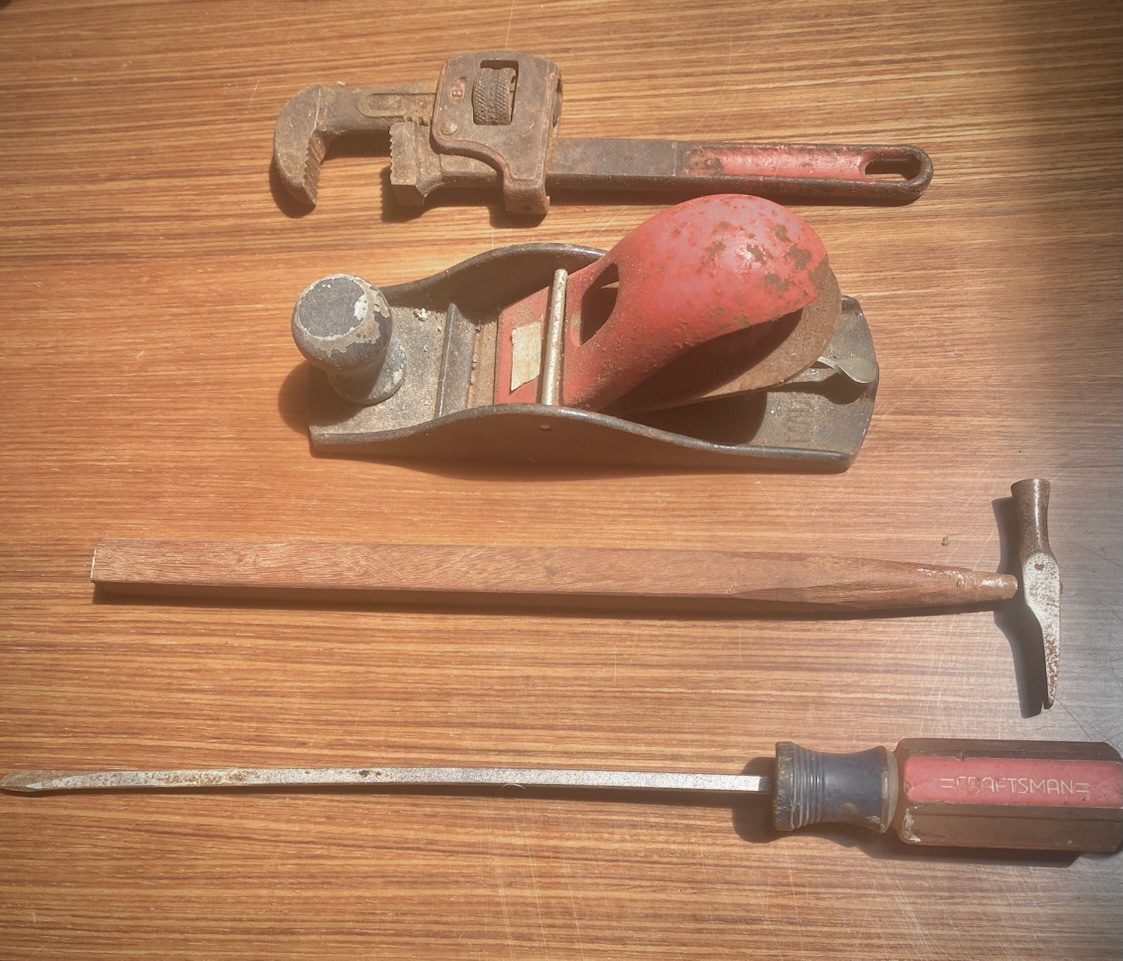
But if you’re a homeowning workman wannabe who doesn’t employ a labor force like Churchill did, I’d like to pass on some tips based on knowledge gained the hard way. First, you know those old tools and stuff you saved from your dad’s basement and garage because they were free? Lose them, or at least don’t use them. Sure, some of them look cool and they’re full of memories. So, take their picture or make an artwork out of them, like a diorama. A fitting tribute, because when you last made a diorama, those tools were new.
Second, there is no shame in driving back and forth to the hardware store five times in one day. Don’t let anyone tell you otherwise.
Third, any time you do have a contractor, or installer, or handyperson to the house for something, you need to be right there with them doing the work. One of the benefits of hiring them is that you get to learn something about the system, or unit, or whatever it is, and its relationship to your house. Don’t sleep on that part of the deal.
Now I need to let you in on a little open secret. Surprising as this may be to some, not every actual skilled workman likes the homeowner to be anywhere near them as they’re doing the work. I have seen some go as far as to impose upcharges on their labor rates that look like this:
Basic Fee: $100.
If You Watch Us: $150.
If You “Help” Us: $200.
If You Worked on It First: $300.
Under no circumstances should you let this deter you. Just try to be cool and of actual assistance as you watch, or as you “help,” or as you show them how you tried but flopped. Failing that, pay the extra fee.
Finally, a word about safety because, heedless of the oft-given warning, you are literally going to be trying this at home. Internet videos will steal hours out of your life and leave you no closer to knowing how to do your project. But they are useful as safety primers. Watch carefully how the power tools are wielded, noting the safety devices employed, the grips used, the angle and speed at which they are applied, and the complete absence of kids, spouses, and pets from the shot. Then place your cursor in the search window and type the name of the power tool you plan to use followed by the word “fails.” Watch as many of the results as you can.
Okay, I’m headed back to the roof with my blower. The internet tells me I’m too old to still be doing that, but I get some satisfaction from blasting the debris in the direction of Ned’s guesthouse.
Pete Jakab, who lives near Three Mile Harbor, “spends his time trying to improve at fishing, farming, and writing after a misspent career in the city.” You can find him on Substack or at [email protected].