Forty years ago, East Hampton Town entered into a 99-year lease for the westerly warehouse building on what had been the Navy’s World War II-era torpedo testing range, on Fort Pond Bay in Montauk, and the 1.5 acres surrounding it, for “marine science research and educational purposes only.”
An appendix to the lease agreement stipulated that the property would host “certain scientific activities known as ‘the Blue Lobster Project’ as currently directed by Dr. Anthony D’Agostino under the auspices of the New York Zoological Society.”
D’Agostino, who died in 2017, had worked at the New York Ocean Science Laboratory, a consortium of several New York universities, from the time of its 1970 opening at the same site. The Blue Lobster Project explored the viability of commercial lobster farming. “Isolating a genetic trait for fast growth and using a color marker of the blue lobster, he was successful in growing a full-sized lobster in the lab in half the time it took to reach maturity in the wild,” according to his obituary in The Star.
The Ocean Science Lab closed in the early 1980s, a victim of insufficient funding. But work at the site continues: Three years after entering into the lease for the westerly warehouse, the town’s shellfish hatchery was established, and not a moment too soon. In 1985, brown tide, unicellular brown algae, decimated eelgrass beds and shellfish populations — particularly bay scallops — in New York, New Jersey, and Rhode Island waters. Landings were reduced to 20 percent of pre-bloom levels.
The following year, commercial sale of striped bass was banned due to high concentrations of synthetic chemicals known as polychlorinated biphenyls, or PCBs, and the State Department of Environmental Conservation accelerated the closure of shellfishing areas because of high coliform bacteria counts. The number of baymen in the town declined sharply in the 1980s.
“Fishermen always are afraid that stocks are declining and things aren’t how they used to be,” said John Aldred, who started working at the Ocean Science Lab in 1974 after stints in the Peace Corps and as a lifeguard. “But things really took a dive in the mid-’80s with the arrival of the brown tide. A lot of the work in the Lab, when I was there in the mid-’70s, was ‘How can we improve things for the fishing community? How can we protect stocks?’ It was not in a big decline yet.”
Mr. Aldred, who in the mid-1980s would join the town’s Natural Resources Department, was instrumental in obtaining funding and developing the mission of the hatchery. He retired in 2010, returning to town government in 2018 following his election to the town trustees.
Brown tide, he said, was a catalyst for obtaining funding for the hatchery. “The Montauk site was looked at as a place that might be immune from brown tide,” he said, “because at the time, it was a western embayment thing, it hadn’t shown up in Lake Montauk yet.”
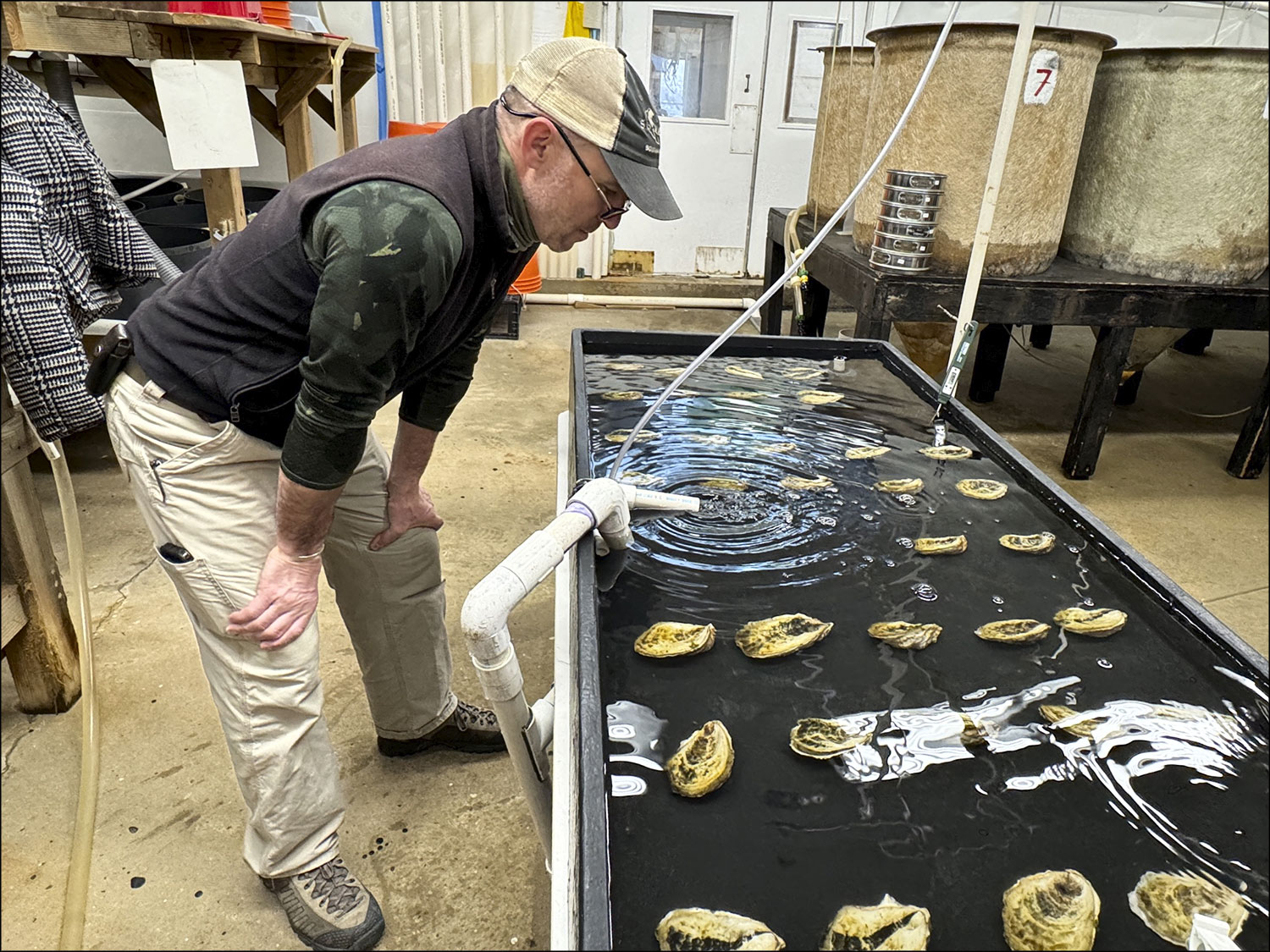
There are three phases to the hatchery’s work before waterways can be seeded with shellfish, Mr. Aldred said: spawning and cultivation through the larval stages in the controlled indoor environment, a land-based nursery system where the shellfish grow, and a field grow-out phase in a harbor or bay. At the hatchery, “we had a nursery system set up with flowing water from the bay,” he said. “But we encountered a problem in that system — we just weren’t getting any growth.”
It was concluded that the waters of Fort Pond Bay are too oceanic for inshore shellfish to thrive. “We set up some trial sites in Three Mile Harbor,” Mr. Aldred said. “We got, like, 100-percent increase in volume of material in a week, so we realized we’ve got a problem trying to grow shellfish in the Fort Pond Bay water.” The nursery was moved to Three Mile Harbor.
Today, with the prevalence of harmful algal blooms and a severe decline in the eelgrass beds that provide essential habitat for juvenile shellfish and finfish, “the mission hasn’t changed much,” said John Dunne, the hatchery’s director. It is “to grow as many oysters, clams, and scallops every year” as practicable. The hatchery aims to grow around two million oysters, six to eight million clams, and “as many bay scallops as the gods will allow,” but at least 300,000, he said.
Like Mr. Aldred, Mr. Dunne, who is called Barley, served in the Peace Corps, but whereas Mr. Aldred spent that time in India, the hatchery’s current director was in the Solomon Islands as a research technician on a project to determine if the archipelagic nation could develop an industry around the black-lip pearl oyster, which produces the Tahitian black pearl. “We collected spat in the wild,” he said of the bivalves in their juvenile life stage, “similar to how we do it with bay scallops here.”
Mr. Dunne came to the town in 2004, starting at the hatchery as a bay management specialist. “I had a carpentry background,” he said, “so was put to work building things, making grow-out material. Soon, I was put in charge of the field grow-out for oysters and clams, and then in 2010 everybody jumped ship,” Mr. Aldred’s retirement included.
Mr. Dunne was named the hatchery’s director and charged with rebuilding the staff. Today, that consists of Samir Younes, senior environmental analyst; Jeremy Gould, assistant waterways management supervisor; Lucia Massey, environmental technician, and Adam Thime, environmental analyst.
“It’s all seasonal,” he said of the hatchery’s work. The spawning of scallops has begun. “We got the oyster and clam spawns done, and all are at the nursery now.”
Mitigating environmental degradation with proactive intervention as with the seeding of waterways with shellfish remains an urgent need. Starting in 2019, the local bay scallop population experienced a severe die-off in the late summer, shortly before they could be harvested. A coccidian parasite is believed to be a cause of the die-off in East Hampton and the greater Peconic Bay region, along with stressors including elevated water temperature and low dissolved oxygen.
This year marks the 10th anniversary of the town’s community oyster garden program, which is run by the hatchery. A single adult oyster can filter up to 50 gallons of water a day, while the gear provides habitat for crabs, nursery fish, and other marine life.
“We’ve been playing around with sugar kelp in pilot projects in Accabonac Harbor and Hog Creek as another means to sequester excess nutrients,” Mr. Dunne said. Last winter “was our best kelp season,” he said. “That’s a winter crop, so it gets planted in November and December, and harvested in May. It doesn’t cut into any of our other projects, and it actually helps fill in the season.”