Some East Hampton Village residents with applications before land-use boards have received electronic communications purporting to be from the village and indicating that fees are due and must be paid. These are fraudulent, counsel for the village’s zoning board of appeals said.
At the Z.B.A. meetings of April 10 and May 8, Timothy Hill said that there had been a series of such incidents in municipalities including the village. These, he said, take publicly available information from applications. “This board and the village do not send out any of those types of invoices,” he said in April.
At the board’s May meeting, he repeated the message and advised applicants to be cautious about fraudulent communications delivered via email. The messages, “however real they may appear, are not coming from the village and are not due or payable to the village,” he said. “The fee that you pay with your application at the time that you file it by check or cash is the only payment that the village seeks in connection with a Z.B.A. application.” He asked that recipients of such messages report them to the village, “and certainly, don’t pay it.”
Certain information related to applicants must be made publicly available online, Mr. Hill said this month, “to be in compliance with the open meetings law and also just as a service to the public to be informed about the subject matter of the meetings.”
Mr. Hill told The Star last week that the village became aware of the fraudulent communications early in April, “but this has been happening elsewhere before that.” Indeed, Southampton Village posted a fraud alert on its website on March 10. “Scammers are using publicly available information from municipal land use applications and project files to obtain contact details and other information about applicants,” it reads. “They are then sending fake invoices that appear to come from a municipality, requesting payment for additional review costs or application fees.”
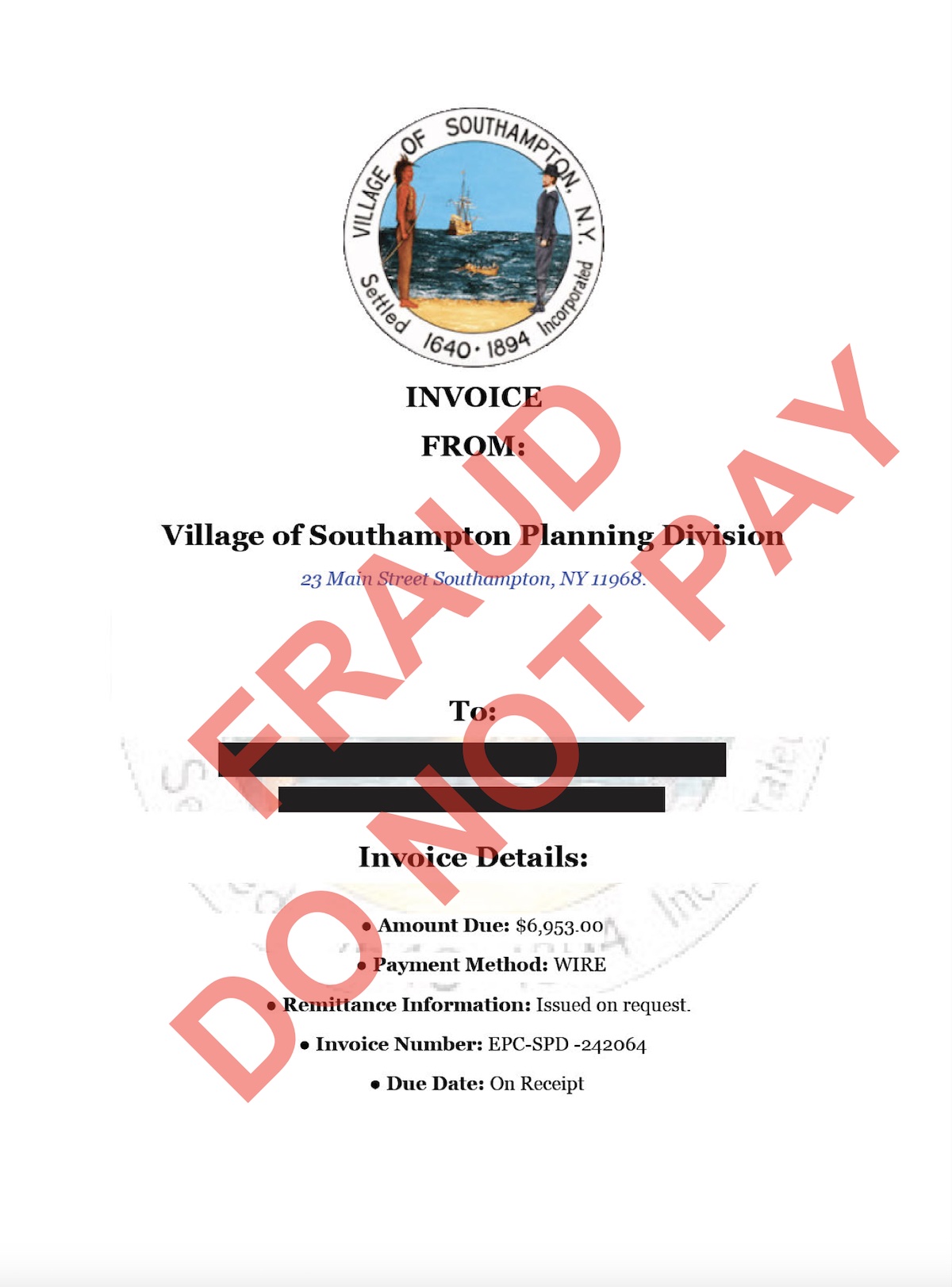
Southampton Village also posted a sample fraudulent message and an attached invoice purporting to be from the “Village of Southampton Planning Division.” “This message serves as an official reminder regarding the outstanding Application Review and Approval Fee associated with your Subdivision Application for the [redacted] acres property located at [redacted],” it reads.
“To proceed with the final approval process,” the email continues, “we kindly request that you settle the attached invoice for the application review & approval fee at your earliest convenience. Timely payment of this fee is crucial to ensuring the smooth progression of your permit application through all required review and approval stages, including necessary compliance evaluations.” It goes on to instruct the recipient to “Reply to this email to request the invoice wire instructions.”
The attached invoice, which features the village’s seal, states that $6,953 is due upon receipt. An itemized breakdown lists a $2,000 “Licensure & Certification Approval Fee,” a $1,503 “Application Processing & Review” fee, a $1,550 “Legal & Compliance Evaluation,” a $500 “Recordkeeping & Inclusion in Official Agenda,” and a $1,400 “Facility & Infrastructure Evaluation” fee.
The recipient is instructed to sign and return the invoice, “along with the wire payment receipt, to the provided email address for confirmation and inclusion in the meeting agenda.”
In East Hampton Village, “they’re coming by email,” Mr. Hill said of the fraudulent messages, “but in some cases it looks like there’s a text content, and in other cases a PDF attachment. In that instance, it has the seal of the village on it, and looks quasi-real.” In some instances, the sender “is impersonating the village by using the names of village officials” as well as addresses and other content.
“We have an application fee, which is nominal,” Mr. Hill said (the zoning board’s fee for a special permit application is $500, and the variance application fee is $1,000 per variance request). “All the rest of it is nonsense.