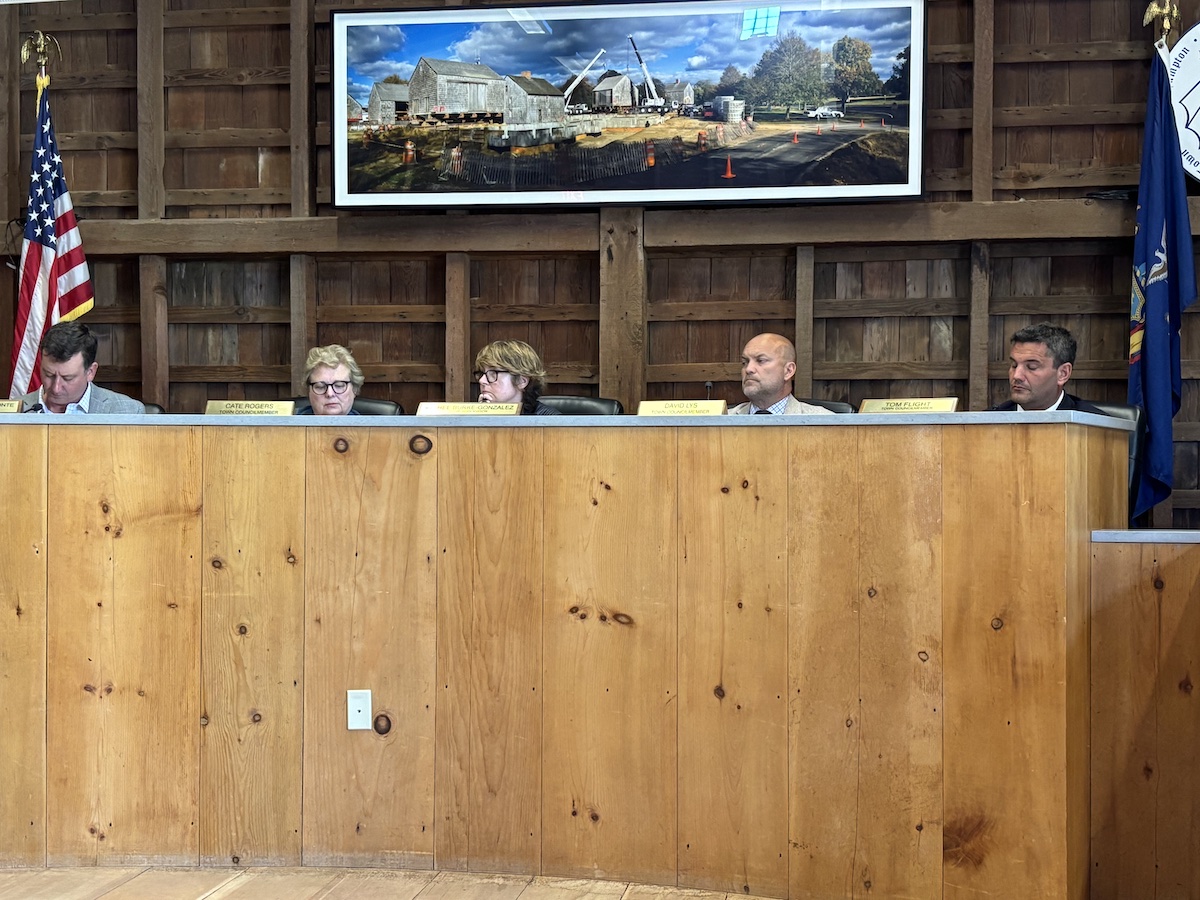
Following a May 7 public hearing on a proposed code change that would allow “rent restricted employer-sponsored housing developments” in East Hampton, the town board ended a long post-hearing discussion on Tuesday with changes to the legislation.
The changes are enough that the law will have to go through another round of public hearings, and then another post-hearing discussion, before it is ready for a vote.
Councilman Ian Calder-Piedmonte said he would make the changes, including the addition of a fee, paid to the town, when a new tenant moves in to the condominium development. He will also draft a requirement that the developer notify the town of any changes made to the offering plan.
At present, the legislation would allow lease terms as short as six months. Mr. Calder-Piedmonte told the board he would prefer a one-year lease. “There’s a lot of concern about it being a revolving door,” he said.
He also requested stronger language compelling the complex’s management company to verify a tenant’s income.
The planning board has already signaled its support for the law in a March 26 memo from its chairman, Ed Krug. Planning board members made some suggestions — for example, to allow people making more than 130 percent of the Area Median Income to become tenants.
“The board members noted that there is also a dearth of housing opportunities for households making more than 130% A.M.I.,” Mr. Krug wrote, “and that this use, which would not consist of “affordable housing units” as defined, could have a higher income cap (e.g. 160% A.M.I.) which would fill a need gap in available housing.”
That suggestion did not have the support of a majority of the town board, with Councilman Calder-Piedmonte, Councilman David Lys, and Councilwoman Cate Rogers all supporting the 130-percent cap.
Councilman Tom Flight suggested moving the cap to 150 percent for essential workers. Supervisor Kathee Burke-Gonzalez was open to a higher cap as well.
The planning board also suggested the use could even be allowed on lots smaller than the proposed three acres.
“I would like to see a project delivered and see how it operates before we move to smaller lots,” said Mr. Flight.
It is not clear when the legislation will be discussed again. “This will take a bit of work,” said Mr. Calder-Piedmonte.