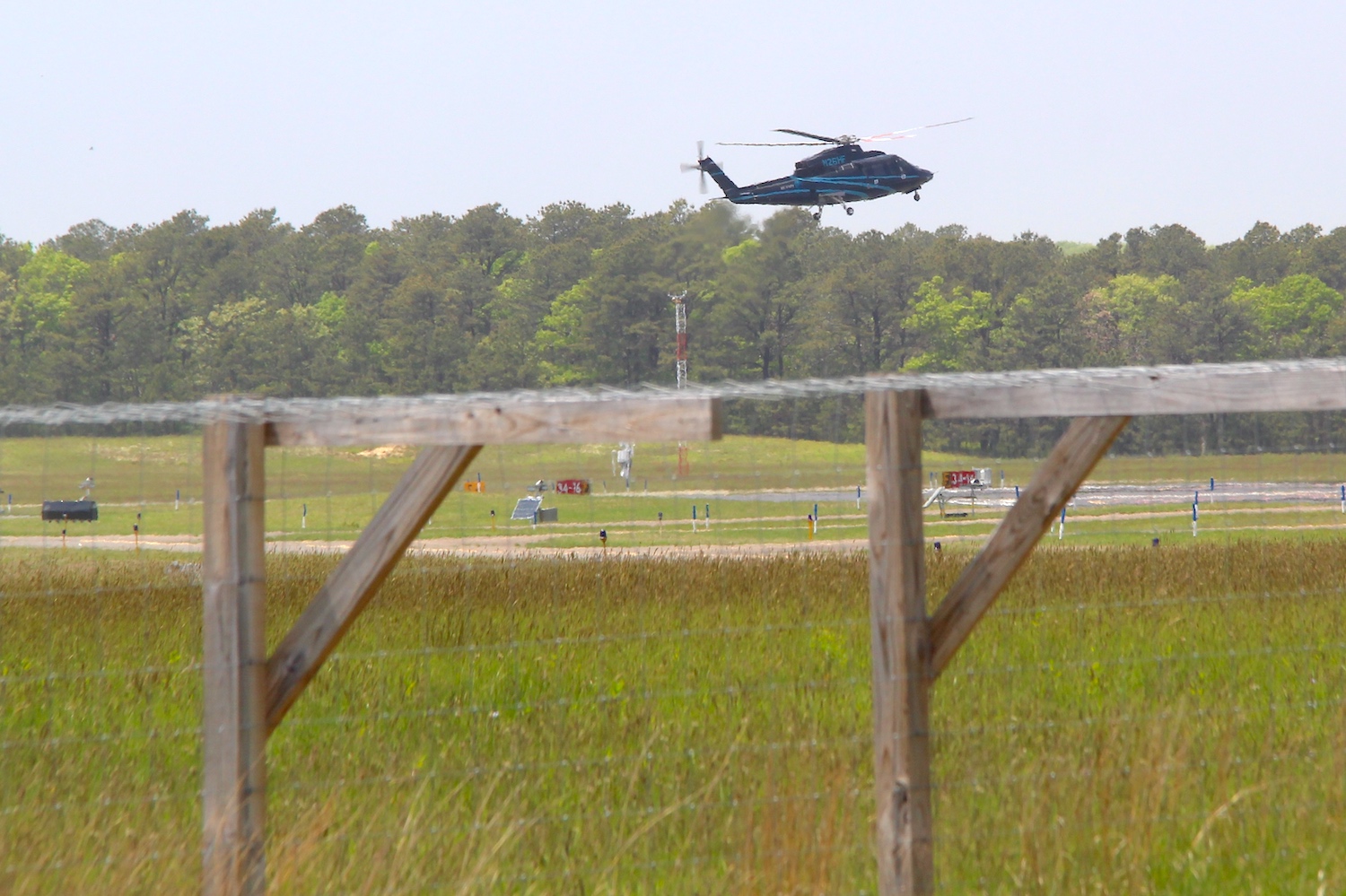
After a presentation Tuesday, the East Hampton Town Board now has data to back up what residents have been saying for years: “Man, helicopters are annoying!”
Matthew Simon, an environmental and transportation planning consultant from HMMH, which the town first hired in 2014 to study airport noise, took the board through an hour’s worth of operations data gleaned from the Vector Noise and Operations Management System and complaint data from the PlaneNoise management system to come to his conclusions.
His goal was to see if problems first identified in 2014, namely that aircraft noise disturbs people, that helicopters are the most disturbing, and that people are most bothered at night and at excessively busy periods, were still true.
For the most part, they are.
But there have been some improvements, he told the board. Perhaps the biggest change that has helped is a voluntary curfew from 10 p.m. until 7 a.m. each day.
Town Supervisor Kathee Burke-Gonzalez thanked Steve Tuma, the president and chief operating officer of Sound Aircraft Services, for helping to impose the curfew.
“In the past we had a voluntary curfew from 11 p.m. to 7 a.m., and we moved it to 10 p.m.,” she said. “Sound Aircraft honors that curfew. They don’t provide services after 10, and I think that’s part of why we saw compliance. He is a good partner with the town.”
Another improvement: While airport operations have increased, complaints have decreased.
In 2022, PlaneNoise logged 34,658 grievances; in 2025, that number declined 48 percent, to 18,169. This could be partly because of helicopter noise abatement routes. That said, those who live along those routes still consistently gripe.
Helicopters simply drive complaints, with about 40 percent of their operations producing a person angry enough to pick up the phone. Mr. Simon showed the correlation between aircrafts and the number of complaints they generated.
Helicopters with a piston engine produced the most, 1.82 complaints per operation, while helicopters with a turboshaft produced slightly fewer, 1.46 per operation. On the other end of the spectrum, small, fixed wing single engine jets produced just .31 complaints per operation and a single engine piston airplane produced only .23 complaints per operation.
Further, two of the three most disputed aircraft were helicopters.
The Sikorsky S76 helicopter had the most complaints (21,587), but also the most operations (16,445). The Bell B407 helicopter had the second most complaints (15,249) with roughly half as many operations.
Of the top 10 complaint counts by individual aircraft, nine were helicopters.
Traffic at the town airport peaked in 2021, likely due to Covid-era restrictions, when many people chose to stay local instead of traveling internationally. There were nearly 35,000 flight operations, or takeoffs and landings, that year. They’ve since dropped and stabilized. Last year, there were over 25,000 operations.
Grievances about noise are closely correlated with the number of airport operations. Further, complaints weren’t simply coming from a handful of households but were spread out over hundreds of households.
Indeed, Mr. Simon’s graphs clearly showed that on Thursday and Friday evenings, when people fly into the area, and then again on Sunday evenings and Monday mornings when they fly out, objections were most consistent: roughly one per “operation.”
“Folks are coming out Thursday and Friday and going back Sunday and Monday,” said Ms. Burke-Gonzalez. “That’s when we get the most complaints.”
Overnight flights, from midnight to 6 a.m., when an operator broke the curfew, drew the most complaints. There were only four operations made around 3 a.m. between 2021 and 2025, but each led to an average of 35 protests.
If some of the conclusions seemed obvious, they’ve also been heard before.
Ms. Burke-Gonzalez admitted to feeling a little “déjà vu,” as she was airport liaison from 2014 to 2017. “We dug into the data quite a bit back then,” she said. “We’re not going to wait five years again to do an analysis. We’ll do it annually.”
However, unless helicopters are banned from the airport or their use curtailed, the same conclusions will likely be reached again.
“Not too much of this is surprising to me,” said Councilman David Lys. “At nighttime, I want to sleep also. It’s interesting that there are only two time slots, the 1 o’clock and the 2 o’clock time slot, in which the operations are greater than the complaints. I don’t know if that’s the sweet spot there,” indicating that squishing operations into the middle of the day may be a solution.
“The data supports what we’ve always heard,” said Councilwoman Cate Rogers. “Weekends are horrendous.”
“It seems there is a lot of voluntary compliance and a few bad actors,” said Councilman Ian Calder-Piedmonte. “I hope we can continue to work with operators to encourage voluntary compliance.”
Two Wainscott residents, Hersey Egginton and Mark Frons, called during the public portion of the meeting to encourage the town board to install noise monitors at the airport.
(Mr. Frons unveiled JPXWatch.org, an enhanced flight tracker, at a Wainscott Citizens Advisory Committee meeting earlier this month.)
Tuesday, he noted that HMMH is a leading installer of such equipment and said the Federal Aviation Authority uses noise monitoring as the foundation of abatement strategies, with resident complaints corroborating the hard data.
“At JPX [the East Hampton Town Airport] the town has been working solely with complaint data,” he said. “The evidentiary record will benefit from actual noise measurement. I respectfully ask the board to ask for a scope and cost estimate from HMMH for a proper noise monitoring program” at the airport.
“We can look into that,” said Ms. Burke-Gonzalez.
John Cullen, the chairman of the Town of Riverhead Helicopter Noise Task Force, attended the meeting and said helicopter noise in Northville, where he lives “has gotten a lot better.”
“Now I have a problem with seaplanes,” he said.