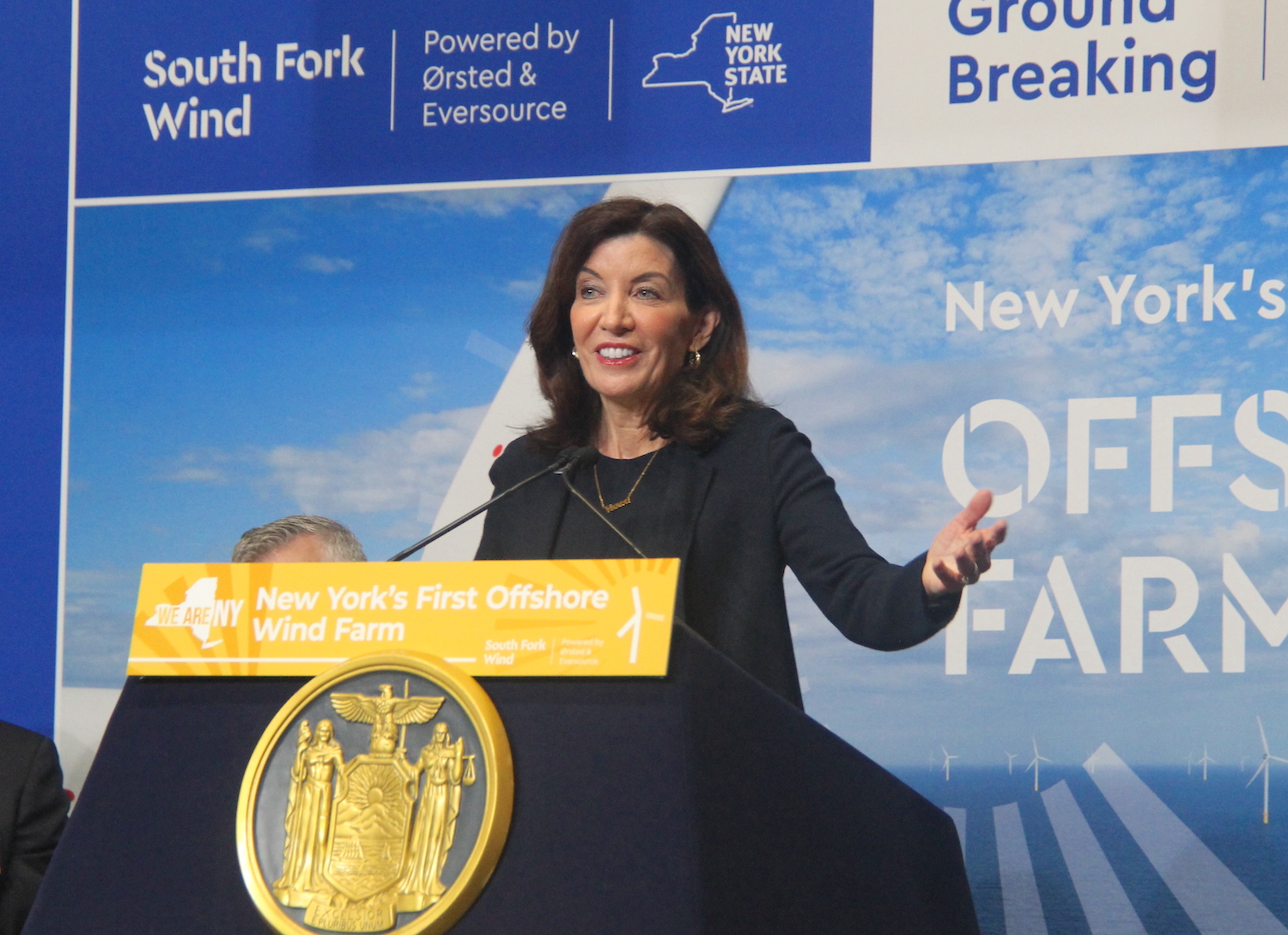
Gov. Kathy Hochul’s intention to delay and alter implementation of New York State’s Climate Leadership and Community Protection Act of 2019 has dismayed local officials and activists who decry the move at a time when the federal government barely acknowledges climate change and adamantly opposes renewable energy in favor of fossil fuels.
The act mandates a 40-percent reduction in greenhouse gas emissions from 1990 levels by 2030 and an 85-percent reduction by 2050. It requires 70-percent renewable electricity by 2030 and 100-percent zero-emission electricity by 2040. But regulations to enforce the law by implementing a cap-and-invest program or other means to reduce emissions, which were required by 2024, have yet to be published. Now, the governor proposes delaying those regulations until 2030, along with amending how emissions of methane, a potent greenhouse gas, are measured.
The governor, who faces a challenge from Nassau County Executive Bruce Blakeman in the Nov. 3 election, cited affordability in a March 20 essay published on the Empire Report website. She cited accomplishments since 2019 including the South Fork Wind farm and two other offshore wind farms under construction, both of which the Trump administration unsuccessfully tried to halt, and the congestion pricing plan in Manhattan that has proven effective and popular.
“I remain fully committed to the blueprint for a sustainable future laid out in that landmark legislation,” she wrote of the Climate Leadership and Community Protection Act. “But so much has radically changed” since it was enacted, “necessitating commonsense adjustments that keep us on our path to a greener future in a way that is affordable for New Yorkers.” Post-pandemic inflation and supply chain disruptions, federally imposed tariffs, and “a White House under Donald Trump, aided by a Republican-controlled Congress, that launched a full-on assault on renewables and the tax incentives that encouraged companies to build and residents to convert” to renewables necessitate modification of the act’s implementation, she wrote.
Absent a federal partner, states are hamstrung, she wrote, unable to pursue new offshore wind projects, while within the state, moratoriums and bans have thwarted the siting of battery storage and onshore wind and solar installations. “Meanwhile, the war in Iran is driving up gas prices at the pump to the breaking point for too many New Yorkers,” the governor wrote. The state has retired “far more fossil fuel plants than it’s been able to replace with renewable sources,” and the New York Independent System Operator has consequently projected potential energy shortages, particularly downstate. “Put simply,” she wrote, “something has to give.”
Thus her push to change the climate act as part of ongoing budget discussions with the Legislature. “This is solely out of necessity — to protect New Yorkers’ pocketbooks and economy,” she wrote. The state cannot meet the act's 2030 targets “without imposing new and additional crushing costs on New York businesses and residents.” The State Energy Research and Development Authority, she wrote, concluded that if the state were to hold to the act's 2030 targets via a cap-and-invest policy that set a strict and declining limit on greenhouse gas emissions, those costs would be passed on to oil and gas consumers.
The result, according to NYSERDA, would be an additional $4,000 expense per year to upstate households and an additional $2,300 in costs to New York City households. Meanwhile, by 2031 gas prices would rise an additional $2.23 per gallon above what they would otherwise be. Environmental groups have disputed these assertions.
Given the quandary, the governor proposes amending the act to postpone regulations for another four years, and to "change what emission limits the regulations are tied to" while adding a new, interim 2040 target for emission limits.
"We still look forward to more concrete proposals from the governor," Assemblyman Tommy John Schiavoni told The Star on Tuesday. "But as far as C.L.C.P.A., it's an important law. New York is a leader in this regard, and my view is that we need to stay the course. . . . Being a coastal community, we are seeing the effects of climate change firsthand."
"You think something is accomplished," East Hampton Town Councilwoman Cate Rogers said, "but in reality the battle never ends. We have progress and, a lot of times, what comes next is pushback."
"I can see what the governor is saying," she added, "because people are absolutely pressed to the wall on their monthly bills. It is difficult to push legislation that might initially cost more and know that's going to be passed on to the consumer. I understand her concerns, but it sends us on a track of very bad results at the end. . . . The science is indisputable. It's been proven for decades already. How are we going to collectively address this?"
Instead, she said, "when you're putting the burden on the state instead of having federal programs and funding, and if your money is all going to a war, and for steaks and lobster tails and ice cream machines" — allegations surfaced last month that in September 2025 the Department of Defense spent $15.1 million on ribeye steak, $6.9 million on lobster tails, and $124,000 on ice cream machines, among other luxuries — "we need to act through the electoral process to correct the mistakes of the federal government so they enhance the state's ability to change."
"There is no doubt that federal funding as matching, or to supplement, state funding is not there anymore, and the policy environment is really hostile," said Krae Van Sickle of the town's sustainability committee. "That can drive costs up tremendously." But "I would certainly argue with the timeframe — six years, instead of a year or two," he said of amending the act to require regulations at the end of 2030. "The nature of our challenge is that we have a relatively short window within which to achieve [greenhouse gas] reductions without cascading effects."
"In critical times of duress," said Mary Ann Eddy of the sustainability committee, "people need strong leaders that don't back down in the face of problems and complications, leaders who don't crumple under pressure. New York State needs a governor who will not kick the can down the road because the way forward is hard. Change is always hard. Now is such a time in New York State for our governor to maintain the course with the C.L.C.P.A."
"The world we are leaving young people will not be pretty," Leonard Green of the sustainability committee said. "We need to act as if we care. The governor's actions are unfortunately symptomatic of a larger and widespread unwillingness to acknowledge just where we are on this precipitous slide into an unlivable future."
"The tragedy about Hochul as governor is that what she doesn't support affects every municipality in New York State and every resident," said Lena Tabori, co-founder of the Climate Change Resources website and a former member of the sustainability committee. "Local officials are off the hook in every direction. Why should they legislate all-electric for new construction when the state doesn't? Why should they provide rebates to landscapers for electric leaf blowers when the state doesn't? We desperately need more solar, more wind, and more batteries if we are going to reduce our reliance on fossil fuels and their damaging greenhouse gases. But, when the state reduces its concern, it gives cover to every town official, and residents cease thinking global warming is the existential concern that it is."
"The worst part," she said, "is that we will vote for Hochul anyway because it will be worse if we have a Republican governor."
"As far as C.L.C.P.A. and climate change and the current political winds," Mr. Schiavoni said, "I would like people to seriously think of how history will judge us if we do nothing."