It was quiet, too quiet, at a Tuesday East Hampton Town Board discussion regarding the generally controversial 42-acre Springs Park, where plans to revegetate an acre cleared of invasive autumn olive trees last year were discussed.
“I’m actually surprised that we didn’t have some folks from Springs that utilize Springs Park here today, because normally anytime Springs Park is on the agenda, we have a packed house,” joked Supervisor Kathee Burke-Gonzalez.
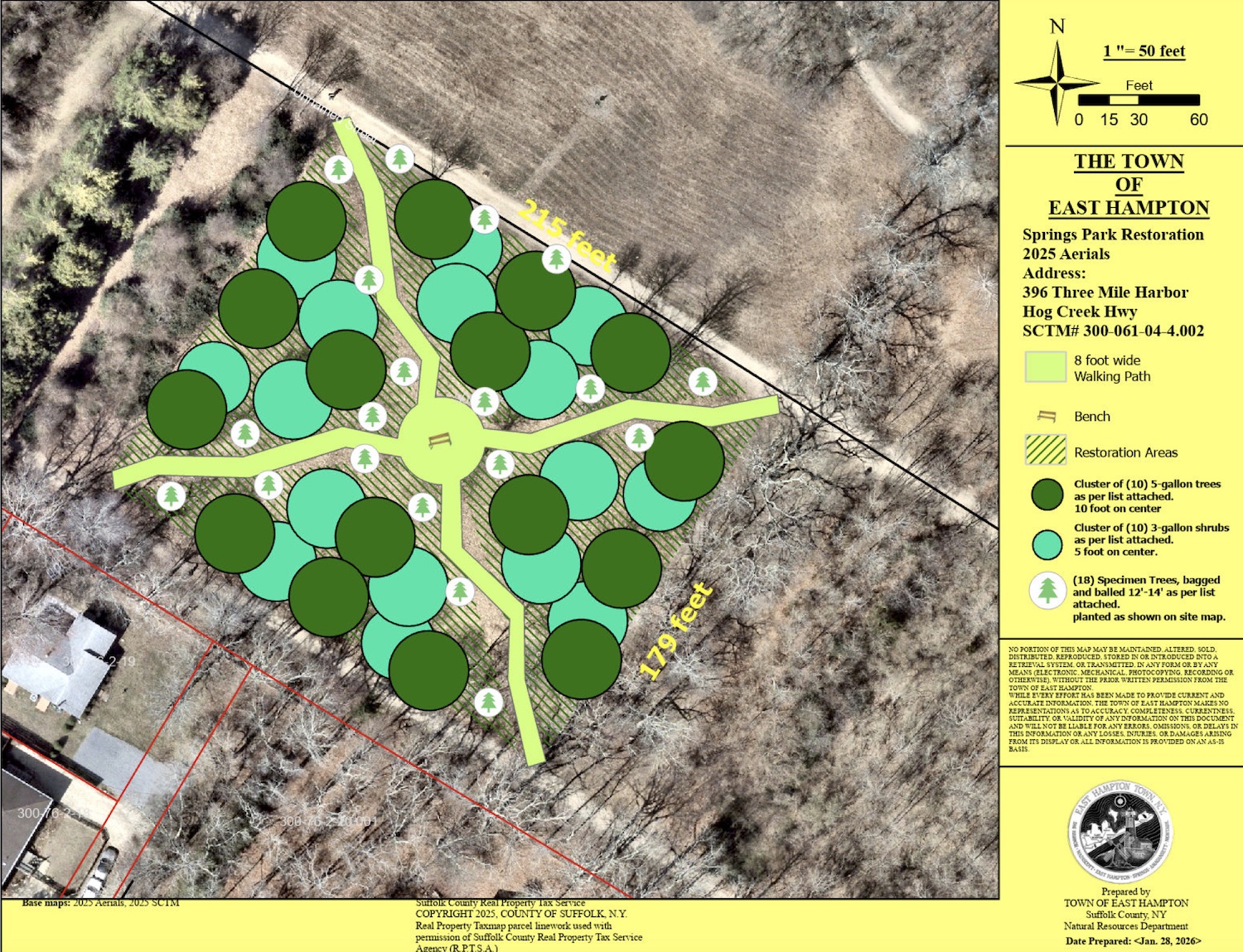
Any new invasives that pop up after last year’s clearing will be removed and their stumps ground up. In their place, 160 native trees and 160 shrubs are to be planted. Additionally, in a nod to park users’ concerns about shading, 18 larger trees, up to 14 feet tall, would also be planted.
Eastern black walnut, American elm, boxelder, flowering dogwood, and black birch were some of the native tree species proposed. Beach plum, black chokeberry, Southern arrowwood, and mapleleaf viburnum were some of the suggested shrubs.
Trails would crisscross the revegetated acre, with benches placed at access points and at the center. There was no cost estimate for the plan, which still needs to go out to bid.
Mark Abramson, the assistant environmental protection manager in the town’s Natural Resources Department, hoped the planting could happen in the fall.
Whoever the contractor is will need to ensure that at least 75 percent of the plants survive over the course of five years. If some die off, they would have to be replaced. The contractor would also be tasked with weeding the area twice annually.
Councilman David Lys was skeptical, but supportive, noting that the area is surrounded by invasives. He hoped in the future to further expand the grasslands in the preserve.
“This is going to be an experiment to see if they can survive within the close proximity to other invasives,” Mr. Abramson said.
“I think that this is a risk well worth taking,” said Councilman Ian Calder-Piedmonte.
The town board also announced opening a new front in the war on invasives in the park, popular with dog owners, with the planned removal of a small area of mugwort. The work will be done thanks to an anonymous $10,000 donation to the Long Island Conservancy. In place of the mugwort, native grasses like big and little bluestems, switchgrass, Indian grass, wrinkleleaf goldenrod, and wild bergamot will take root.
“I wasn’t initially convinced that we needed to do a revegetation, but after seeing the result of the clearing, I think it’s appropriate, and I think that this is a good plan,” Mr. Calder-Piedmonte told the board.
He was particularly excited about the fact that the park is completely fenced in and might allow for some uncommon native plants. “We can actually see what these plants would look like in a habitat that doesn’t have as many deer. It’s kind of taking a bad situation and creating a win-win.”
“I think it was essential to get rid of those invasive species in the first part of this, and now obviously the replanting with native species will only enhance everyone’s experiences and provide better ecological benefit for wildlife,” Councilwoman Cate Rogers agreed.
A public hearing on the plans was tentatively scheduled for mid-April.