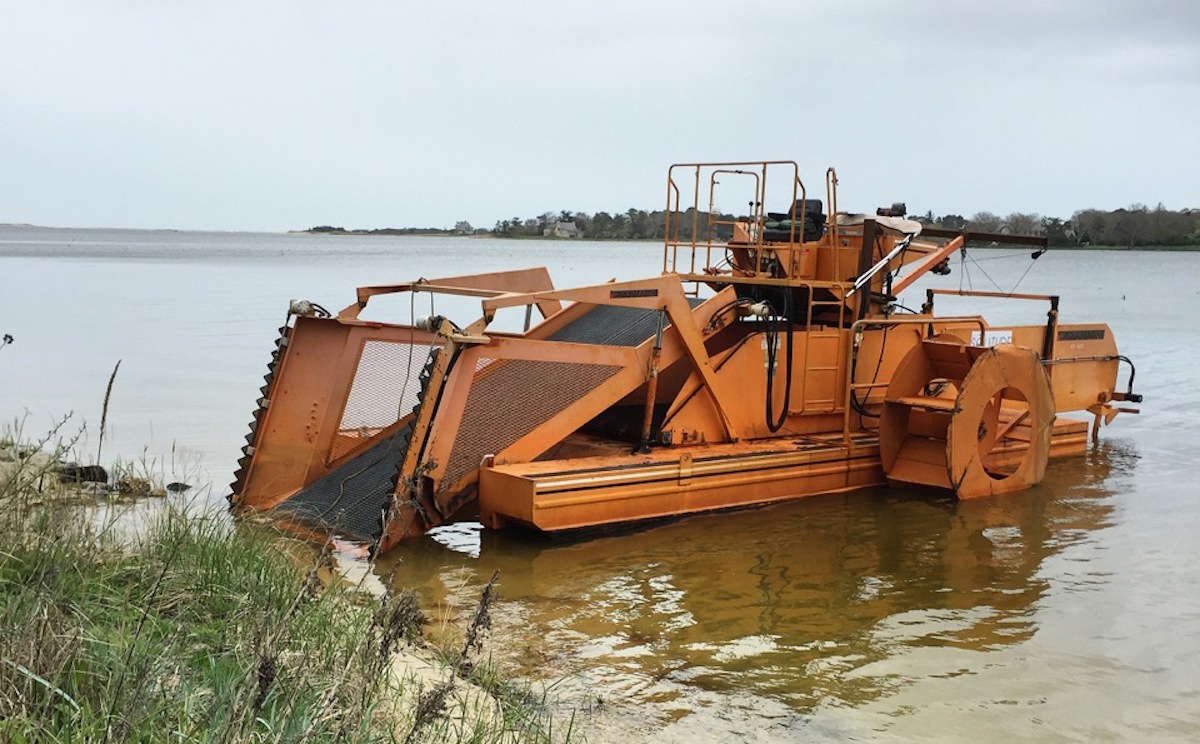
As in past years, the East Hampton Town Trustees voted last week to permit the use of an aquatic weed harvester in Georgica Pond this year and through 2030, in what is seen as an effective means to discourage the harmful algal blooms that have beset the pond starting almost 15 years ago.
On behalf of the Friends of Georgica Pond Foundation, Will Bowman of Land Use Ecological Services told the trustees on March 9 that the foundation’s use of the harvester to selectively remove plants and algae biomass was last approved by the trustees, who have jurisdiction over the water body, in 2023. That permit was in effect through last year. The weed harvester has been used most summers since 2016.
Blooms of cyanobacteria, or blue-green algae, in Georgica Pond were fueled in part by the release of nitrogen and phosphorus from decomposing aquatic plant biomass and macroalgae biomass, Mr. Bowman said.
The foundation implemented a pilot project for the harvester between 2016 and 2018. In those years, between 30,000 and approximately 95,000 pounds of aquatic plant biomass were removed annually, Mr. Bowman said. “However, since those early years, harvester use and total plant biomass has declined over time,” he said. In 2025, just 12,250 pounds were removed, and almost none in 2023 and 2024.
“It’s expected that the need for the use of the harvester will continue to decline,” he said. “However, Friends of Georgica Pond would like to continue the capability of using the harvester to address excessive dense stands of aquatic plants and macroalgae should they arise, and decrease the potential for these harmful algae blooms and anoxia events” — a lack of oxygen — “in the late summer months.”
The vessel traditionally operates for seven and a half hours per day, five days per week, and Mr. Bowman said that schedule would continue. It cuts aquatic vegetation up to a depth of about one foot below the surface “to minimize disturbance to benthic communities and maintain aquatic plant cover,” he said. “Vegetation can continue to grow toward the water surface, and if necessary can be cut again in 10 to 14 days.”