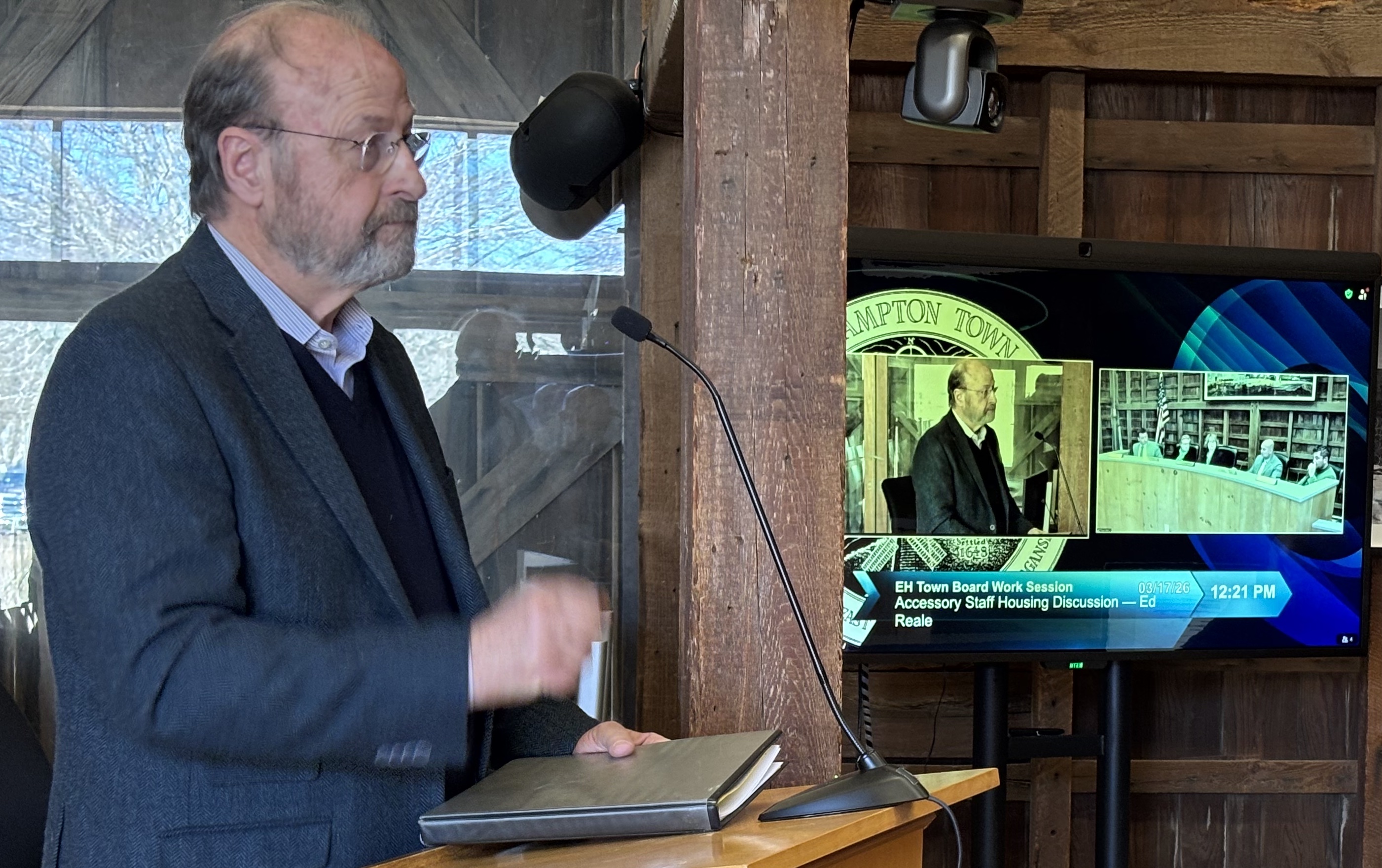
Enticing private investors and employers to build housing units was a focus at a recent East Hampton Town Board work session when the board discussed several housing-related issues and how best to build affordable housing in the town.
"When teachers, health care workers, municipal employees, and local business staff cannot find housing in the communities they serve, it affects the entire town," Supervisor Kathee Burke-Gonzalez said in a press release on the subject. "That is why we are evaluating a range of approaches."
Perhaps the one with the most potential to yield many new units is the proposed creation of a new use under the town code called an "accessory staff housing development" that would allow employers to build housing for their employees.
Apartments, single-family homes, or even rooming houses with bedrooms as small as 70 square feet, having the potential to accommodate up to 16 residents on a single acre, could be built on employer-owned properties if the proposed law were passed.
Development would be restricted by the Suffolk County Department of Health Services, based on septic density allowances, and applicants would need a special permit and approvals from the planning and architectural review boards as well. Zoning setbacks would apply.
Lot sizes could need to be at least an acre. While no income restrictions would be placed on residents, rents would need to be "affordable," not exceeding 130 percent of "fair market rent." Leases could be as short as 90 days, to accommodate seasonal staff.
The housing could only be built as accessory to the principal use on a lot.
So, for example, even if a business owns an acre of land separate from its business location, it couldn't use this portion of the code to develop it. Accessory staff housing would need to be built on the same land where the business operates.
"I'm supportive of this legislation," said Councilman Ian Calder-Piedmonte. "Like anything that comes before the board the first time, there are going to be changes. This middle income is a lost target for us that we just aren't doing enough for. The idea of producing legislation that would allow for private funding to take care of this problem in some way is a really great thing."
"The main thrust of this initiative is to create a way for private businesses to put some housing on their own property at their own expense," Ed Reale, a former town attorney who was rehired by the town in November to provide special counsel on housing initiatives, told the board. "There's no public investment in this."
He imagined that farms, for example, could benefit from the legislation.
"Work-force housing sited at the employer's business solves a number of issues and also takes care of some of the guardrails that I'm always worried about for abuse," Councilwoman Cate Rogers said. "Like things turning into market-rate rentals."
Placing housing where people work could also mean that fewer cars and parking spaces would be necessary on the lots, relative to the amount of housing provided.
Ms. Burke-Gonzalez asked where the number 16 came from, in regard to the potential rooming houses.
"The 16-person cap, realistically, most projects are not going to approach that," Mr. Calder-Piedmonte said. "We wanted to put something there, so people weren't worried about the absolute worst case scenario. That's a fairly arbitrary number, to be honest with you."
"Currently, I think employers will buy single-family homes, but it's not used as a family unit," he continued. "This just recognizes that and perhaps allows for developments more consistent with the actual use."
The board seemed open to further expanding the legislation, should it be received warmly by the public, to allow for such building on smaller lot sizes. The board informally discussed having another work session on the topic toward the end of April, with the potential for a public hearing in May.
Another work-force option contemplated by the board would create "rent-restricted employer-sponsored housing," which could be constructed only in either an affordable housing overlay district or a limited business overlay district. Both districts would place the housing, in theory, closer to employment centers, services, and transportation.
Units would be built for moderate-income families and subject to rent limits. Occupancy would be offered only to employees of the sponsoring employer. The employer would be responsible (which is important, not the town) for hiring a third-party management company to ensure compliance with the code.
The proposed code changes contain elements previously discussed by Kirby Marcantonio, a private developer who started the East End Housing Initiative. He was in attendance at the town board work session but did not address the board. Mr. Marcantonio has a few work-force housing plans that he has previously presented to various boards.
A controversial one for 79 condominium units off Three Mile Harbor Road fell apart this winter amid community opposition, which led the town board to vote against rezoning the property, which was required in order for the plans to proceed.
Perhaps furthest along is his property at 350 Pantigo Road in East Hampton, where he and his lawyer Christopher Kelley appeared before the town planning board last summer, pitching 47 units.
The town board also discussed using community housing fund money (which comes from a 0.5-percent tax on real estate transfers) to help finance the construction of accessory dwelling units. The proposal, from the town's Office of Housing and Community Development, would provide 10 interest-free loans of up to $100,000 for eligible property owners. If the C.H.F. money were to be used by the owner, that owner would have to adhere to conditions, such as a requirement for the A.D.U. to remain a year-round affordable rental for at least 10 years.
Finally, the board mulled whether the town could adopt a property tax exemption for A.D.U.s. Existing regulations do not prevent an exemption.