The East Hampton Town Trustees responded Friday to intense criticism over their disposal of Canada geese suspected to have died of highly pathogenic avian flu, also known as bird flu.
Over 700 dead geese were buried in place in the sand near Georgica Pond by Jim Grimes, a trustee, and his landscaping company, which the trustees contracted to complete the work he had started voluntarily.
A post from a popular local Instagram account, Kook Hampton, which often lampoons the excesses of the East End, questioned the wisdom of burying the geese and accused the trustees of responding to demands made by the wealthy members of the Georgica Homeowners’ Association.
It showed photos of the hole on the beach with the dead geese along with a quote from an anonymous source claiming: “When I called the trustee office, they told me, ‘We’re just doing what the Georgica Homeowners’ Association told us to do.’ This high level, anonymous source at the trustees’ office told me there had been zero input from the state or county health dept., or the C.D.C., as to how to properly dispose of these infected birds. They were just doing what they were told from wealthy people.”
In a follow-up post, the Kook Hampton account shared a press release from the trustees addressing their handling of the “mass waterfowl die-off at Georgica Pond.”
The trustees said in the release that they had “determined that quick and decisive action was required to prevent further environmental and public impacts,” and had followed New York State Department of Environmental Conservation guidelines in doing so.
“Warming temperatures raised concern amongst the trustees that rotting geese carcasses with potential avian flu could create an increased hazardous risk to humans and animals and therefore time was of the essence to address this immediate public health hazard,” the trustees said.
“This is a fake news guy that lives in Puerto Rico,” Mr. Grimes said of the Kook Hampton account. “We had to address some of the misinformation he put out that had zero credibility.”
In an email to The Star, Kook Hampton took issue with Mr. Grimes’s characterization. “Right off the bat, the first thing he has mistaken is that a singular person runs our account,” a spokesperson wrote. “Kook Hampton is run by the voices of our local community. We give the people who normally don’t have a voice a platform to express themselves.”
“These people in charge make decisions on our behalf. We have a right to have concern,” the spokesperson said. “Instead of worrying about our Instagram account, Mr. Grimes (who is truly a good man) should probably concern himself with the fact there [are] 750+ dead, infected and toxic waterfowl buried on a public beach in an awfully shallow grave.”
The New York State Department of Environmental Conservation, which has jurisdiction over the dead birds, issued a statement Monday that defended the trustees’ actions.
“The New York State Department of Environmental Conservation (D.E.C.) corresponded with the East Hampton Trustees regarding the removal and burial of a large amount of deceased Canada geese in the Georgica Pond area,” a spokesperson for the D.E.C. said.
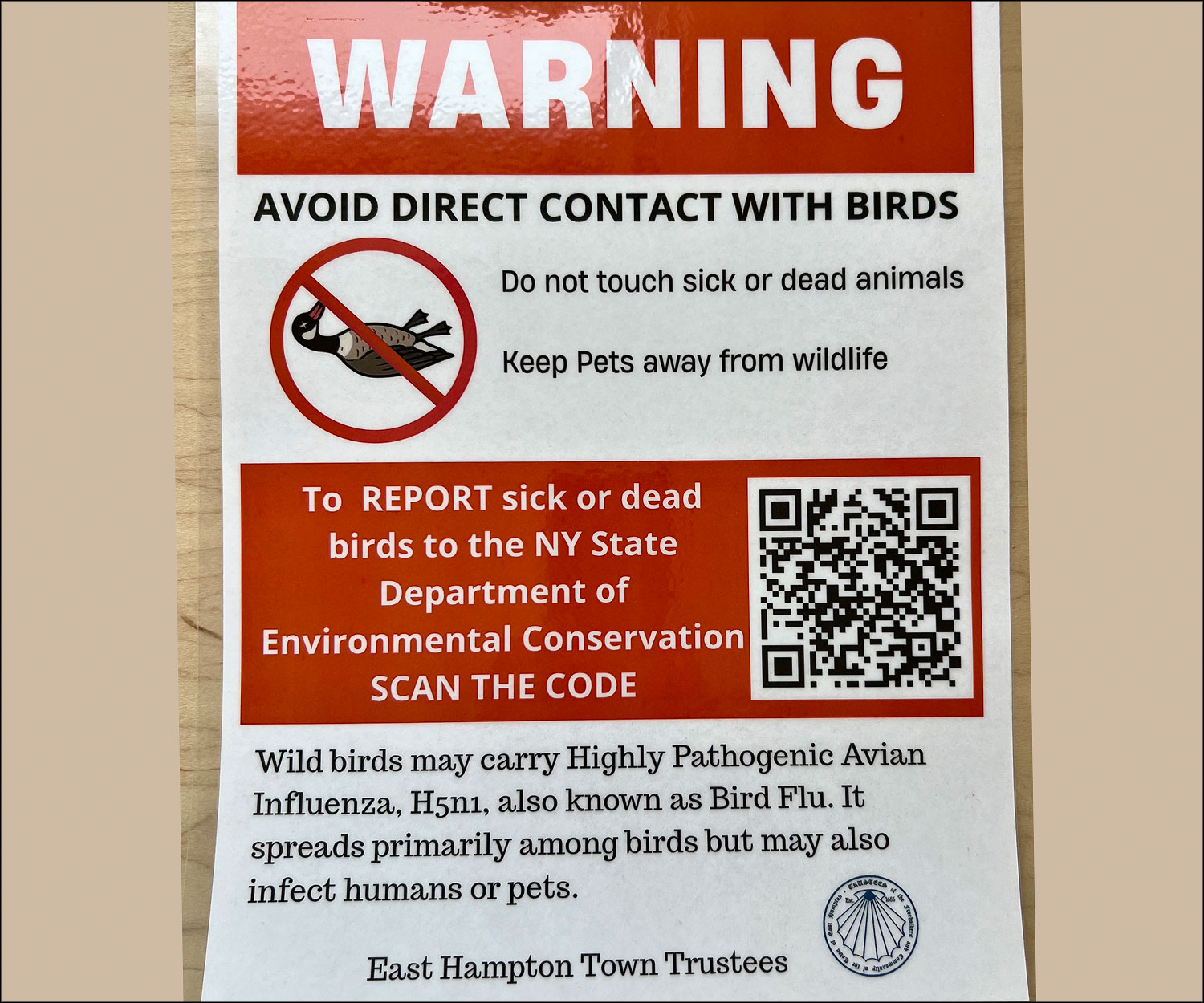
“Burial of birds with suspected highly pathogenic avian influenza (H.P.A.I.) can be a proper method of disposal if suitably located and at an appropriate depth. D.E.C. confirmed with the trustees that the geese were buried at an appropriate depth of over three feet and were placed outside of tidal wetland areas,” continued the statement. “D.E.C. was informed that final burial depths were deeper than initial depths circulated online, with a significant amount of sand placed over the area. The trustees also confirmed that signage was posted in the area advising residents to avoid contact with sick or dead birds based on D.E.C. guidance.”
According to their press release on Friday, the trustees were first made aware of the hundreds of dead geese by Tim Treadwell, the town’s head harbormaster, on Feb. 27. The ponds within the town are the responsibility of the trustees, not the town board, and so Mr. Grimes “visited the area to document conditions and assess the scope of the die-off” which “appeared confined to trustee and Georgica Association properties.”
Mr. Grimes collected some birds, buried others, and contacted the D.E.C., but “the agency declined to visit and referred the trustees to its general disposal guidelines, which includes burial in place.”
“I was the only option,” said Mr. Grimes in a phone call Monday, describing how he was hired to do the grisly and potentially dangerous work. He had yet to submit a bill to the trustees but said he would do so by their next meeting.
“Burial was outside the tidal zone at a depth of approximately three feet, with an additional three feet of locally sourced and compatible sand placed on top. Thus, providing a total of six feet of coverage,” the trustees said in the release. “At the conclusion of the clean-up effort, the N.Y.S.D.E.C. confirmed that all work was done within their guidelines.”
“At no time did the Georgica Association request assistance from the trustees regarding this incident. The trustees have been made aware of inappropriate comments and misinformation shared by a trustee staff member in response to public inquiries. The trustees take this matter very seriously, and it is being addressed internally in cooperation with the Human Resources Department and under established Civil Service protocols.”
Mr. Grimes was set to revisit the area on Tuesday morning to address another collection of dead geese in the northeast quadrant of the pond. He confirmed that the previously buried geese had not been dug up.
But in the email to The Star, Kook Hampton wondered if eventually “decaying animal matter will run into the ocean where kids will be playing this summer, directly into our surf breaks, on a beach where local dogs play.”
Bird flu hit the East End hard this year. A combination of ground covered by deep snow, frozen ponds, and the coldest stretch of weather in over a decade conspired to weaken waterfowl as the virus emerged on the East End in mid-January.
If there is any good news, it’s that the worst seems to be behind the birds.
The D.E.C. said it “expects bird flu cases to lessen as we head into spring,” because “during the warmer weather, birds no longer gather in large flocks, and break off into breeding pairs. Smaller flocks or groupings of birds lessen the chance of transmission of bird flu within a flock.”