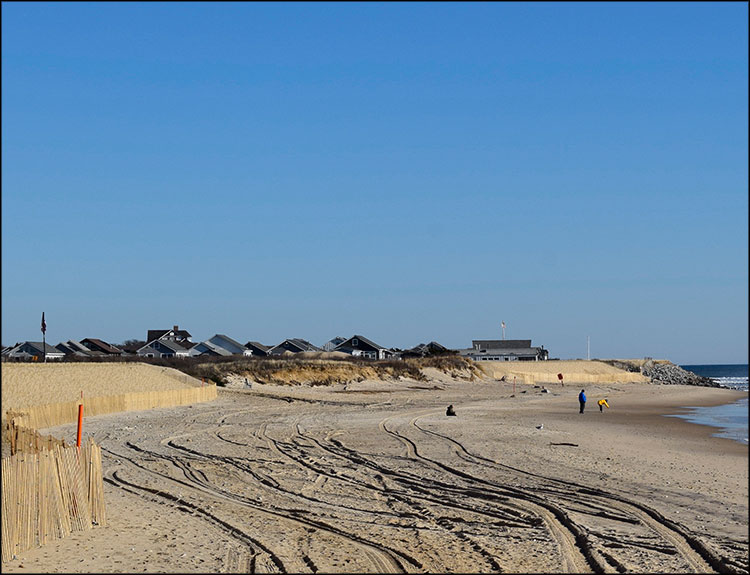
The East Hampton Town Board, minus Supervisor Kathee Burke-Gonzalez, who was attending Gov. Kathy Hochul’s State of the State address in Albany, took a bit of a victory lap at Tuesday’s meeting in Montauk for the completion of the Ditch Plain dune.
The 16-foot-tall “emergency structure” now stands impudently, or perhaps daringly, maybe both, before the Atlantic, extending from just east of what’s known as the “dirt lot” parking area to a few hundred feet west of the Seaside Avenue parking lot.
The importance of the project was made obvious two winters ago, when three unnamed storms, in December 2023 and January 2024, destroyed the primary dune that protects the residential neighborhood bordering the beach.
At the time, flooding from those storms extended a couple of blocks north of the beach covering the asphalt roads in sand stolen in part from the previously protective dune.
“The beach was eroded to hardpan,” said Councilwoman Cate Rogers. “Any remain of the primary dune was gone.”
Immediately, Ms. Burke-Gonzalez and her board began to secure funding for its replacement, including a request to the state. They also put $5 million into the town’s capital plan to ensure its reconstruction.
In August 2024, the board hosted Governor Hochul and walked the beach with her. Shortly after, the governor announced an additional $2.5 million from the state to help protect the beach.
Working with Henry Bokuniewicz of Stony Brook University, an expert in the dynamics of coastal processes, the town created a survey of the beach’s profile and, when he recommended the creation of a new primary dune, the town board started a search for contractors.
By July 2025, the New York State Department of Environmental Conservation had given the town a permit for the project and along with Brian Frank, the project manager and town’s assistant planning director, worked to get easements from homeowners along the dune’s span.
Bistrian Materials was awarded the contract in October 2025, and work began just before Thanksgiving.
Councilman David Lys, now the deputy supervisor, who ran the meeting in Ms. Burke-Gonzalez’s absence, explained that three large mounds of sand, one piled in the Seaside Avenue parking lot and the other two in the dirt lot, were kept in case any winter coastal storms rumbled through and the dune needed replenishment. He promised they would be removed in advance of the summer season.
Describing the dune as a “hurdle” that any winter storm would need to overcome, he was humble regarding its long-term viability, recognizing that “one coastal storm” could change the dynamics of the beach.
“It’s not a solution in the end. It just bides time for the community to become more resilient,” he said.
Meanwhile, Ms. Rogers explained the 16-foot dune configuration was chosen “to give us eligibility in the event of a declared disaster, for funding or repair, from the federal government through a FEMA program that hopefully still exists,” she said, as cautious about the Federal Emergency Management Agency’s long-term viability as Mr. Lys was about the dune itself.
President Trump has called for the agency to be “phased out,” which would place the burden for disaster recovery squarely on states.
“As the Trump administration examines FEMA’s side and structure, any reform should strengthen disaster response,” Representative Nick LaLota said in a statement. “If the administration reduces FEMA’s work force, I’ll fight even harder to ensure federal dollars continue flowing through state and local emergency management agencies so coastal communities like East Hampton can recover when storms overwhelm local capacity.”
The congressman helped secure initial federal funds for the dredging of Lake Montauk, an Army Corps of Engineers project authorized under the River and Harbor Act of 1960, last winter. However, when the project went out to bid, the federal government said it was over $1 million short, and that $10 million was the maximum it could commit.
East Hampton Town opted to use money from the town’s host community agreement with South Fork Wind to ensure that the project, 14 years in the making, went forward.
Meanwhile, speaking of the dredge, Mr. Lys said the dredging of Lake Montauk is taking longer than expected and “an extension of environmental windows is being explored.” The project has already knocked out the Oyster Bay, the first mechanical dredge sent to do the job.
There are two methodologies of dredging running concurrently at the Lake Montauk inlet. The Scrod 2, which replaced the Oyster Bay in December, is a hydraulic pump and its work could be complete by Friday, but the mechanical excavator is encountering some burly materials and is taking longer than expected to get the job done.
“Nearly 90,000 cubic yards of material has been removed,” Mr. Lys said at Tuesday’s town board meeting. “It’s not going to be a long extension, and only of the mechanical digging.”