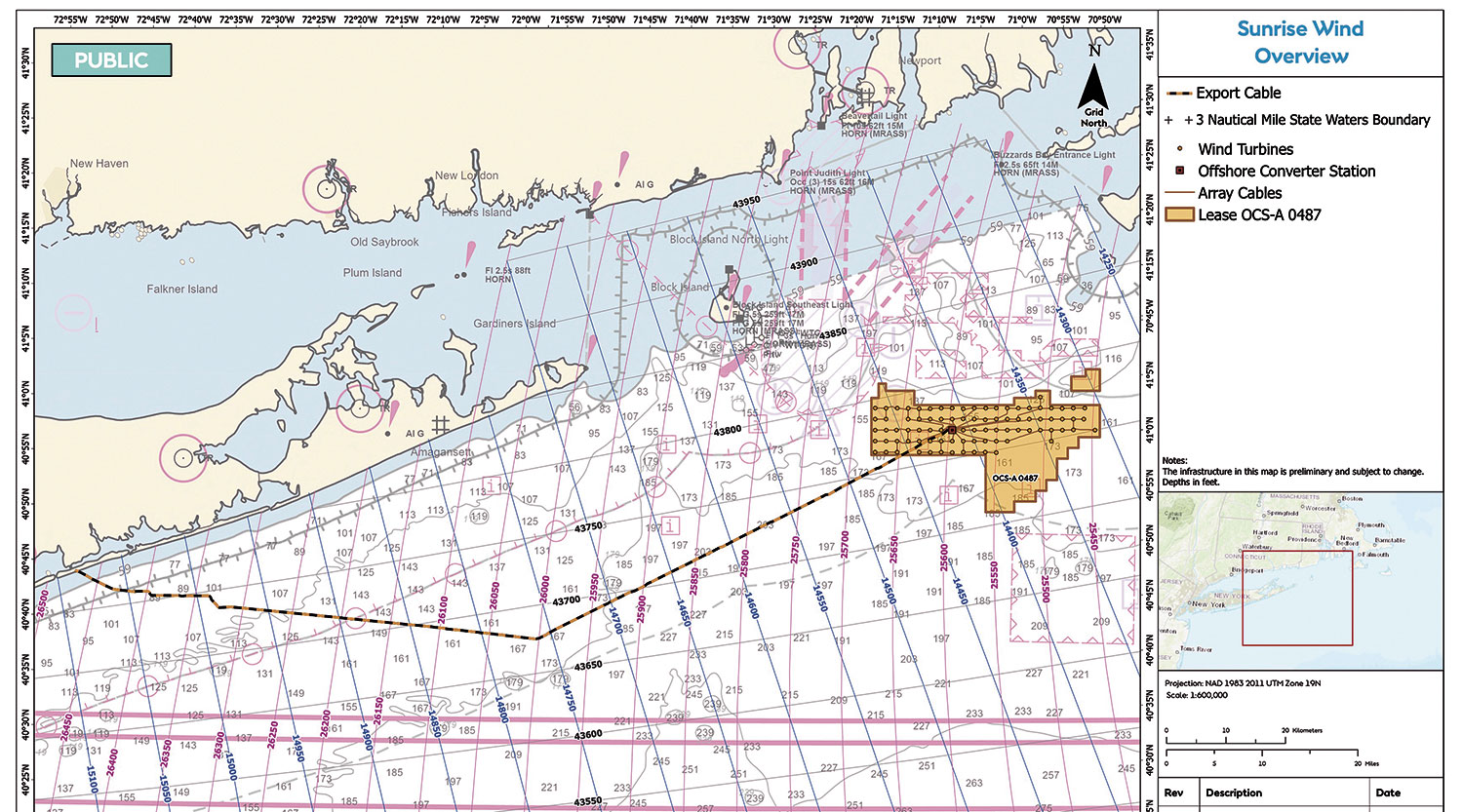
Gov. Kathy Hochul and the governors of Rhode Island, Connecticut, and Massachusetts have written to Secretary of the Interior Doug Burgum to demand rescission of the Trump administration’s Dec. 22 pause of leases for five wind farms under construction, including Sunrise Wind and Empire Wind off New York and Revolution Wind off Rhode Island and Connecticut.
In the latest round of on-again, off-again whiplash with respect to offshore wind, the Dec. 22 announcement escalates the president’s hostility to the renewable energy source, which he has criticized by citing multiple falsehoods. The latest rationale, according to the Interior Department, is that wind farms could interfere with radar systems.
The five wind farms “have already been subject to extensive federal review, including an assessment that expressly addressed national security considerations,” the governors wrote to Mr. Burgum on Dec. 24. “Neither the Department of the Interior [Bureau of Ocean Energy Management], nor any other federal agency, including the Department of Defense, informed our respective States of any purportedly new risk prior to these suspensions nor did they account for our States’ substantial reliance interests — our States’ economies are dependent on the power that these projects will generate — in these vital projects that already have undergone many federal approvals, including from the DoD. The absence of such notice undermines our ability to plan effectively and violates basic principles of cooperative federalism. The sudden emergence of a new ‘national security threat’ appears to be less a legitimate, rational finding of fact and more a pretextual excuse to justify a predetermined outcome consistent with the president’s frequently stated personal opposition to offshore wind.”
The governors argue that “true national security is energy security.” The federal government’s “irrational and erratic action” is in fact creating a national security and economic disaster, they wrote. The United States is in a race to dominate the industries of the future, they said. “You cannot run a 21st-century economy on a 20th-century grid. By blocking gigawatts of domestic clean energy, you are effectively throttling the U.S. economy and handing a strategic advantage to foreign rivals who are building power generation as fast as they can.” In 2024 alone, they note, China added new capacity equivalent to one-third of the entire United States power grid.
“You cannot claim to be building an energy independent nation while actively dismantling its capacity to generate power,” the governors wrote. “A grid that is overly reliant on fossil fuels is a soft target and has higher costs that our residents will be forced to carry. Offshore energy is already providing needed electricity at lower prices to our grid.”
The South Fork Wind farm, electricity from which makes landfall in Wainscott, remains the nation’s only commercial-scale wind farm in operation. The five-turbine Block Island Wind has been in operation since 2016.
The governors demanded a classified briefing “to review this supposed evidence and all information related to this purported rationale,” adding that “it strains credulity to believe that vital, substantial projects that underwent many federal reviews and processes, including by the DoD, all of a sudden present new, existential, unforeseen threats.” The federal government, including the Department of Defense, reviewed all information for offshore wind projects years ago, they wrote, and the military did not raise concerns or objections when it had the opportunity to do so, and moreover “certified there was no threat to national security. To claim a threat exists now, after billions of dollars have been invested in these projects and reviews fully completed, is the height of irrationality.”
Earlier in December, a federal judge struck down the president’s executive order, issued on the first day of his second administration, halting approvals of all wind power projects in federal waters. New York had led a coalition of 17 states in challenging the executive order, and the judge sided with them, stating that the federal government had not provided a reasoned explanation of its decision.
To date, the four governors who signed the Dec. 24 letter have not announced a legal challenge to the Interior Department’s Dec. 22 pause on wind farm construction, but they concluded their letter with a different kind of warning. “Do not be the administration that handed the future to our adversaries by turning off the power at home,” they wrote.
Orsted, the Danish energy company that developed the South Fork and Block Island wind farms and is developing the Revolution Wind and Sunrise Wind installations, issued a statement in response to the Interior Department’s pause on the leases for its wind farms under construction. It is complying with the order and “evaluating all options to resolve the matter expeditiously,” but notes that both Revolution Wind and Sunrise Wind are “in advanced stages of construction and will be ready to deliver reliable, affordable power to American homes in 2026, with Revolution Wind,” which is more than 80-percent complete, “expected to begin generating power in January.”
Both wind farms under construction secured all required federal and state permits, a requirement of which was that the developers “consulted closely and directly with the U.S. Department of Defense Military Aviation and Installation Assurance Siting Clearinghouse to evaluate and address potential impacts to national security and defense capabilities” from the wind farms, according to Orsted’s statement. The wind farms, it said, will power around one million residences across New York, Rhode Island, and Connecticut.
Equinor, a Norwegian energy company, is developing the Empire Wind farm, which is to power some 500,000 New York residences. Empire Wind “has coordinated closely with the federal officials on national security reviews since it executed its lease for the project in 2017, including with the Department of War,” read a Dec. 22 statement.
The project is more than 60-percent complete, Equinor said. “In total, dozens of vessels, around 1,000 people, and more than a hundred companies in the U.S. and globally have been working in coordination” on the wind farm. “The stop work order threatens the progress of these activities and without a swift resolution there may be significant impact to the project.”