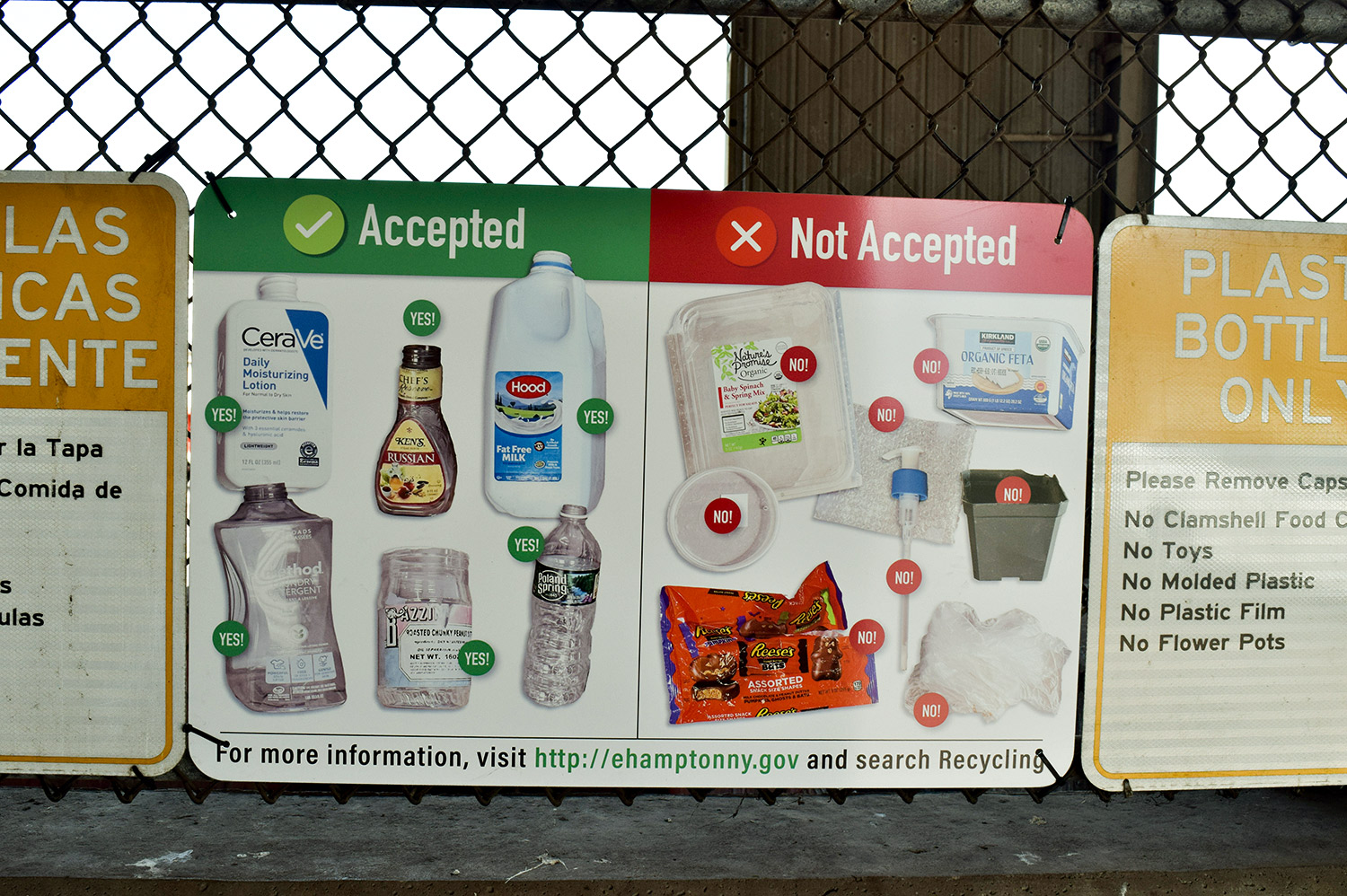
New signs offering visual depictions and greater specificity have been installed alongside text-only signs at the East Hampton recycling center on Springs-Fireplace Road.
At the same time, a new brochure on recycling is being distributed with new permits to use the center. The permits renew on April 1 each year and cost $115 for residents.
The signs depict what is and is not appropriate for a particular bin, each of which is designated for materials like paper, glass, plastic, and aluminum, as well as nonrecyclables.
“We wanted to educate,” said Lena Tabori of the town’s energy and sustainability committee. “We wanted to make some impact on the contamination.” Around half of the town’s residents have recycling permits, Ms. Tabori said. The remainder use private carting services.
The project began when Lauren Steinberg, then with the town’s Natural Resources Department, secured a grant. Ms. Tabori then worked on final designs with Kim Shaw, the department’s director, Samantha Klein, an environmental analyst in the department, Craig Fick, the recycling center’s crew leader, Susan Miller of the town’s Sanitation Department, and Mary Tiegreen, the art director for Climate Change Resources, Ms. Tabori’s nonprofit organization.
The mission was to educate. “Mainly, how do we help people care more,” Ms. Tabori said. “We believed that if people are already going to the trouble of coming to the recycle center, they want to do the right thing, and it is our job to give them the knowledge to do that as best they can.”
The town sells the corrugated cardboard and brown paper, mixed paper, dry newspapers, and tin and aluminum cans that are taken to the recycling center. The town pays for plastic bottles to be taken away and recycled, according to the new brochure.
At present, however, every bin has items in it that do not belong there, Ms. Tabori said. “Until now, there have only been ‘word’ signs at each bin and those are open to interpretation.” Pictorial signs “speak clearly and simply to what should and shouldn’t be in a bin. The cleaner the bins are, the more effective Craig’s group can be in getting the waste where it needs to go and in maximizing the money the town can get — which impacts on taxes, of course.”