
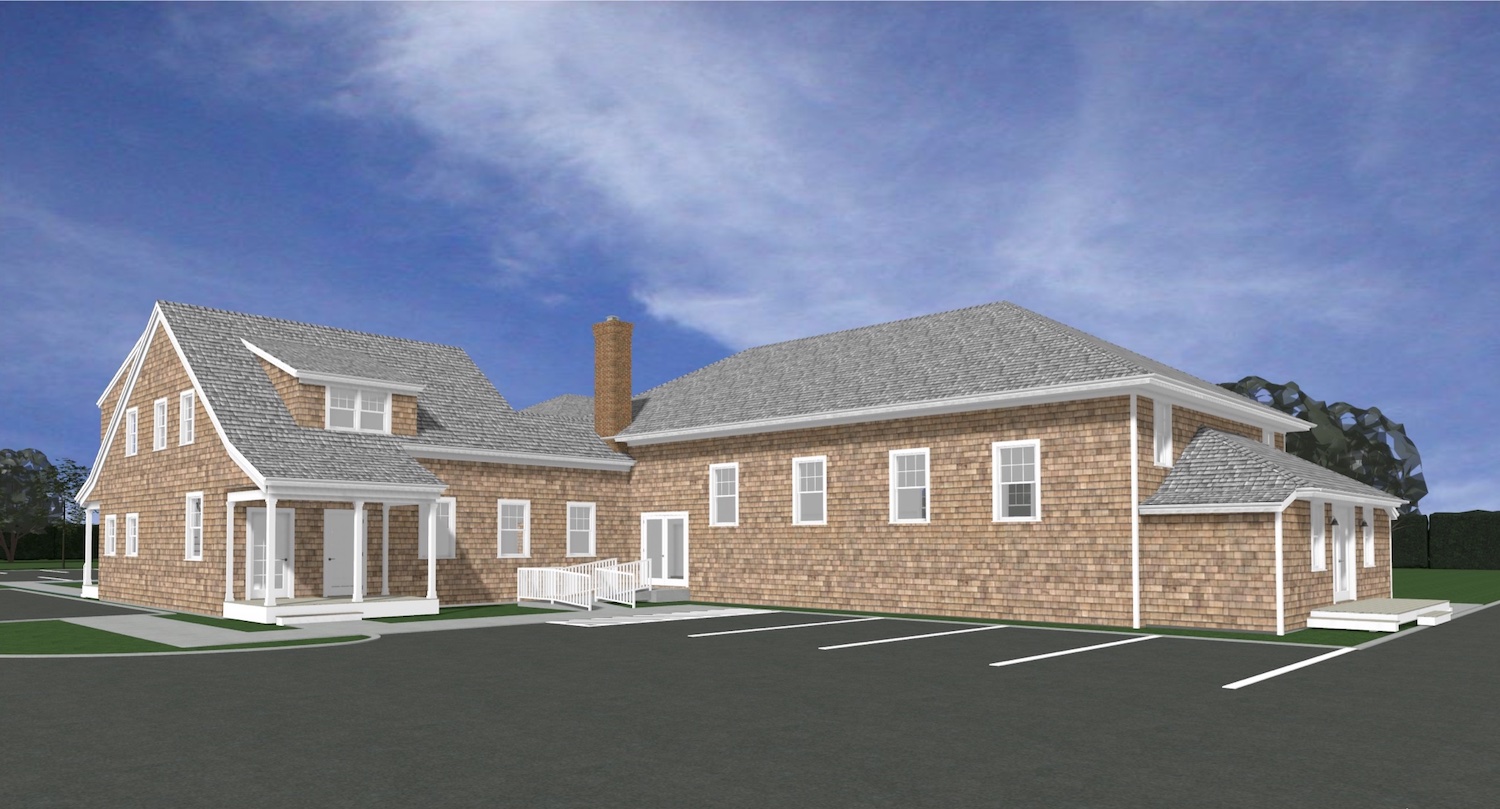
The East Hampton Town Planning Board reviewed and applauded a “substantially revised site plan” for Project Most’s headquarters that saves the historic Neighborhood House on Three Mile Harbor Road rather than demolishing it, as previously planned.
The board reviewed the plan at its Oct. 22 meeting.
The nonprofit Project Most provides after-school, summer, and community programming for children.
“We’ve been working really hard to listen to the board’s comments, listen to the community, and listen to the comments from S.H.P.O.,” said Tara Burke, a land planner, referring to the New York State Historic Preservation Office. “As a result, we’ve redesigned the project, with the primary goal of locating a new addition in a fully conforming location and preserving the existing structure.”
“The student population and employee numbers aren’t changing,” she added. “The use isn’t changing. The only thing that’s changing is the design of the building.”
Previous iterations of the plans, dating back to February 2023, were controversial with a portion of the Freetown community, who resisted a proposal to replace the historic structure with an anonymously donated Further Lane house.
“I was given a challenge with this initial go-round because my client had donated an old Francis Fleetwood house for the program and it just felt so out of character,” said Val Florio, the architect, who said he pushed for the preservation of the Neighborhood House. (Last winter, The Star reported that a portion of the Fleetwood house had to be demolished after it was exposed to the elements.)
Under Project Most’s current plan, the Neighborhood House “is going to be re-shingled and re-detailed,” continued Mr. Florio. “I have photographs from the historical society that show what it looked like in the 1800s.”
Sarah Lewis, a principal planner for the town, explained the project to the board. “The proposed work is now more compatible with the confirmed historic nature of the Neighborhood House,” she said.
According to her memo, the Freetown area is “a historically significant area where freed Black and Indigenous people settled centuries ago when they were unwelcome elsewhere. Prior to being known as the Neighborhood House, the structure was considered a settlement house, which were often known to re-educate poor or disadvantaged people. The historical significance, as both a longstanding community facility and part of a culturally important neighborhood, contributes to the complexity of any proposed changes to the site.”
The 4,232-square-foot first floor will receive a 2,284-square-foot expansion and contain a lobby, classrooms, a gym, multipurpose room, bathrooms, meeting spaces, and a commercial kitchen. The second floor, now 1,096 square feet, will grow by 1,567 square feet and contain a caretaker’s apartment, office spaces, upstairs foyer, and bathroom.
The total upstairs portion of the building will be 9,179 square feet.
A 6,591-square-foot basement will hold additional classrooms, bathrooms, storage, small music rooms, an art room, and a kiln room.
In the rear of the building, a new parking and drop-off area (there will be 22 spaces, including two handicapped spaces) will be built, as well as a new sport court.
“The parking is at the rear of the site and setbacks at the facility are compliant with the town code,” said Ms. Lewis. “These are all positive aspects of the project.”
In the summer of 2024, the state office of historic preservation said that no archaeological resources would be threatened by construction, but when it analyzed the site, it noted that the Neighborhood House was eligible for listing in the state and national registers of historic places.
Hence the revised plan.
Adding to the significance of the structure, the office noted that it had historically been used for nursery schools and children’s programs, including the Boy Scouts.
“I came on the board when this was still being discussed as a completely different project,” said Jennifer Fowkes, the vice chairwoman of the planning board. “I think that this is a great first step in the reinvention of this project.” “I’m just glad that this kind of change has taken place,” said Louis Cortese, one of the more outspoken board members. Still, he mentioned some concern about noise given the number of children who would use the facility and
questioned the size of the additions. “For the size of the building, it’s really because of all the different activities and the classes that we anticipate and provide for the children,” said Rebecca Morgan Taylor, the executive director of Project Most. She said there were tutorial programs, music and art, and STEM classes. “There’s a multipurpose space and a stage where numerous plays and performances have taken place.”
“It’s important to note that this has been a community center since the 1950s,” said Ms. Burke. “It hasn’t been active recently but historically has been a center of a lot of activity within our community.” Most of the noise-intensive activities, like the music classes, would occur in the basement of the house. The second story is largely for administrative use.
“There’s parents who’ve got to work two jobs,” said Mr. Florio. “These are essential workers. I deem them Project Most. It has heart for me. I put effort into this because I’d like to see children benefit but also respect the community.”
Given the substantial changes to the application, the planning board agreed to re-establish lead agency status to coordinate review. The building will also be in front of the architectural review board and eventually, once the application is complete, there will be a public hearing on the project.