
How does music affect lettuce growth?
How can athletes mitigate concussions in the game of football?
Can networks of fungi be used as a sustainable building material?
How do genetic alterations affect leukemia treatment?
Can glycerol monolaurate and petrolatum help eliminate staphylococci in atopic dermatitis?
What effects do storms have on ocean wave dynamics along the East Coast?
Those were just some of the questions presented at East Hampton High School’s annual Science Research Symposium last Thursday, when 25 seniors shared their findings from three years of scientific research under the guidance of mentors in their chosen field. Afterward, the community was invited to the cafeteria, where all of the students in the program from 10th through 12th grades shared posters detailing their work.
“To say I was proud of these 87 students and the symposium that they put on for our community would only scratch the surface,” said Stephanie Forsberg. She and Paul Rabito are the science research teachers who oversee the three-year program, along with Renee McGuire, the department coordinator. “I felt that they communicated their research and passion for this program at a professional level, and to me, that is one of the greatest skills that will follow them in any career path,” Dr. Forsberg said.
“Communication and passion for what you do is something that will help these students no matter where their lives take them. I am most grateful to our community members for coming out to support these students each year and giving them the opportunity to communicate and share their passion for science.”
The students’ work was mind-blowing, to say the least, with several parents and guests commenting that they could hardly keep up with all of the big words and brilliant ideas on display. Thankfully, several of the seniors were happy to explain them in the simplest terms.
Owen Browne studied how different types of music affect lettuce growth rate in a controlled environment, looking at whether the plants preferred silence, pop music, or rock-and-roll. Turns out, lettuce loves Katy Perry. “I wasn’t surprised because everyone loves Katy Perry, so why wouldn’t the plants?” he said, smiling. Next year, Owen will join the honors program at Eastern Connecticut State University on a full scholarship, thanks in large part to the work he did in this program. “Being able to write and research at a college level really helped me get into Eastern Connecticut State University,” he said. “I met with the head of the honors program and he told me that my application really stood out because I already had an introduction into a college-level of writing.”
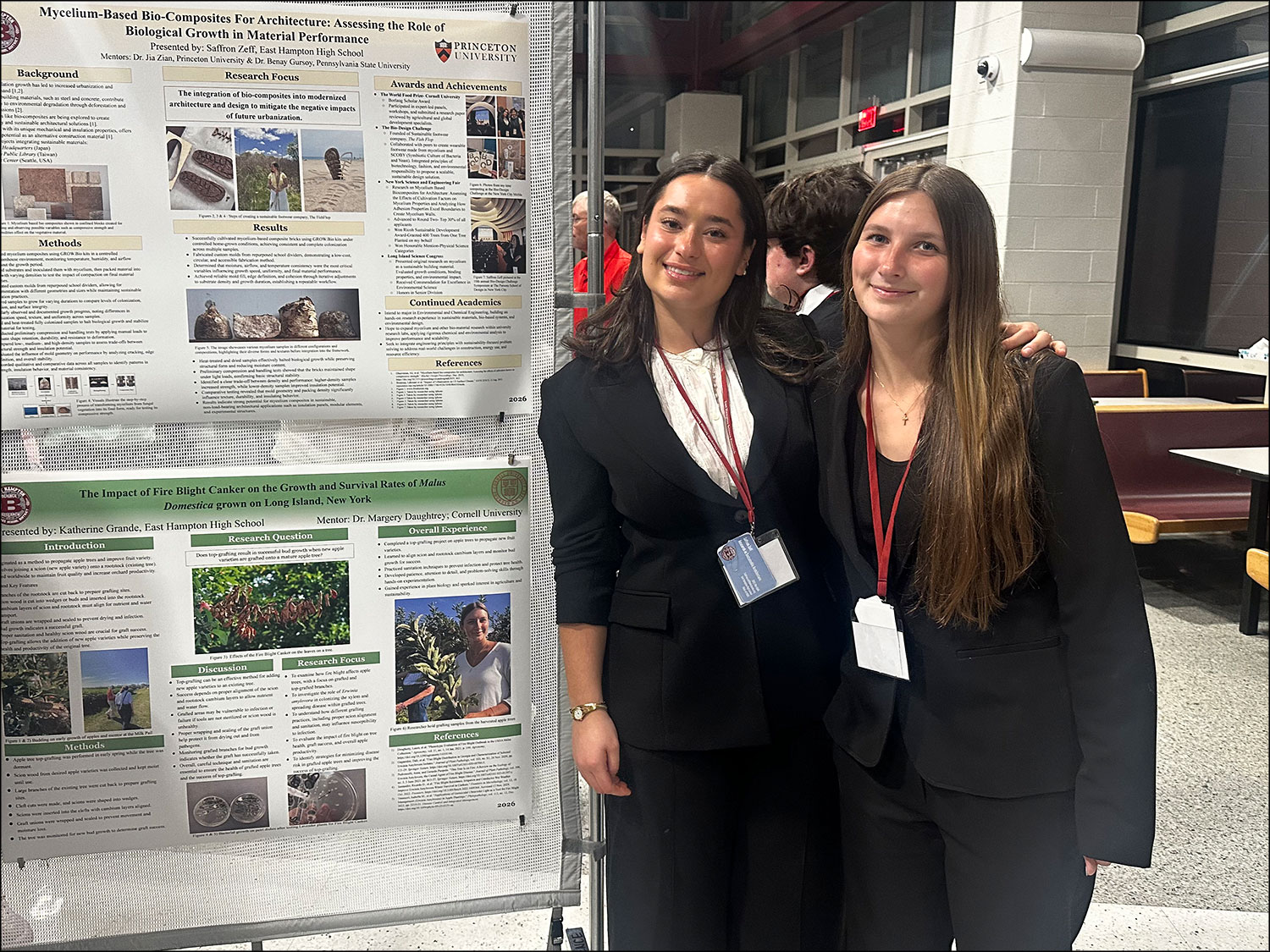
Sticking with agriculture, Katherine Grande explored how blight canker spreads and impacts apple trees. The bad news for fruit lovers: the Honeycrisp, a fan favorite, is most susceptible to canker. “Their root stock is most affected because they’re just the weakest kind of apple to grow,” she explained. The good news? You apple pies won’t suffer. “It does not affect the taste because an apple won’t grow if it is infected with canker. The ones that you’re eating are perfectly fine and you are okay.”
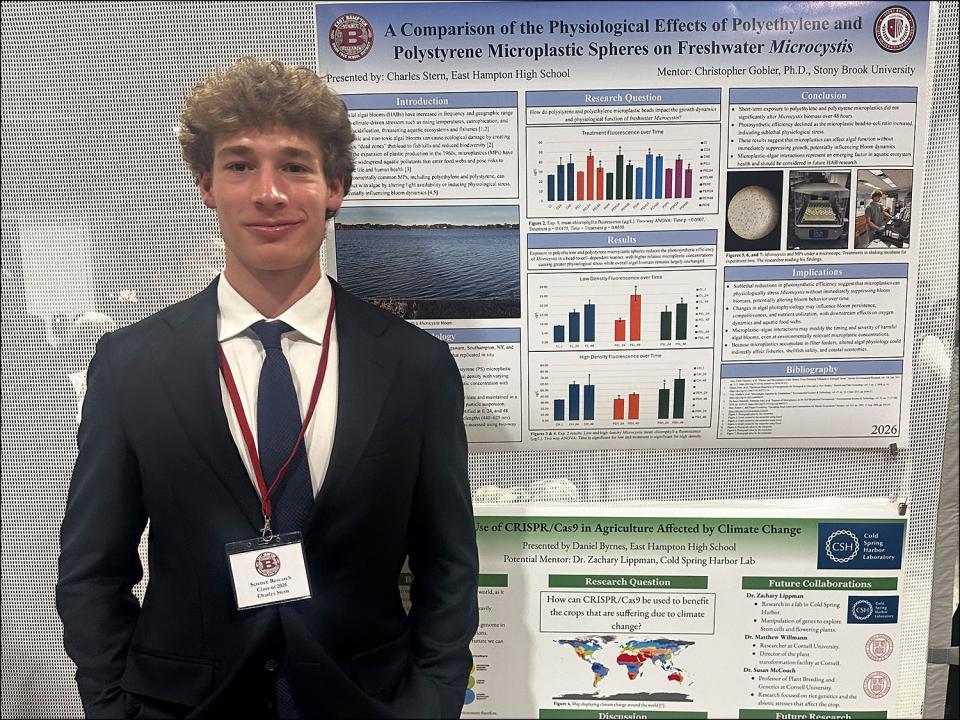
Charlie Stern, the salutatorian of the class of 2026, studied the effects of microplastics on the blue-green algae responsible for harmful algal blooms. “I think one of the most important things that I’ve learned throughout science research is how to manage my time and how to choose a grand goal and then work towards it. It teaches you how to problem-solve, which is multidisciplinary. It spans business, science, athletics,” he said. “I’m actually playing sprint football in college. I’m going to the Wharton School of Business at UPenn.”
Caleb Buestan looked at how being bilingual can affect the structure of the brain, particularly the corpus callosum which helps in communication between both cerebral hemispheres. He’ll be studying neuroscience at the University of Rochester next year and credits the science research program with helping him discover what he hopes will be his life’s work. “I learned how to communicate with a professional in the field and I learned multiple skills that helped me grow as a person and as a student. I’m really grateful because I found a love for it and it’s what I want to do in the future. Research is what I love and till I retire, I know this is what I want to do. I want to be a doctor, but I want to continue my research no matter what. I would love to explore Alzheimer’s and dementia.”
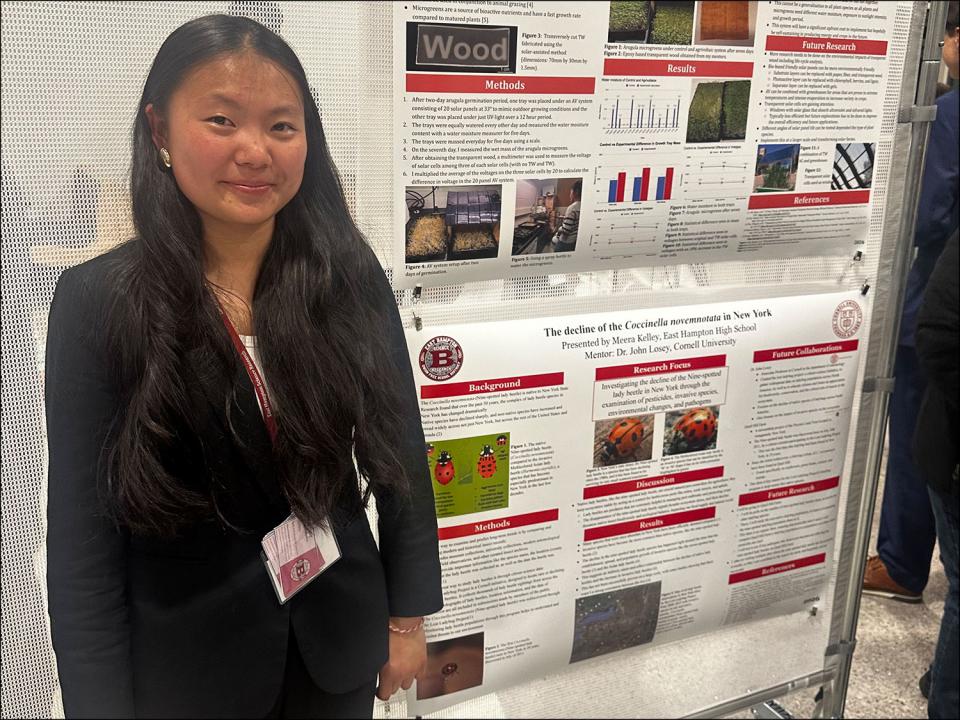
Shirley Jiang worked with Dr. Sheldon Shi and Dr. Xuan at the University of North Texas to combine transparent wood with solar cells to grow arugula microgreens more efficiently.
“Basically I found a way to make wood transparent. Well, my mentors did. It is boiled in a lot of chemicals until it turns completely white and then it’s infiltrated by a resin to make it clear,” she explained. “Then I put it on top of solar cells, which increases the amount of energy the solar cell can produce from the same amount of sunlight. Having the plants under the solar cells allows the plants to reserve more energy for growing, instead of fighting off extra evaporation.”
Thanks to her last name, Saffron Zeff was the last student to present her research, but certainly not the least. She explored whether mycelium, root-like networks of fungi, are a potential sustainable building material, and even created a flip-flop from the bio-based material. Part scientist and part philosopher, she imparted some wisdom to any students considering the science research program.
“I’m going to study the same topic in college next year, so if I were to say anything to a generation coming up that would also be interested in this, it would be: ‘Go out of your comfort zone. Do something that you don’t always think you’re going to do because, in the end, everything happens for a reason and it leads you in the right direction, like it did for me.’ ”