
Big things are on tap in several South Fork school districts in 2026. From capital improvements to bond referendums, here’s a look at the year ahead.
East Hampton
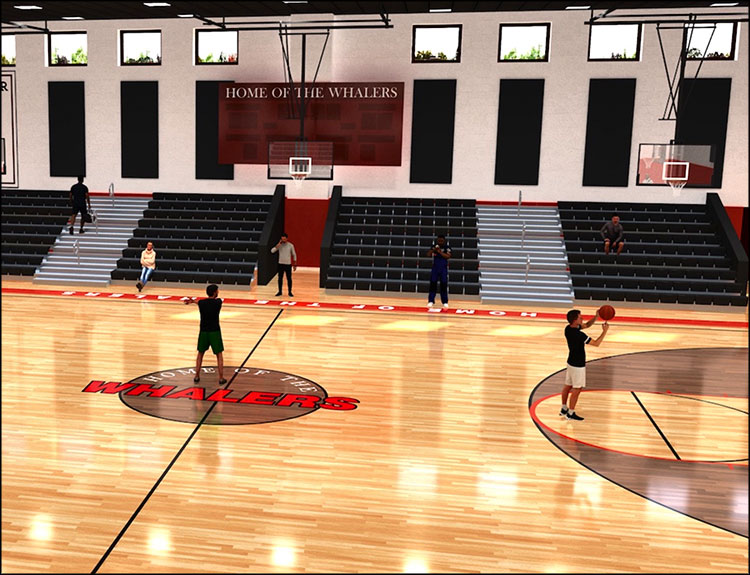
Last month, East Hampton’s school board unanimously approved adding three sets of capital construction projects to the May 19 ballot.
Proposition One includes $63.9 million in upgrades to all three district schools: East Hampton High School, East Hampton Middle School, and the John M. Marshall Elementary School.
If it passes, the proposition is expected to have no impact on taxpayers. It will be paid for with $64 million in new debt issued between 2028 and 2030.
The proposition covers essential upgrades or “needs” along with some additional “wants” at each of the schools. The high school’s needs list totals $20.96 million and includes $14 million for the auditorium, a $3.82 million roof, outdoor bathrooms at a cost of $1.4 million, $1 million in security upgrades, $540,000 in track resurfacing, and a $200,000 concession trailer. The high school “wants” list totals $13.9 million and includes $3.86 million in mechanical upgrades, a $2.43 million cosmetology lab, $2.3 million for a turf field and bleachers, $1.8 million for tennis courts, a $1.5 million jogging track around the property, $1.38 million for stadium lights, $408,000 for baseball bleachers, $180,000 for new scoreboards, and a $50,000 pollinator garden.
The middle school list of needs totals roughly $9.14 million and includes $3.94 million in new windows, $1.68 million in mechanical repairs, $1.08 million for the HVAC systems, $1 million in security upgrades, a $583,800 roof, $420,000 in masonry, $342,000 for a new fire escape enclosure, and $95,000 for stairway glass. The middle school wants list totals $6.45 million, and covers $5 million for the auditorium, a $516,000 life skills classroom, a $510,000 science lab, and a $420,000 English as a new language classroom.
The elementary school has $8.5 million in needs. Hallway flooring is the biggest item at $1.87 million, followed by $1.77 million for a new roof, $1.67 million in upper window panels for the gym, $1 million for classroom bathrooms, $1 million in security upgrades, $800,000 in mechanical repairs, a $250,000 sound system for the gym (which also serves as the auditorium), and $150,000 in masonry repairs. The wants list has four items totaling just over $5 million: $4.5 million worth of new multipurpose classrooms that include music and sensory needs, a new $300,000 gym floor, a $125,000 kitchen, and an $80,000 gym stage.
Proposition Two will ask voters to approve $43.68 million for a new indoor pool building at the high school. It would cost the average taxpayer $194.37 a year.
Proposition Three would allocate $18.54 million for an indoor athletic facility, which will cost the average taxpayer $82.53 per year. Of the taxpayers surveyed about the upcoming bond project, 56.8 percent said they were interested in the new pool building and indoor athletic facility.
Proposition One must pass for Propositions Two and Three to be approved.
There are several key dates before the bond vote on May 19. On Jan. 20, the school board will see the final project presentation. The board has until Feb. 2 to make any adjustments to the projects. March 3 is the deadline for the board to adopt the State Environmental Quality Review Act and ballot proposition language. Additional community forums and bond-specific meetings will be added to the calendar as the vote approaches.
Montauk
In its second iteration, Montauk’s bond referendum passed last month with overwhelming support from voters. A slightly more expensive version of the 20-year, $34.8 million bond narrowly failed in May of 2025.
More than $33 million of the bond will cover crucial upgrades to the 98-year-old Montauk School — including building a new science lab, improving Americans With Disabilities Act accessibility, and adding adult bathrooms. The bond will cost the average Montauk homeowner with a $1.5 million house just over $31 a month, or roughly $379 a year.
It allocates $1.8 million to rebuild the dilapidated Fisher house on South Dewitt. Robert Fisher, a former district superintendent, and his wife donated the property as superintendent housing. It will be rebuilt as a three-bedroom, three-bathroom ranch with storage space in the basement for district use. The basement was a hotly contested issue ahead of the vote, especially among a group of South Dewitt residents. The board has said it will work with them to reach an agreement on an acceptable design for the basement before construction begins.
The construction document review process is currently underway and will wrap up in June. Between July and September of 2026, the project will be submitted for New York State Education Department approval and third-party review. The bidding and awarding process for the work is scheduled for October and November of 2026. The goal is to begin pre-construction in December of 2026. If all goes according to plan, full construction would start in the summer of 2027 and wrap up by the start of the 2028 school year. There could be some additional site work through the summer of 2029.
A second, separate ballot item — using $2.9 million in capital savings — also passed with little opposition and will not raise taxes. It’s money the district has already set aside but needed voter approval to spend. Those funds will correct urgent infrastructure issues such as heating, ventilation, and air-conditioning upgrades, boiler leaks, CO2 detectors, and A.D.A. accessibility. That work will begin immediately.
Sag Harbor
The Sag Harbor School District has a bond referendum on Jan. 22. The final community forum on the project will be on Wednesday at 6:30 p.m. at Pierson High School. The forum will include a review of the projects in the proposal and a tour of the areas of the high school most in need of improvement. Attendees will be able to ask questions and provide feedback.
The 30-year, $40 million bond, also known as the Pierson Capital Improvement Project, includes upgrades to the high school gym, fitness and wellness center, technology and woodshop room, robotics lab, and Red Cross shelter. It also adds a new marine science lab, a third music room, and a recording and streaming studio. A taxpayer with a home assessed at $1 million would pay $151.32 per year, or $12.61 per month.
“This bond plan has been designed to support the continued excellence of our academic programs and represents an investment in our students today and in the future,” Jeff Nichols, the superintendent, said. “Community input and engagement have always been a bedrock of our community and our school district. We encourage all Sag Harbor residents to join us at this forum and, most important, to come out and vote on Jan. 22.”
Springs
In November, the Springs School Board approved using just over $1.5 million from its more than $4 million repair reserve fund for five exterior projects. The fund is a savings account voters approved in May 2025. The repair work will have no additional impact on taxpayers.
The district will use $540,000 to fix aging exterior steps, railings, walkways, and curbs at the school and $405,000 to renovate the exterior fascia and cupola (both have rotting wood). The playground will receive $251,485 in new safety surfacing. Artificial turf will replace thinning wood chips, making the entire surface of the playground wheelchair accessible. Deteriorating exterior paint and stucco will be repaired and repainted at a cost of $216,000. The district will also spend $129,600 to replace fencing that is rusted, bent, entangled in nearby trees, and in need of several new gates.