
East Enders in search of a cultural experience, look no further than the Ross School’s senior projects. Laid out across the school’s campus, these student presentations feel more like an exhibit at the Fondation Louis Vuitton in Paris than a high school showcase. They include everything from photographic series to fashion design, car restoration, novels, and even a walking table, all the more impressive having come from teenagers,
“The senior project has been a part of the school from the beginning,” said Tom Sturtevant, the head of school. “It’s a culminating experience for our students academically. The idea is that their passions and their interests and their academic capacity and skills all feed into a passion project that they pursue on a very serious level, working with faculty mentors. It’s like a pivot point in their lives.”
The project begins in 11th grade. “Students submit a preliminary proposal in the spring of their junior year, and this is a proposal for a six-to-eight-month project,” explained Louisa Garry, the school’s director of senior projects. “They start their research, they start exploring and brainstorming over the summer. Some of them actually do a bulk of the work in the summer and then when they return in the fall they launch their formal proposal, which includes a description, the rationale, relevance, and the goals of the project. Then they document the process the whole way. They ultimately have a grade for the process, a grade for the product, and then they have presentations which come up [this] week.”
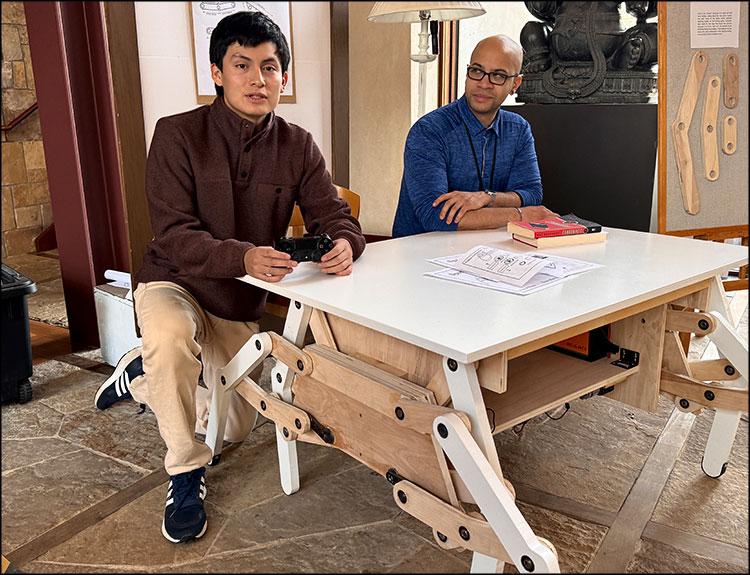
Bryan Chuya’s “The Spider-Table” greets visitors in the entrance hall of Ross’ Senior Thesis Building. Bryan worked with Kieran Ryan, who runs the school’s innovation lab, on a movable table that can be rearranged without any human effort. He was inspired by his grandmother.
“She wanted to rearrange furniture in her house, but because she doesn’t have the physical strength to do it anymore, she was having a lot of difficulty,” Bryan explained. “So, in the face of this problem, I looked back at my old love for mechanical walkers in some old Lego videos that I used to watch and they would have these contraptions that would allow full-on robots to move around with a leg-walking motion. I decided to make a table that uses the same mechanism that the Lego walkers did.”
Bryan designed a fully-functioning model in the innovation lab using 3-D software on the computer. He cut the pieces in the woodworking shop, then used his dad’s larger workshop at Tri-R Services, and even went to his home country of Ecuador to use a plasma cutter to create a solid metal piece that he welded together to connect all of the other components and enable their rotation. While he was demonstrating how the table works, a leg broke. No problem. Bryan had spares and fixed it on the spot.
“We try to provide a space that prepares for the necessary failures in order to make something better,” Mr. Ryan, his mentor, said. “You can’t have improvement if you don’t break a few things in the process and thankfully Bryan is somebody who’s always prepared for things to break.”
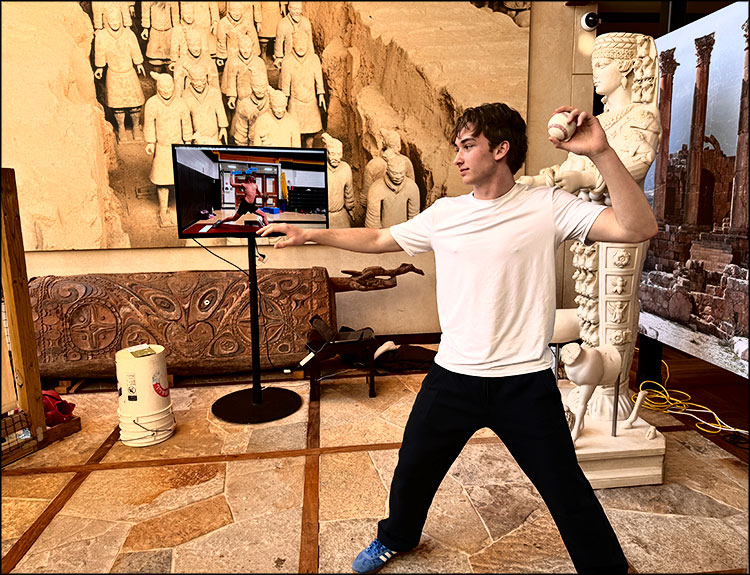
Just beyond “The Spider-Table,” Tate Foard, a baseball player, created PitchVision, a pitching practice system that uses motion-tracking technology and automated ball-throwing return, so pitchers can practice on their own. Its two-camera setup provides mechanics analysis to help players improve their form and prevent injury.
“When I was a kid I wanted to be outside all the time throwing with my mom and dad and they didn’t always want to be out there throwing with me, so I created this system which allows pitchers to train by themselves,” Tate said. “You throw the ball into that net, it knocks it down into a track, and the machine throws it back.
His motion-tracking technology works with any type of video to tell pitchers what they’re doing right and wrong. It’s the kind of thing major league teams employ an entire staff to do.
“Pitchers in elite and amateur settings have really increased injury rates in recent years and I found that one of the big things is that pitchers are focusing on the velocity of their pitches rather than their mechanics,” he explained. “Professional pitchers are coming to the league at 21, 22 years old, throwing incredible 100-plus-mile-per-hour stuff and then they’re getting injured.” An Atlanta Braves fan, Tate would love to see Spencer Strider or Chris Sale use his product.
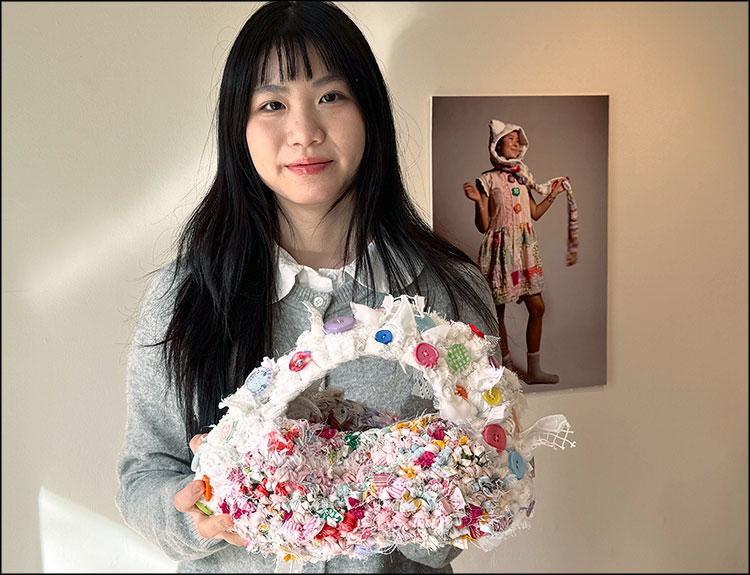
Anh Nguyen combined her love of fashion with her crocheting and sewing skills to create “Threaded Renewal: Sewing and Crocheting With Recycled Finds,” a collection of eight to 10 mixed-media fashion pieces inspired by 10 concept drawings, modeled by her fellow classmates. Anh was inspired by the 2000s fashion brand Blugirl and would love to work with a major designer like Miuccia Prada. She hopes to attend Parsons School of Design after graduation.
“My inspiration for this project comes from my personal experience of growing up in a judgemental environment where my appearance and self-expression were always criticized. Fashion became my way to resist and rediscover myself,” Anh said.
Michael Coppola also channeled personal challenges into his project, “A Journey of Self-Discovery Through Music,” a self-curated musical performance that weaves together different genres and styles in three sections: discovery, transformation, and enlightenment.
“My project is an eight-song performance that outlines how music has shaped me as a human being,” he explained. “The first piece starts when I was a kid and as the performance progresses, it ends in a song that I’m currently working on.”
Hunter Dec’s project, “The Bonds of Relationships Through Damascus,” uses science and technology to show how the chemical compounds of two metals bonding — in this case, to make Damascus steel — relate to humans forming a deeper connection.
“I basically made three products. Two are hammers, one is a mini crowbar,” Hunter said. “It’s about finding the right properties in a metal and making sure they bond in certain circumstances, whether your welds are right. If they’re clean. That’s what I look for in a relationship.”
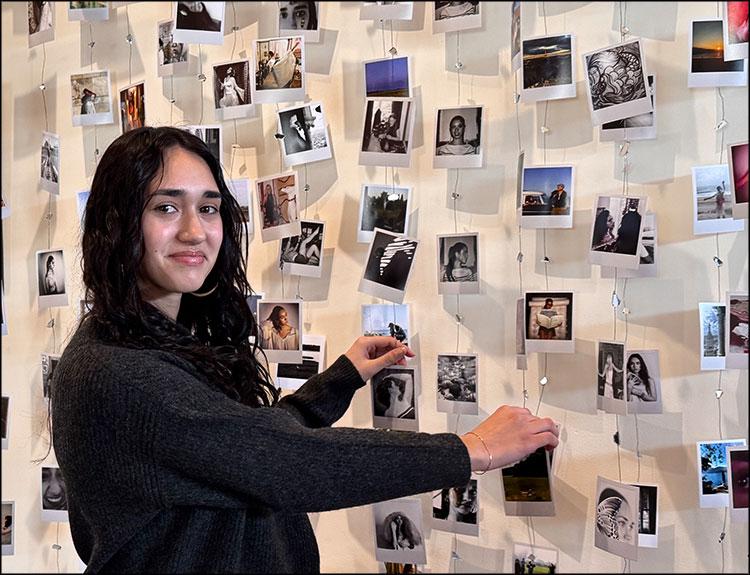
Sasha Dutrieux created a stunning photographic series of polaroids strung from rods, called “Two Versions of Me,” which shares her personal experiences in different places and moments, while encouraging viewers to connect her stories with their own.
“I started by shooting on a Canon camera and then I put the images into a polaroid photo in Photoshop and I edited each photo individually,” Sasha explained. “I added the broken glass and mirrors because I wanted people to reflect on it within themselves, to think about how it made them feel.”
Coco Bovio also created a photographic series. Called “Where Life and Death Meet,” it was shot in New Orleans during the Day of the Dead. The images are so stunning that a Tulane University faculty member visited the shoot and Coco was accepted to Tulane the next day.
The list of incredible projects goes on and on, from Jordan Blake’s transformation of a 2004 Lexus SC430 to Gabriel Kaczmarek’s cookbook “Cast Off Cuisine” and Victoria Dupree’s psychologically-themed children’s coloring book “The Art of Growing Up.” They are a true testament to the power of what young people can do when they are creatively challenged and supported.
“The school really encourages creative, original, inventive thinking,” Ms. Garry said. “This is the capstone project. It’s supported by the entire faculty, who believe in helping kids see the best in themselves and become the best of whatever they’re hoping to be. I think this is the best of Ross in so many ways.”