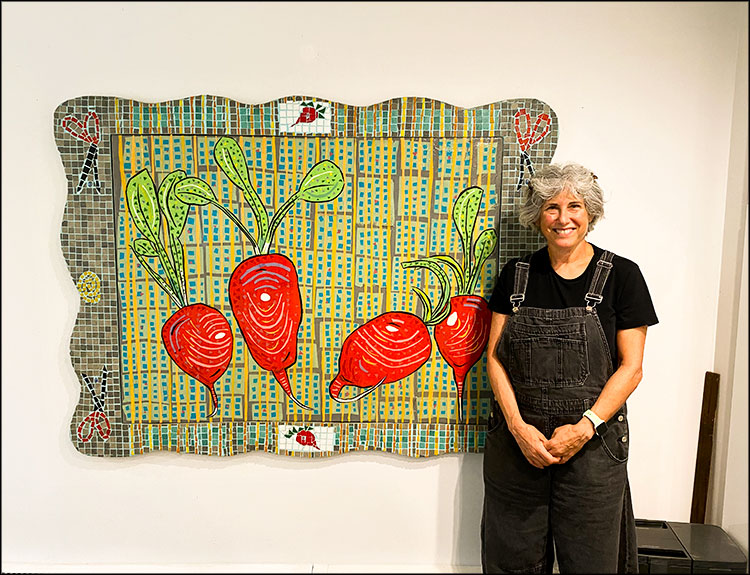
Like most artists, Marcie Honerkamp was making art from as far back as she can remember, but she was 16 when she got serious, she said during a conversation at her East Hampton studio. One important reason was her aunt, Adrienne Mim. “She’s a sculptor, and she was my idol.”
Mim, who is still alive at 95, has exhibited widely in museums, galleries, and public art venues and had three residencies at the prestigious MacDowell Colony in Peterborough, N.H., during the 1970s.
When Honerkamp first came out to live in East Hampton in 1983, she stayed in her aunt’s house on Skimhampton Road. Mim’s partner at the time, Roger Wilcox, had a 15-acre property off Abraham’s Path that he had purchased in the 1940s and subsequently opened as a sculpture park. Wilcox knew Willem de Kooning and Jackson Pollock, among others, so art was in the air in that “little house” when Honerkamp was in her early 20s.
But she was still in her teens when she enrolled at the Parsons School of Design in 1978. “I knew I wanted to be an artist, but I didn’t know what to do. Painting was what I mostly did until about 1998.”
Honerkamp showed a visitor one of the last paintings she created during the 1990s. “They are basically paint collages. I would take paint and paint it on plastic sheets, then peel it off and cut it and collage it on the canvas.” With hindsight, that technique foretold her dramatic shift from painting to mosaic, which happened in 1998.
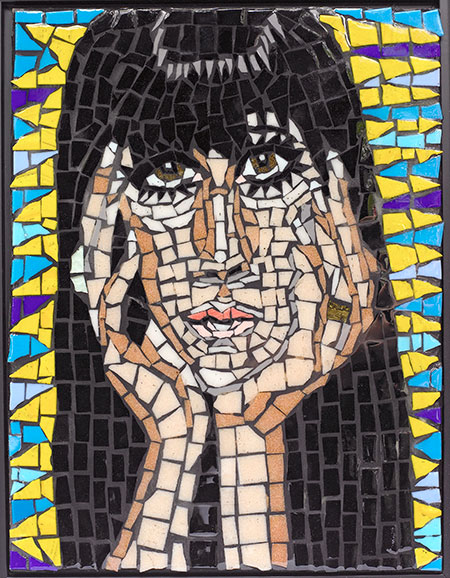
The transition began with her making mosaic frames for her paintings and soon led to an astounding variety of mosaic works, both individual pieces and installations. Among these are surfboards, table tops, guitars, album covers, Pop portraits, fish, a pig, skulls, a giant shoe, murals, tabletop swimming pools, and Lazy Susans. And that does not exhaust her subjects.
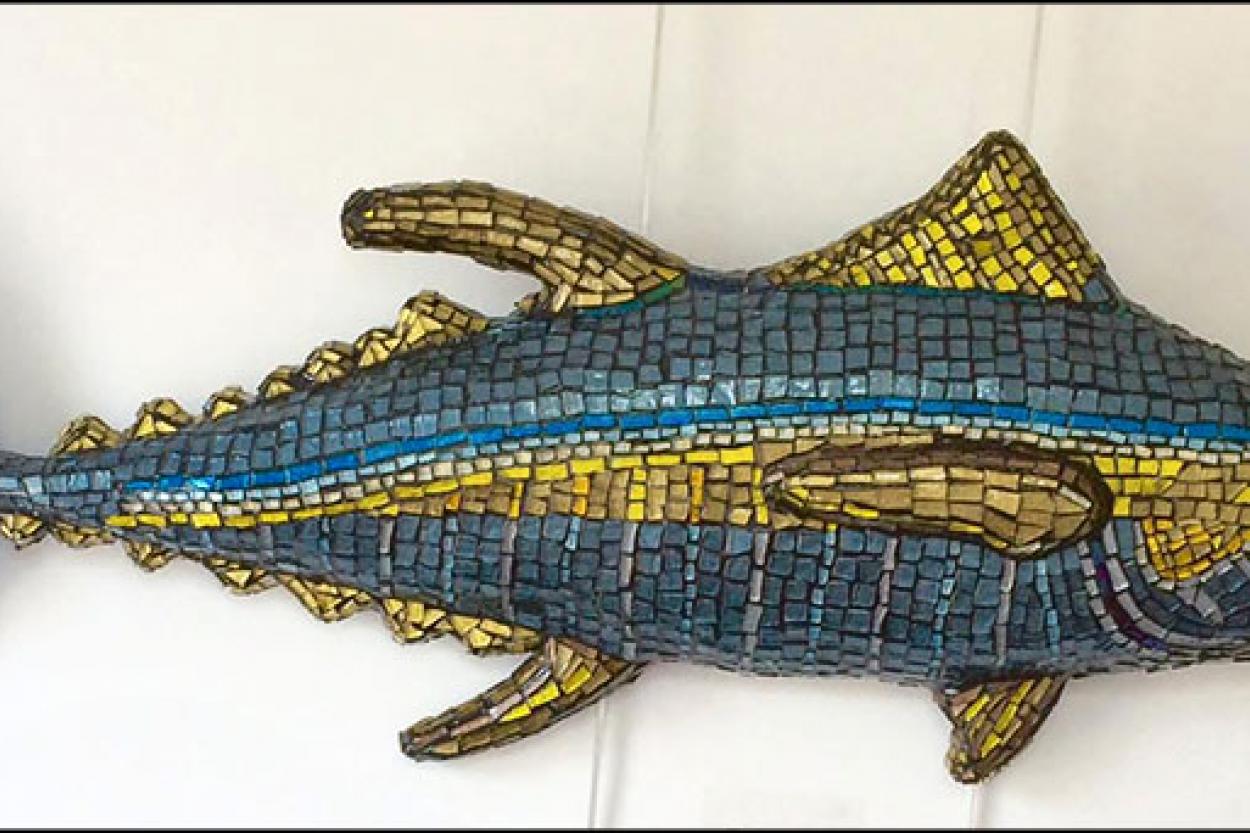
Her swimming pools, a surfboard, and a yellowfin tuna were shown last month at the Women’s Art Center of the Hamptons, and a selection of Lazy Susans were included in a furniture and fine art exhibition at Ashawagh Hall last month. As for the guitars and album covers, the former can’t be played and the latter do not hold records. However, many of the album covers can be seen at the Stephen Talkhouse in Amagansett, where she also created a large mosaic mural, but more on that storied venue later.
She made her first swimming pool for the East End Hospice Box Art Auction a few years ago, and many more have followed. The walls of the pools are finished with mosaic work, and each contains miniature swimmers that she ordered online. “I used to do synchronized swimming, but I couldn’t find any synchronized swimmers so I decided to make my own out of polymer clay. It’s hard making little things.”
Honerkamp taught herself the art of mosaics, though she admitted to taking a class at a mosaic conference on how to make sculpture for mosaics. Other than that it was trial and error. “I just experimented,” she said. “I’m not afraid. If you mess up, you mess up, but you learn.”
She starts with a sketch, which she likened to a cartoon. “I just do an outline. If I’m working from a photograph I just sort of paint with the tiles and figure out what goes where as I’m working. I don’t usually plan out a piece. I do it by intuition.”
The one class Honerkamp took introduced her to the use of Styrofoam as an underlying surface to keep the weight of the piece manageable. She pointed out that surfboards are basically foam. “I don’t make the surfboards. People give me surfboards.” While she is a serious swimmer, she doesn’t surf.
It began when a woman saw her tables at Michael’s restaurant in Springs, which was owned at the time by a boyfriend. “She came up to me and said, ‘Why don’t you make surfboards?’ A friend had a surfboard he couldn’t use so he gave it to me. That was the first.”
People often ask her if you can surf on her mosaic-encrusted boards. (She finishes both sides.) She tells them she thinks they would sink. Picking up a yellowfin tuna on her coffee table, she pointed out the Styrofoam, beneath which she affixed plywood. She said that the noted English mosaic artist Gary Drostle even uses Styrofoam as the base for his monumental public sculptures.
Honerkamp carves the Styrofoam with a hot knife, creating the basic form, then uses a wire brush to shave it, which makes snow everywhere. “It’s kind of a nasty process.” While she was given dozens of boxes of little tiles from someone whose parents were mosaic artists in the 1950s, she also cuts tiles herself and affixes them with Weldbond adhesive if the piece will remain indoors. For outdoor installations, one of which can be seen on the facade of her house, she usually uses silicone. She also has a mosaic mural at the Springs School.
There are two processes for tiling. The direct method involves placing the tiles directly on the surface. One indirect method is to tile on mesh to create a larger piece, the kind often used on bathroom floors.
A more complicated indirect method involves preparing the design in reverse, as a mirror image, on a piece of Kraft brown paper. The tiles are glued face down on the paper over the reversed drawing with water-soluble glue. Then a layer of mortar or cement is placed on a backing board or installation site, the tiled section is flipped and pressed into the wet mortar bed. Dampening the paper backing with a wet sponge dissolves the water-soluble glue.
In 1984, a year after moving to East Hampton, she met Peter Honerkamp. Three years later they married and bought the Stephen Talkhouse from Buddy Pontick and his partners. Actually it was Peter who bought it along with Marcie’s father, her aunt, and another friend. Her father and aunt are still partners, and her half-brothers and children both work there, as does Marcie, who has been the bookkeeper since 2007.
“At the beginning, we didn’t know what we were doing at all. We just said, ‘Let’s buy a bar, yay!’ We didn’t close during the winter, but in the early years we were always wondering how we would be able to get through it. We own the building, but had we not I don’t think we could have continued.”
While she and Peter divorced in 1996, they are still close. “Peter actually saved me because doing the whole Talkhouse thing gave me a lot of confidence and he was very supportive. We have a great friendship. It changed my life.”