Driving west from the Montauk Lighthouse, coming downhill as you approach Deep Hollow Ranch on your right, something astounding, almost mirage-like, rises into view on your left: a pile of shipping containers, seemingly, unaccountably dumped into the landscape.
Across from Deep Hollow is a dirt driveway. It will behoove you to follow it until you come to a wooden gate, the entrance to The Ranch, the property of Max Levai that for six years has been a showcase for venturesome and often dramatic artwork. Levai, the former president of Marlborough Gallery and more recently his eponymous gallery on Lispenard Street in TriBeCa, knows his way around art and the art world.
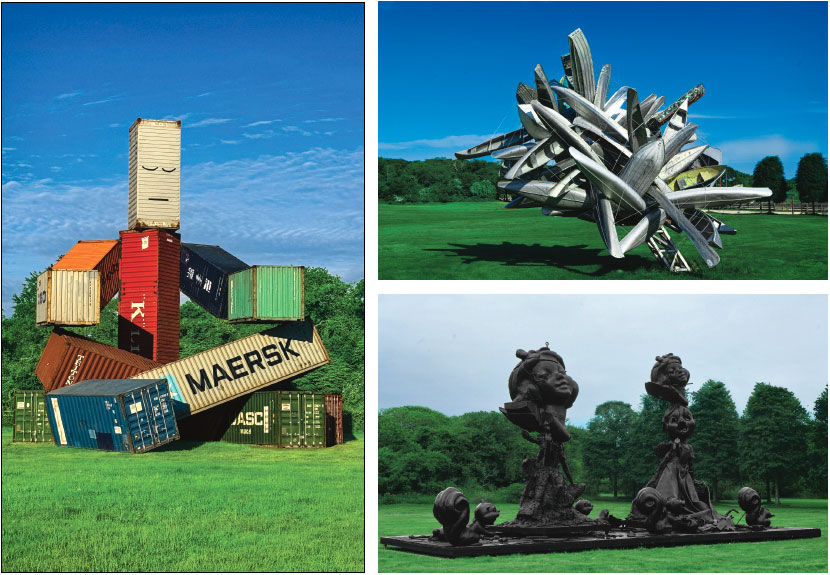
The 12 decommissioned shipping containers? It’s “Meditating Figure” (2026), a sculpture by Matt Johnson that is one of three works — the others are by Nancy Rubins and Paul McCarthy — that constitute The Ranch’s 2026 exhibition, “LA Monumental.” And speaking of Rubins, she has another show, “Drawing and Sculpture,” in the venue’s West Barn, a renovated horse stable.
“We do one big show of outdoor sculpture every year that arrives at the beginning of the season and stays for the entire season,” Levai said. “And then, depending on the year, we have two to four shows in the West Barn.”
Levai went on to explain the “LA” in the exhibition’s title. “Artists who live in Los Angeles tend to make sculptures that are truly monumental and that almost verge on land art. Los Angeles is much more expansive, there are expansive vistas, there’s more space, and a lot more opportunities for fabrication.”
The three artists have strong connections to the University of California, Los Angeles. McCarthy and Rubins taught there, and Johnson was a student of Rubins and also took classes with McCarthy.
A tour of the show started with “Friends of Pluto,” Rubins’s sculpture. The piece has been assembled on site from 52 canoes, Jon boats, and rowboats, all suspended in an arrangement that seems to defy gravity. What arrived at The Ranch was the truss that supports all of the boats, and a 40-foot shipping container filled with the kayaks and boats.
As for the assembly, Levai said, “We have a crane and two cherry pickers and six guys with rock-climbing harnesses and equipment. Nancy circles around the truss like a boxer, and everyone’s on walkie talkies. She’ll say, ‘Okay we’re going to do the blue one now.’ The crane picks up the blue one, and she says ‘A little to the left, a little right,’ until she is satisfied and the crew slams it right onto the truss. She did that 52 times over three weeks.”
Rubins has been making heavy, monumental works for decades, and not always with boats. “Agrifauna Delicata I” (2017), another of her works on the site, while not part of “LA Monumental,” reflects her process, consisting as it does of kitschy animal sculptures of deer, flamingos, and a wild boar, all held together, like “Friends of Pluto,” by tension, and attached to a truss.
As for the boats and animals, Rubins collects readymades from specialized places and hoards them in organized containers on her vast property at the top of Topanga Canyon, which she acquired with her late husband, Chris Burden, who was also an uncompromising artist.
Johnson lives not far away in a secluded place atop a hill in Malibu. The idea for using shipping containers came to him because he has multiple shipping containers on his property that he uses for storage and steel work. In 2023 he created “Sleeping Figure,” his first container piece, which now rests in Marfa, Tex.
As for “Meditating Figure,” which was created specifically for “LA Monumental,” getting the containers took the artist and a team from The Ranch to the Newark shipping yards, where there are stacks of containers that have been decommissioned after spending a certain number of miles at sea. Anyone wishing to buy one has to take the topmost container on the stack.
Because the color and the logos were important to Johnson, who wanted an international selection, the team spent several days in their cars at the shipping yards, waiting for the ones Johnson wanted to come to the top so they could buy those.
Mike O’Toole, a fabricator and engineer at The Ranch, said that Johnson’s sculptures rely on having a nimble feeling, as if they were just dropped. As a result, the contact points between the containers had to be hidden. “We were able to make connections and add reinforcements inside the boxes and do things you can’t see to make it rigid at every point of contact,” O’Toole said. “It’s all rigid. You can walk out on the edge of any of the containers.”
Because the work is a figure rising 60 feet in height, with the topmost container having the suggestion of a face, a team had to decide whether the head should face the property or the road. They decided on the property, so that as one walks around the field, the face and “arms,” which suggest the lotus position, are always visible.
McCarthy’s “Sisters” is the only piece in the show that wasn’t made at The Ranch. The work dates from 2013, the same year of McCarthy’s monumental installation at New York’s Park Avenue Armory. Like some of his other work, “Sisters” relates to the theme of Snow White, and is among the more ambitious works the artist has made, according to Levai.
Fabricated in a foundry, the piece was developed through a process of modeling, duplication, scanning, enlargement, and recombination, evolving into a bronze sculpture measuring nearly 20 feet in height and dominated by the two female figures who seem to melt from their heads down to the base of the piece.
Everything in the sculpture is bronzed: a hammer, a television set, buckets, gloves, squirrels and bunnies, a shovel, and whatever debris was also in his studio at the time of its creation. “Sisters” was already in New York City and was shipped out to Montauk on five trailers.
“Oscillating between figuration and abstraction, humor and unease, ‘Sisters’ reveals McCarthy’s enduring fascination with transformation — how image, stories, and cultural symbols are distorted, amplified, and reimagined through scale,” according to The Ranch.
“Nancy Rubins: Drawing and Sculpture,” organized in collaboration with Alex Scull, brings together 13 drawings dating from 2005 to 2021 as well as “Agrifauna Delicata I,” which was described above.
At first glance Rubins’s drawings appear sculptural — dense, tactile, and metallic, as they curl and peel off the walls of the West Barn. What looks like black metal is in fact layers and layers of graphite applied by hand to heavy Arches paper. Once the graphite has been applied, Rubins decides how she wants them pinned to the wall to enable the drawing to destabilize into sculpture — and back again.
“Drawing and Sculpture” will be on view through July 22. “LA Monumental” can be seen through Nov. 15.
The Ranch is a private horse farm. Requests to visit can be made by email to [email protected].