"Tony Bechara: An Artist of Many Worlds,” the first institutional survey of the Puerto Rican artist’s work and career, will open at the Parrish Art Museum in Water Mill on Saturday and continue through Nov. 1. Over six decades, Bechara, who died last year, developed new modes of abstraction while at the same time serving as a cultural ambassador and advocating for overlooked artists, among them Carmen Herrera and Leon Polk Smith.
“Bechara’s work is a synthesis of art historical traditions, global influences, and an abstract language spanning time and space,” said Mónica Ramírez-Montagut, the museum’s executive director. “He was an outspoken, graceful, and elegant advocate for Latinos, Latinas, Latinx, and Latin American artists, and an extremely powerful institutional voice.”
Born in Puerto Rico in 1942, Bechara attended Georgetown University, Georgetown Law School, and New York University before studying at the Sorbonne in Paris and the School of Visual Arts in Manhattan. The survey begins in the late ‘60s at the start of his career. His early works were marked by a highly chromatic, hard-edge style of abstraction.
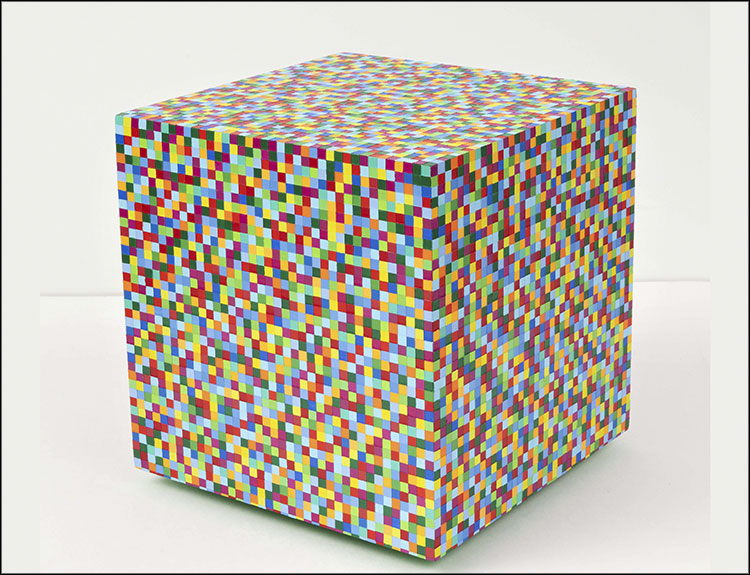
In the ’70s, that style yielded to the grid, with dynamic, color-saturated paintings creating a pure field of physical perception. Using strips of masking tape, Bechara arranged carefully formulated hues into an invigorating optical surface composed of a multitude of small colored units, according to the Lisson Gallery, which represents his work.
Bechara cited influences across art history, including the colors of Matisse and Vuillard, the pointillism of Seurat and Signac, traditions of weaving, the precision of hard-edge abstraction, and the Byzantine-era mosaics at Ravenna.
He used a tile-like grid as the basis of his explorations into the principles of color usage, particularly the intersection of organization and randomness. The surface was divided into small modular boxes similar to pixels, resulting in oscillating compositions. Through the structure of the grid, according to the museum, the artist found endless ways to explore color and form.
Bechara was chairman of the board of directors of El Museo del Barrio from 2000 to 2015, and became chairman emeritus in 2016. As chairman he played an important leadership role in the museum’s transformation into a nationally and internationally recognized Latinx and Latin American art museum. He was also a trustee for Studio in a School, Instituto Cervantes, Brooklyn Rail, the Brooklyn Academy of Music, and was a benefactor of the Metropolitan Opera.
“Bechara found inspiration in his many studies and travels around the globe, drawing his vibrant palette from a richly lived life,” said Kaitlin Halloran, the Parrish’s associate curator and publications manager. “His work reminds us how it is possible to find harmony and community among a diverse array of ideas and perspectives.”
The exhibition was co-organized by Ramírez-Montagut and Halloran. A members’ opening reception will happen Sunday at 11 a.m., and a curator-led tour will follow at 11:30.