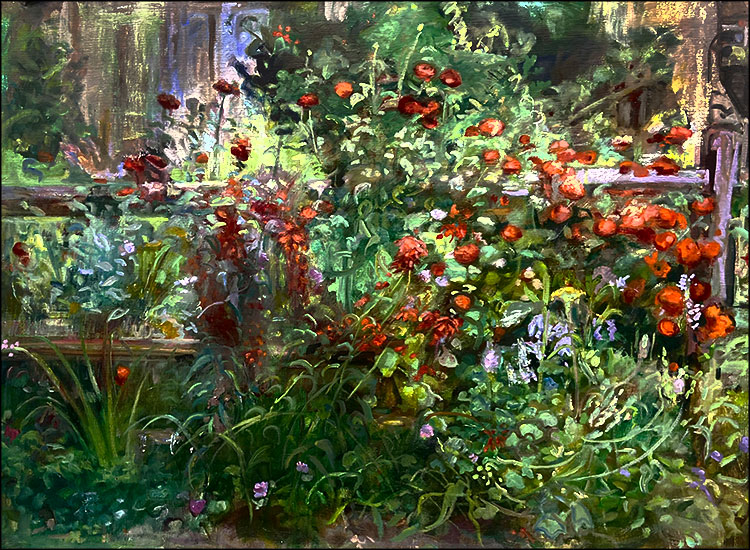
“Bruce Lieberman: Paintings,” a new exhibition of work by the Water Mill artist, will open Saturday at the Bridgehampton Museum’s Nathaniel Rogers House with a reception from 4 to 6 p.m. and continue through April 11. The show is a focused selection of recent and earlier works that reflect the evolution of an artist whose practice has been informed by the people, objects, and natural world he is familiar with, as well as the history of painting itself.
In the catalog essay, Don Perlis, a painter known for his socially engaged artworks, says that “Bruce Lieberman’s landscape paintings are among the finest produced in this country since the Hudson River School. Yet, his work departs radically from that earlier tradition, inspired instead by the raw energy of 1950s abstraction. More intense and personal than his predecessors, Lieberman is a product of his postmodern era.”
Among Mr. Lieberman’s mentors and teachers were artists who began as abstract painters but transitioned into figuration. In an interview with KDHamptons, he said, “I studied in the late ’70s at Stony Brook University with the sculptor Robert White, and then at Brandeis with Paul Georges. Bobby White, having studied with Saint-Gaudens, infused in me a sense of lineage among other things. Bobby introduced me to Paul Georges. And through Paul, it was the eclectic openness of Hofmann and Leger that would influence and take a lifelong hold. I was incredibly young and a blank slate.”
Mr. Lieberman’s mature style crystallized with breakthrough paintings of trees, according to Mr. Perlis. One of those, “Big Fucking Tree” from 1991, is “a huge dark form, vigorous in its verticality and individuality. . . . The power derives mainly from value, but the color is local and is natural.”
A recent painting, “First Touch of Fall” from 2022, creates a formal space, with foreground, middle ground, and background punctuated at the center by a tall tree that overlooks a body of water and three small chairs and a stone path that add a domestic element to the space. Like most of his paintings, rather than offering a single fixed viewpoint, this becomes a meditation on perception, a sustained act of looking.
In that and in all of his work, Mr. Lieberman deals with space and composition while embracing the quality of paint and the process of painting. He builds surfaces through improvisation, allowing forms to emerge gradually and color to carry the weight of the image.
As he himself has written, “I am trying to make the greatest paintings that I can make. Work that transcends the contemporary issues of photography, market, and fashion. It is a conversation with the history of painting and a rejection of pretense and the photographic.”