“Regeneration: Long Island’s History of Ecological Art and Care,” an exhibition by 11 intergenerational artists whose work engages with environmental challenges here and everywhere, is opening at the Parrish Art Museum on Sunday and will continue through June 14.
The show at the Water Mill museum is the first in “Parrish USA250: Life, Liberty, and the Pursuit of Happiness,” a yearlong series celebrating America’s 250th anniversary and exploring the nation’s founding values and aspirations.
During a Zoom conversation, the show’s curators, Corinne Erni and Scout Hutchinson, talked about how “Regeneration” relates to the series, “Life, Liberty, and the Pursuit of Happiness.”
“This is the first one in the series, focusing on life,” Ms. Erni said. “There is an interdependence of all life forms, and we as humans cannot exist without nature.”
“It’s also about our responsibility to other life forms,” said Ms. Hutchinson. “As Corinne mentioned, we are interconnected species, and we have a responsibility to care for the other life forms that help sustain us.”
The artists, all of whom have close ties to the East End, are Sara Siestreem, Jeremy Dennis, Scott Bluedorn, Cindy Pease Roe, Michelle Stuart, Tucker Marder, Mamoun Nukumanu, Sasha Fishman, Randi Renate, Alan Sonfist, and Maya Lin.
Ms. Siestreem, a member of Oregon’s Hanis Coos tribe, is represented by a newly commissioned work made in collaboration with the Shinnecock Kelp Farmers, a collective of Indigenous women who harvest seaweed to address nitrogen pollution in local waters.
Ms. Erni encountered Ms. Siestreem’s work at the Cristin Tierney Gallery in TriBeCa and was taken by it. “When we started this idea of working with the Shinnecock Kelp Farmers we gave them a list of artists to collaborate with. They connected to Sara’s work.”
“She has been meeting with the kelp farmers for a little over a year, and has made two site visits during that time to go out on the water with them and learn about their project,” said Ms. Hutchinson.
Ms. Siestreem is showing works from her “sugar kelp” series, created with acrylic, graphite, and Xerox on panel boards, and “skyline,” seven glazed slip-cast ceramic baskets inspired in part by her study of Hanis Coos basket weaving.
A panel discussion with Ms. Siestreem and members of the Shinnecock Kelp Farmers will take place Sunday at 3:30 p.m.
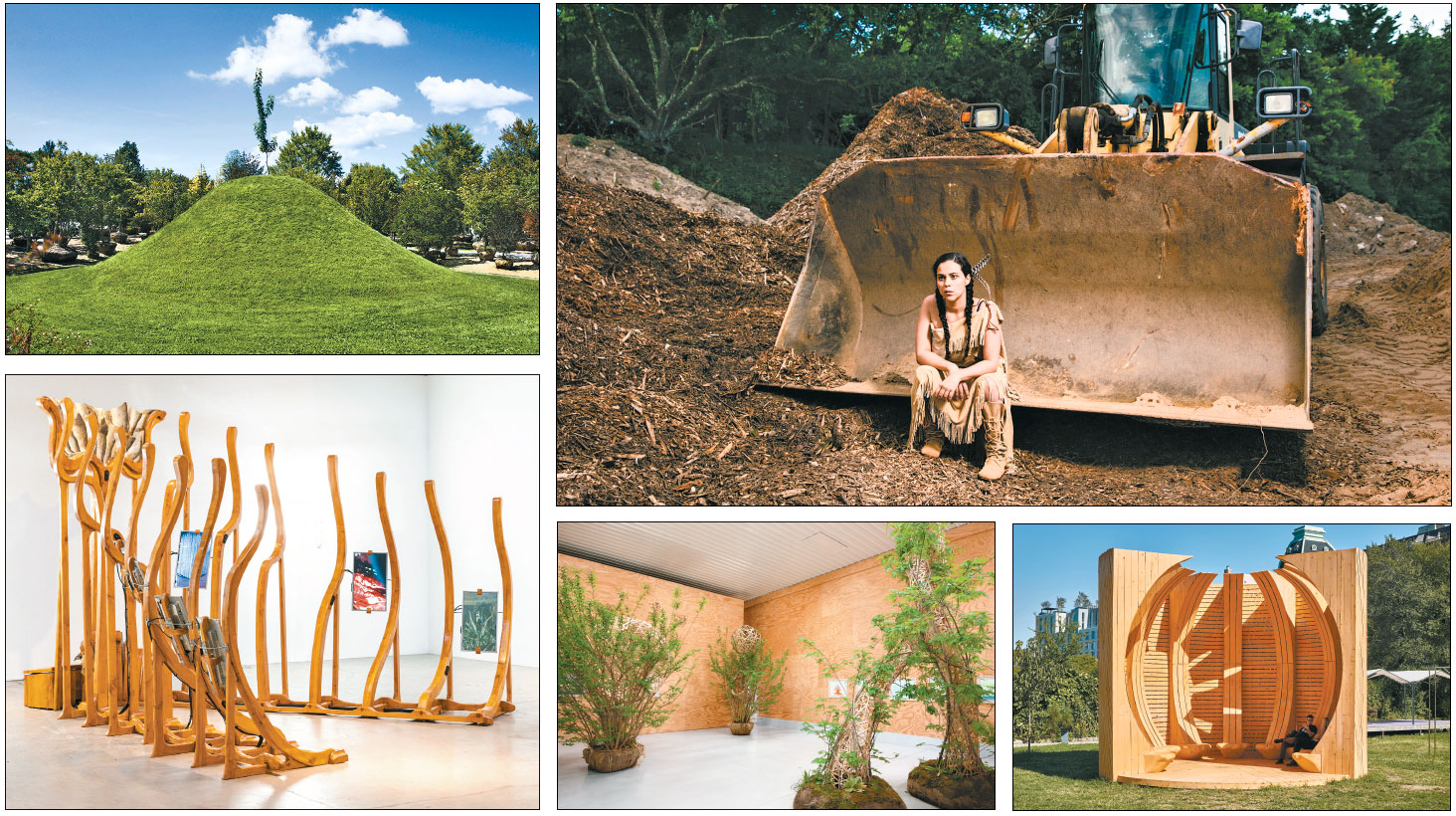
Mr. Dennis, a Shinnecock fine-art photographer, is showing works from his “Sacredness of Hills” series, which is based on recurring desecrations of tribal burial grounds. It includes images of Shinnecock women in scarred landscapes with earth-moving equipment, representing the impact of construction on sacred sites.
Mr. Bluedorn and Ms. Roe integrate discarded materials into their work. Mr. Bluedorn’s practice engages with the relationship between Long Island’s shifting ecology and the history of Bonac fishing, farming, and hunting. Ms. Roe constructs abstract assemblages from plastic waste and human-made debris collected from the region’s shores.
Mr. Marder has created over the past 15 or so years a variety of multimedia works that could be called performances, projects, happenings, but that in the end defy categorization. Some have involved animals and the landscape. In 2013 he founded the Folly Tree Arboretum in Springs, “to promote an exuberant environmental ethic through art and science.” An archive of trees, it includes a sycamore that has been to the moon, a tree whose fruits have become evolutionarily useless, an oak tree that “owns itself,” and many varieties of weeping conifer.
The exhibition will include a map of the arboretum, created over the years as the property has grown. “It’s a very whimsical take on a map,” said Ms. Hutchinson, “kind of an overhead view of the different, I would say, characters that live there.” Several photographs of the trees will also be on view.
Another artist whose work engages with organic materials and living systems is Mr. Nukumanu, who creates biomorphic sculptures from various plant species that provide habitats for local flora and fauna. Much of his work can be seen outside the museum, where he has been working over the past few months and adding plants and trees. A new bamboo structure, the basis for the outdoor living sculptures, and several drawings will be on view in the galleries.
Ms. Renate is an oceanographer, reef conservationist, and deep-sea diver, as well as an artist whose works reflect those other pursuits. Her “Are we psychic coral-polyps?” (2022) is a model of a coral polyp that is so massive — 16 feet tall by 20 feet wide — that it will not come to the museum until late April, when the ground is warm enough for a foundation. It will be accompanied by a podcast that will include interviews with local water conservationists. The show will also feature a series of drawings she made while in residence at the Orient Point Lighthouse.
Mr. Sonfist is one of the earliest practitioners of ecological or environmental art. His “Time Landscape,” sited at the intersection of Houston Street and La Guardia Place in Greenwich Village, which he first proposed in 1965, developed over 10 years into an indigenous on-site forest which, as he said, “offers a glimpse into 17th-century and earlier Manhattan.” For the exhibition, has paired photographs with several “gene beds,” which include samples of biological materials collected across the East End.
Ms. Fishman’s sculptures and installations are informed by her research into marine biomaterials, toxicology, and alternatives to plastic. The show includes her large-scale installation “I want to be wet,” consisting of Douglas fir, shellac, beer, salt, dried fish collagen, salmon eggs, marshmallow and more, as well as monitors, media players, speakers, audio, and video.
Organic materials also play an important part in the work of Ms. Stuart, who will show “Aquilegia” (1995-97), an assemblage of columbine seeds gathered in Amagansett and displayed on rice paper.
Ms. Lin is represented by “Bay, Pond, and Harbor (Long Island Triptych),” originally created in 2014 and shown at the Parrish. Made from recycled silver, which gives the pieces the reflective quality of water, the piece depicts Mecox Bay, Georgica Pond, and Accabonac Harbor.
Ms. Erni founded an organization focused on art and climate change 20 years ago. “The environment has been on my mind for a very long time,” she said. “It has been my dream to do something that’s really relevant to the East End, at the Parrish. I feel like what is happening in this microcosm is also speaking to the macrocosm, the global issues of water and land pollution, adaptation of land, and so forth.”
“As we started researching artists and meeting artists, it was really interesting to see how some of them already knew each other, had already been introduced by way of their interests,” said Ms. Hutchinson. “And younger artists were really excited to be in a show with some of these artists who’ve been making environmental art for decades. On the other hand, the younger generation is taking ecological and environmental art in a different direction, thinking about human relationships among other species and what that can and might look like in the future.”
Corinne Erni is the Parrish’s Lewis B. and Dorothy Cullman chief curator of art and education. Ms. Hutchinson is the FLAG Art Foundation associate curator of contemporary art.