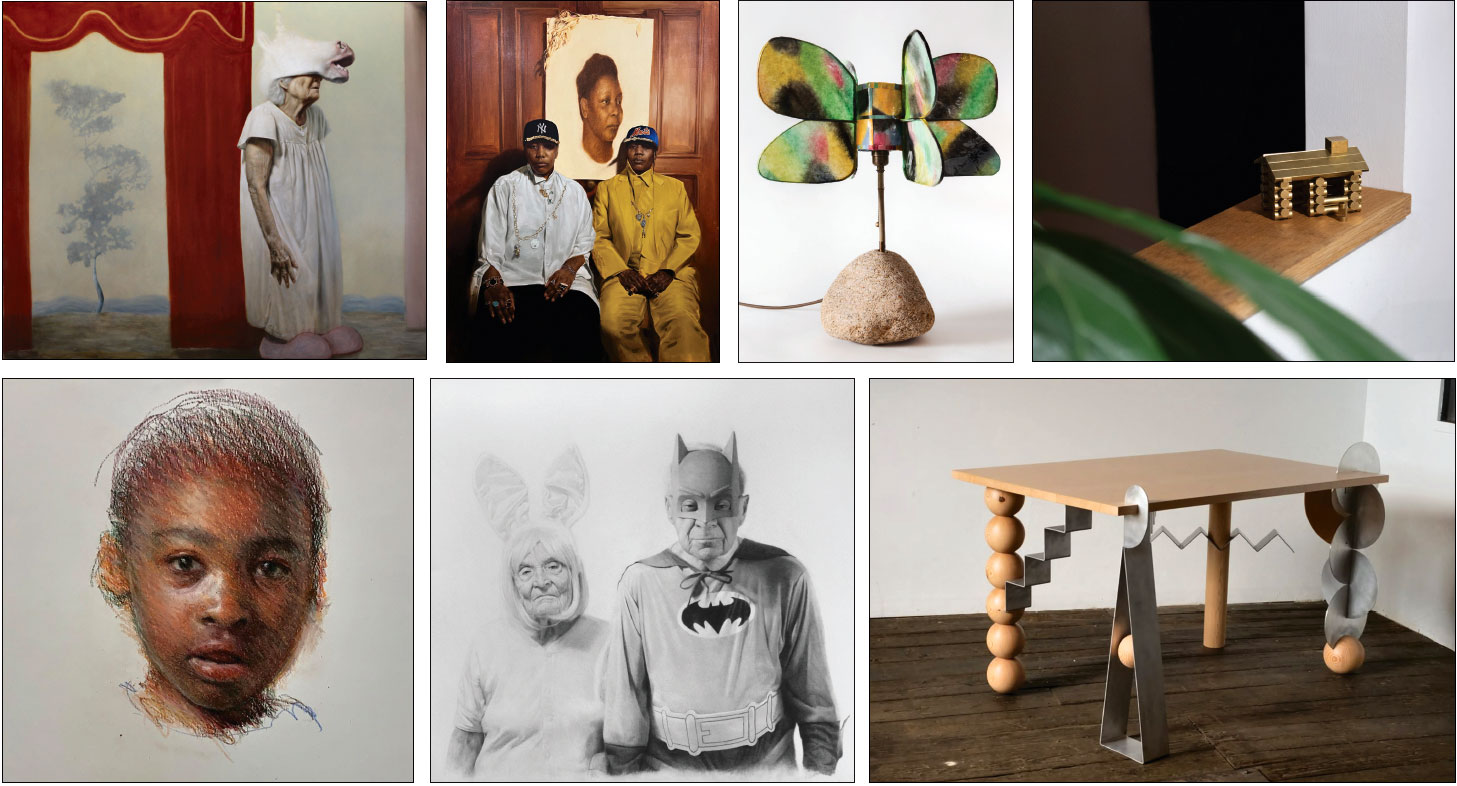
Guild Hall will open two exhibitions on Sunday that couldn’t seem more dissimilar. “Jason Bard Yarmosky: Time Has Many Faces” consists of meticulously rendered portraits, many of his aging grandparents, created over a period of 10 years. “Liberty Labs: A Decade of Design” features furniture, lighting, and other objects by 33 former and current members of Liberty Labs Foundation, a design collective focused on collaboration and experimentation.
“The interesting thing about these two shows is that both artists are in their mid to late-30s, they are both based in Brooklyn, and both have strong ties to the East End,” said Melanie Crader, the museum director and curator of visual arts, during a tour of the exhibitions.
A cousin of Mr. Yarmosky has an iconic home, the so-called Double Diamond House in Westhampton Beach, designed in 1959 by Andrew Geller, which the artist has visited since early childhood. Evan Yee, one of the founders of Liberty Labs and a key figure in organizing the Guild Hall exhibition, grew up dividing his time between Sag Harbor, where his father and stepmother own Yoga Shanti, and California.
Mr. Yarmosky’s work centers on themes of aging, time, and memory, subjects that have engaged him since childhood. His connection to those ideas developed through a close relationship to his grandparents, who were six decades his senior. Growing up, he often visited museums, becoming aware, he said, of the historical aspect of idealized beauty, which often emphasized youth, yet forming a broader perspective that would reflect his personal experience.
The show had its genesis in 2021 when Ms. Crader read a New York Times article about the Double Diamond house and Mr. Yarmosky’s time spent there after the death of his grandparents. Living in Los Angeles at the time, Ms. Crader began to follow his work online.
Having begun work at Guild Hall in 2023, she was visiting the artist Ross Bleckner at his house in Springs when she noticed a very small portrait among his art collection. “I asked Ross if it was Jason’s work, and he said it was, remarking that he was a great painter. I said I’d love to meet him.” By the next weekend it happened.
Ten large portraits are installed in the north gallery, six of them of his grandparents, with a selection of drawings and several small paintings in the Tito Spiga exhibition space. The paintings mix 17th and 18th-century painting techniques with contemporary imagery, including dreamlike elements, theatrical costumes, and staged interiors.
“From a distance you could think they are photographs,” Ms. Crader said. “One of the things I find fascinating is how the focus is on the faces, and then it tends to blur out at the edges. I think that grounds the viewer in the practice of painting.”
In one painting, the artist’s grandmother is seen in a nightgown with a horse’s head mask atop her head, partially hiding her face. In another she sports rabbit ears. In a smaller pencil drawing, “Trick or Treaters,” his grandfather is costumed as Batman.
The exhibition also includes portraits of Mr. Yarmosky’s friends and other family members, which, like those of his grandparents, feature costuming and couture. “The playfulness of it is a constant in his work,” Ms. Crader said, “as are empathy, care, integrity, devotion, and dignity.” Not to mention humor, which generates a compelling dialogue with his meticulously traditional painting technique.
One outlier of sorts is “Keys Open Door,” a painting from 2024 of two elegantly attired Black women, one wearing a Yankees cap, the other a Mets cap. They are seated beneath a portrait of their mother, who has recently died, and are honoring her, just as Mr. Yarmosky celebrates his grandparents.
“Mr. Yarmosky values the enduring role of portrait painting throughout history,” says Ms. Crader in a wall text. “ ‘Time Has Many Faces’ brings together works from the past decade alongside previously unseen sketches, offering insight into a practice grounded in close observation and the sustained, intimate exchange of painting from live models.”
“Liberty Labs: A Decade of Design” marks the 10th anniversary of the Liberty Labs Foundation, a nonprofit based in Red Hook, Brooklyn, in the Liberty Warehouse, once home to the Statue of Liberty before it was installed in New York Harbor in 1886. The foundation was founded in 2015 by John Koten alongside co-founders Reed Hansuld, Pat Kim, Joel Seigle, Tom Breglia, and Mr. Yee.
“It’s basically a co-working space where the members share large tools and machinery that would be hard for one person to afford,” said Ms. Crader. “They have a central space, where the heavy tools are situated, and around the perimeter are individual studios. The members include graphic designers, architects, furniture designers, metal workers, but all of them have varied backgrounds.”
Mr. Yee is an artist and a designer of lighting and furniture, among other objects. Andrea Grover, Guild Hall’s executive director, commissioned him to design the outdoor furniture located in front of the building. When Ms. Crader proposed to Ms. Grover last summer’s exhibition “Functional Relationships: Artist Made Furniture,” Ms. Grover connected her to Mr. Yee. “He was the first person I invited into that show,” said Ms. Crader, “and I asked him to take the lead with the design of ‘Liberty Labs.’ ”
“A Decade of Design” encourages visitors to engage directly with the works. Select furniture pieces may be used, sound elements will activate the space, and occasional public events will further animate the gallery, blending art, design, and social interaction.
Among the items in the show are a Douglas fir etagere, a kelp screen, a cherry wall cabinet, a backgammon set, a lattice table, a basketball hoop, a variety of chairs, a pair of handmade solid cherry audio speakers, and lights, lamps, and sconces.
Mr. Yee explained the provenance of a number of enormous wooden beams that are stacked from the gallery’s left and right walls. The beams came out of an old school, now demolished, in the Liberty Labs neighborhood.
“They were 24 feet long originally, and we were lucky enough to get some of them salvaged. The construction company cut some of them in half, and we went on site with our pickup truck and chain saw and got some cut-offs. We were thinking of building a wall to divide the gallery, but it was going to be over budget. So we decided instead to stack these beams and use them as a way to divide the space. And tell a story.”
The story Mr. Yee mentioned involved a tragic fire that destroyed a 19th-century warehouse, which was filled with artist studios and work by more than 500 artists for its annual open-studio tour. The massive beams that remain will be used in the reconstruction of the warehouse, “which is really cool. You can’t get this stuff anymore, it’s old yellow pine.”
In addition to the Liberty Lab’s co-founders named above, the participating artists include Alara Alkan, Alex Sagnella, Andrea Steves, Annika Bowker, Bowen Liu, Bryan Johnson, Charlie Recknagel, Cherylyn Ahrens, Chris Cushingham, Chris Gentry, Cissy Huang, Cody Campanie, Evan Jewett, Jason Hernandez, Jason Pfaeffle, Jess Chace, Jon Billing, Julien Leyssene, Kelsey Knight Mohr, Maggie Pei, Michael Yates, Pat Keesey, Sam Kallman, Shengning Zhang, Thomas Yang, Timothy Furstnau, and Todd Higuchi.
Both exhibitions were organized by Ms. Crader, with support from Phillipa Content, museum manger and registrar, and Claire Hunter, museum coordinator and curatorial associate. They will remain on view through April 19.