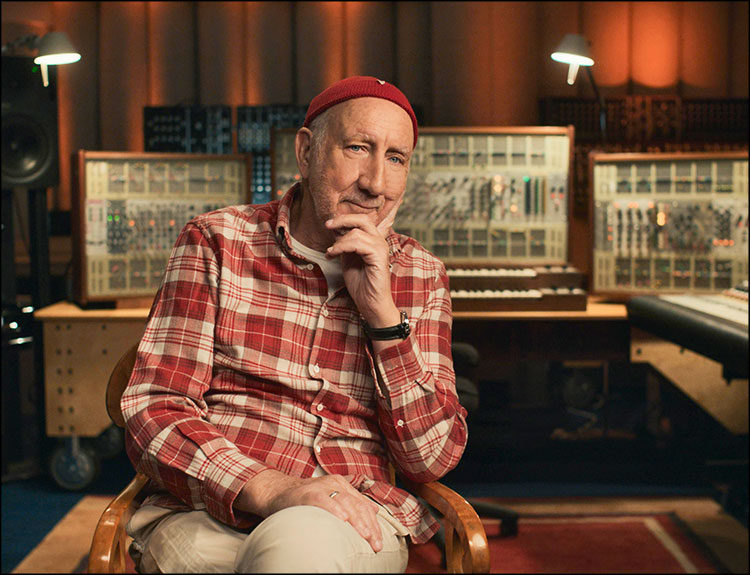
Now 81, Pete Townshend is a certified rock-and-roll survivor, having endured untold hours on the road, in the air, atop the charts, and under the influence. Late last year, he and Roger Daltrey, 82, concluded a North American tour titled “The Song Is Over,” 64 years after they and John Entwistle first performed together as the Detours.
In 1964, the Detours became the Who, and with the explosive, revolutionary drumming of Keith Moon embarked on a creatively and sonically audacious journey largely defined by Townshend’s increasingly exploratory, adventurous writing.
“Pete Townshend: Behind Blue Eyes,” which will be screened on Saturday at 11:30 a.m. at the East Hampton Cinema and on Sunday at 2:15 p.m. at the Southampton Playhouse during the Hamptons International Film Festival, is the proper documentary that its subject has long deserved. In it, the directors, Frank Marshall and Nigel Sinclair, show the soaring highs and devastating lows of this intellectual and deeply sensitive artist as he pushed against and ultimately broke down artistic boundaries, creating some of the most memorable and enduring rock-and-roll of the genre’s seven decades.
To be sure, plenty of power chords and adolescent angst are included, and fans of classic rock will relish the ample concert and recording studio footage of the Who at the band’s best. But it is Townshend’s inner exploration and confrontation of a deep melancholy he attributes to childhood abuse and trauma that are most compelling. Here, a thorough examination of his “Lifehouse” project, which was to follow the Who’s triumphant rock opera “Tommy” but was abandoned, only to surface decades later and in different forms, provides a starkly revealing portrait of Townshend as artist and philosopher.
“I was totally unaware of ‘Lifehouse,’ ” said Marshall, whose father was the jazz guitarist and composer Jack Marshall, who had also compiled and edited instructional books including “West Coast Guitar: Eight Original Solos for Guitar.” “When Pete was smashing guitars, I was not a fan of this,” he said. “I didn’t understand it. Now, I do understand where this came from. When Nigel said, ‘There’s this unfinished sequel to “Tommy,” ’ I was fascinated to find out what that was all about.”
Sinclair, who produced “Amazing Journey: The Story of the Who” in 2007, has long been close with Daltrey, and through him became acquainted with Townshend. In Los Angeles, he recalled, the directors met with their subject, who told them that he had written “Sunrise,” from 1967’s “The Who Sell Out,” based on chords found in one of the elder Marshall’s books. “I feel with these documentaries some kind of Zen happens when we get working,” he said, “and you find these connections. That was an extraordinary link.”
“Pete Townshend: Behind Blue Eyes” details the Who’s rapid success, from the single “I Can’t Explain” and the band’s American debut at the 1967 Monterey International Pop Festival to the present, including the deaths of Moon, at just 32 years old in 1978, and Entwistle in 2002. Kit Lambert and Chris Stamp, the band’s influential managers until their 1971 dismissal, and their successor, Bill Curbishley, are also prominent, as is the musician Brian Eno, an art-college contemporary of Townshend’s.
In a fascinating sequence, the subject describes an out-of-body experience enabled by LSD, after which he embarks on a spiritual journey, is given a copy of “The God-Man,” a biography of Meher Baba, and becomes a devotee. But it is “Tommy,” the “deaf, dumb, and blind boy,” and the ill-fated “Lifehouse” project that best portray Townshend’s artistry in all its complexity.
“It was beyond understanding, how successful it was,” Townshend says of “Tommy.” “But I was lost, because I didn’t know where ‘Tommy’ had come from,” nor did he know how to proceed. “We decided to do something completely new,” he says. “And we hadn’t really decided what that’s going to be yet.”
Townshend, Daltrey tells Cassidy Hartmann, one of the two screenwriters, “has an ability to write from a very internal perspective. It’s not a veneer. It comes from very, very deep.”
“I realized that ‘Tommy’ was about me,” Townshend says, opening up about the childhood abuse and trauma that “was a huge part of it.” It was not sexual abuse, he is quick to note, but left him feeling abandoned and isolated for an extended period. “I never spent a second in reality,” he says. “Not a second.”
“He came close to breaking down telling that story,” Sinclair told The Star. “But every word he said is interesting. . . . When he says these things, it really lands in your heart.”
In “Lifehouse,” Townshend sought to combine music, art, film, “all of my ideas becoming reality.”
“But it came with this script which we knew nothing about,” Daltrey recalls. “We were completely lost when he started talking about this narrative. This script was dealing with things like virtual reality, and this was 1970. None of us could grasp it.”
Unearthed film of a band meeting at Daltrey’s residence is one of the most compelling elements of the documentary: rock-and-roll musicians on top of the world but unsure what came next. A debut performance of songs slated for “Lifehouse” met a cruel reception at London’s Young Vic Theatre, some fans calling out for the hits and others walking out before the band relents and accommodates them. “I just kind of fell to bits,” Townshend says.
“For me,” Marshall said, “these music docs are a journey of discovery. We started with the focus on ‘Lifehouse,’ and then it became, as we started talking to people, ‘We have to expand this out to really be Pete’s journey as an artist.’ ”
“We looked at ‘Lifehouse’ and realized that it basically, in one sense, brought him close to breaking, which is explicitly told in the story, quite brutally,” Sinclair said. “And that actually it was, in a sense, an anvil on which his career was forged, because up to that point, he was looking to solve his problem, ‘I want to be an artist. I have this band and I’m really good at it, but I don’t necessarily see how they fit into the artistry.’ ”
“We explained to Pete that ‘this is about “Lifehouse,” because “Lifehouse” is, probably along with art school, the central enabling pivot of your life, because everything was different after the failure’ ” of that project, he continued.
Hartmann, Sinclair said, “came up with the idea that this is a love story. What’s really going on here is, he’s got this relationship with Roger that started when they’re 17, and they’re now 82 and they’re still playing together and they’re still having the first argument they had when they’re 17. . . . I’ve explained to Pete, it’s about ‘Lifehouse,’ but you can’t make a film about ‘Lifehouse’ without having the audience know you and why it mattered to you.”
“That’s what you discover as you go through the journey of making these films,” Marshall said. “You go down one avenue and then something becomes apparent as you put the pieces together, and that’s what happened here. As we dug into ‘Lifehouse,’ we found that it was about much more, and much more about Pete and his journey.”