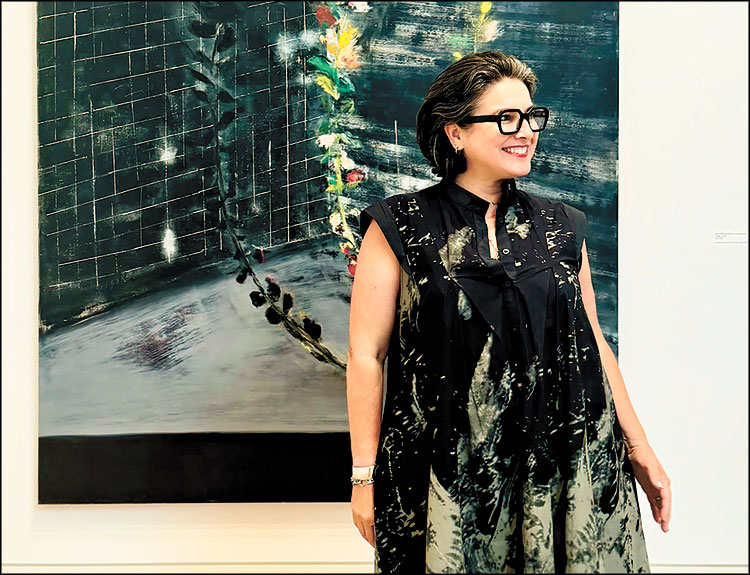
Born and raised in Louisiana, Melanie Crader, Guild Hall’s museum director and curator of visual arts, was interested in art from a very early age. “When my dad would take me to the toy store, I would always go to the coloring section,” she said during a conversation at Guild Hall. “There was a 64-pack of Crayola crayons, and every time we would buy that I would go home and then rearrange the colors so they would look like a little rainbow.”
Fast-forward to 2003, when she was a practicing artist and before she was a museum professional. “The Basics,” a solo exhibition at Women and Their Work, a nonprofit in Austin, Tex., featured a series of works “based off the idea that you would make something and you could get it in any color. Everything I made was a multiple in various colors,” including five wood panels that were fastened perpendicularly to the gallery wall at the height of things found on a rack in a store. Color, yes, with a suggestion of another theme in her work, consumerism.
The path from the toy store to “The Basics” began in Lake Charles in western Louisiana and continued through college there at McNeese State University, where she earned a B.A. in fine and studio arts. (The prominent artist Lynda Benglis was born in Lake Charles. Crader recalled “as a young woman seeing that she was such an amazing artist, and pretty radical, made her an important artist for me to look at.”)
In addition to introducing her to the work of Louise Nevelson and Jackson Pollock, her high school had given her access to a full darkroom. So at McNeese, because there were so many examples of women artists who were photographers, she gravitated toward that medium. “I’ve always drawn and dealt a lot with observation, and that’s also why photography was so interesting to me.” She also studied printmaking and art history there, taking up painting only in her senior year.
After graduating, Crader took a gap year before graduate school and opened her own photography business, doing portraits “and things like that. I really did not like it very much and realized that that application wasn’t going to work for me from an artistic standpoint.”
Wanting to move far away from Louisiana after having spent her entire life there, she landed at the University of Ohio in Athens, where she concentrated on printmaking and painting, earning an M.F.A. in 2000. While there she worked through many representational aspects of her work. “I started paring a lot of things back, really trying to get at the essence of things, and my work became very minimal and abstract. It became much more about the idea and how to articulate an idea with the least amount of information.”
Crader met Mick Johnson, an artist, while still in Louisiana. They both went to Ohio and were married in 1999. A year later they moved to Houston, in part because both of their fathers lived there but also because it had such a thriving art scene, including the Museum of Fine Arts, the Menil Collection, and the Blaffer Art Museum.
“When we arrived in Houston, we parked our moving van at the Museum of Fine Arts at 9 at night, and went through the Turrell tunnel. Then we went to a pub. We had been in a college town, so it was exciting to be in a major metropolitan city.”
Crader was making art and teaching at the Glassell School of Art, which is affiliated with M.F.A. Houston, but to make ends meet she secured a job in the marketing and communications department of an investment company, where she worked for eight years until she decided she needed a change.
“I had been living a double life,” she said. “I had my art practice and my art friends and I served on a couple of boards, so I was active in the art community. But I really wanted to work for a purpose or mission that was art-related. I targeted the Menil Collection because I really felt it had been so important for my art education.”
When a position opened in the curatorial department, Crader was hired. She wasn’t a curator, but over the first four years she managed the exhibition program, the budget, the contracts, and the traveling exhibition program. From there she moved into the administration department and helped manage the operating budget, worked on the capital campaign and other projects, and continued to oversee the traveling shows.
In the latter capacity she worked often with the Museum of Modern Art, all the museums in Los Angeles, the Metropolitan Museum, and the Whitney, among others. “I was able to really get to know the museum industry not only from the inside but also from collaboration,” she said.
While there she was working with the Hammer Museum in Los Angeles on an exhibition of work by Forrest Bess that the Menil was traveling. The Hammer was looking for a director of exhibitions and publications, and, within a couple of weeks of applying, she was hired. She moved there in 2014 with her husband and their son, who was 3 at the time.
In 2010, while still at the Menil, she had what turned out to be her last solo exhibition, “The Eula Project,” at the O’Kane Gallery at the University of Houston-Downtown. It was an ambitious and elaborate installation that was a meditation on family and memory given inventive form in a variety of mediums.
Eula had been Crader’s grandmother who, along with her husband, “lived a very pared down life. Their living room had three 8-by-10 photos on the wall, two chairs, a table, a lamp, a console stereo, a sofa, a toy chest, and a painting of my grandfather’s shrimp boat.” When she and her husband bought their house in Houston, years after her grandmother’s death, she realized it was remarkably similar to her grandmother’s.
“The Eula Project” was a recreation of Eula’s living room and Crader’s own. She made 8-by-10 photographs of objects found in a box from Eula’s house, recreated a vitrine based on Eula’s stereo console, and filled that with the same objects she had photographed. Crader also created an end table and a composite sculpture of a telephone stand that combined her grandmother’s with her mother’s.
“It was a really interesting project for me to dive deeply into a personal history but also into what’s left behind and how that can be transformed into a portrait,” Crader said. “It was also about memory, and how memory changes.”
Between 1998 and 2011, she had solo and group exhibitions at galleries around the United States as well as participating in Art Frankfurt 2004 in Germany. But once she moved to Los Angeles, she took a break from making art. After eight years there, she was hired as deputy director of the Parrish Art Museum, but in May 2023, after a little over a year at the Parrish, she landed her current job at Guild Hall.
Both she and Andrea Grover, Guild Hall’s executive director, had been based in Houston at the same time and knew each other casually. “When the job opened up, she told me about it,” and the rest is recent history. “I’ve always admired Andrea and it was a great opportunity to work with her.”
As for the break from making art, she has recently started doing a lot of observational drawing. “I started this whole path because I liked drawing. I’m trying to always remember how it is to discover art and the dialogue around it. For me it’s just drawing and observing that are important.”