News For Foodies: 04.02.15

News For Foodies: 04.02.15

Local Food News
By
Joanne Pilgrim

D’Canela restaurant in Amagansett has launched a takeout menu with free delivery service in East Hampton and Amagansett. The extensive menu includes breakfast, lunch, and dinner choices, ranging from eggs to appetizers, sandwiches, and salads, and including items such as burritos, tacos, and tostadas. There is a Monday through Friday lineup of soups of the day and a daily $12.50 lunch special that includes a soup and entree of the day.

Bostwick’s Reopens

Bostwick’s Chowder House on Pantigo Road will open for the season next Thursday. Service, to start out, will be from Thursdays through Sundays, beginning at 11:30 a.m. The menu at the seafood-centric East Hampton restaurant will continue to include favorites such as blackened fish taco, baked stuffed clams, clam roll, crab-stuffed flounder, and seafood pasta.

Easter Sunday Meals

Easter Sunday this weekend brings a prix fixe holiday menu to the American Hotel in Sag Harbor, with service from noon to 8:30 p.m. Among the entrees are roast leg of lamb, Long Island duck, local flounder almondine, Scottish salmon, crab cakes, and filet mignon, accompanied by a starter and dessert. Additional items may be substituted for a premium. The cost is $65 per person ($32.50 for children), not including tax and tip.

At the Montauk Yacht Club, an Easter Sunday buffet will be served from 10 a.m. to 4 p.m., with carving stations, eggs and omelets cooked to order, handcrafted pasta, a seafood bar, and a chef’s table with choices including roasted ham and Montauk tilefish. A chocolate fondue fountain and a Viennese dessert table top off the feast. The cost is $34.95 per adult, $12.95 per child over age 8. Those younger may eat for free.

Almond in Bridgehampton will have a prix fixe Easter brunch and Easter dinner, served a la carte, featuring smoked ham and lamb as holiday specials. For brunch, served from 11 a.m. to 3 p.m. and including three courses for $45, there will be sausage and eggs, Nicoise salad with grilled trout, stuffed French toast, leg of lamb sandwich, and a house-cured smoked fish platter with bagels. A kids menu will also be available. At dinner, from 5 to 9 p.m., holiday dishes will be served family-style for $25 per person. Side dishes and a la carte items from the regular menu will be available as well. Reservations have been recommended.

Theater and Food

The 1770 House in East Hampton is offering those who will be attending upcoming Guild Hall theater lab events on April 21 or May 5 an opportunity to stop in for a $27 two-course prix fixe dinner before heading across Main Street. Dinner service will begin at 5:30 p.m. so that theatergoers can make the 7:30 p.m. curtain calls at the two free performances, which will feature East End artists.

Website Online

Rudy DeSanti Jr. and Debbie Conklin Geppert of Dreesen’s Catering, two veteran foodie professionals, have a new website for their business, dreesenscatering.com. The site features sample menus for weddings and other events, from elegant soirees to barbecues and clambakes, as well as information about the Dreesen’s donut truck — which can make a stop at private events — and about the duo’s local and homemade approach to food, which includes prime meats butchered by Mr. DeSanti onsite at the company’s custom-built commercial kitchen in East Hampton.

Mr. DeSanti, a native of East Hampton whose grandfather founded Dree­sen’s Excelsior Market, started Dreesen’s Catering when the family closed the market in 2004. He is a graduate of the Culinary Institute of America. Ms. Geppert worked at the Raleigh and Concord hotels in the Catskills and as director of restaurants and room service for the Hilton Corporation before returning here to her hometown in the late 1990s. After working at Bostwick’s restaurant, she had her own catering business before partnering with Mr. Dreesen in 2013, and now oversees the catering division and event operations at Dreesen’s.

Food Ed at Page

Page restaurant in Sag Harbor kicked off a food education initiative with a “Little Foodies” event last weekend. About 25 children and their parents learned about how food grows in the restaurant’s aquaponic gardens, discussed the importance of making healthy eating choices with representatives from the Wellness Foundation of East Hampton, I-Tri, and Cornell Cooperative Extension, and participated in an interactive cooking demonstration with Page’s chef, James Carpenter.  Page is developing a pilot program through which aquaponic systems would be built in local school greenhouses to help provide school cafeterias with organic produce.

Buying a Share of the Harvest

Buying a Share of the Harvest

Amanda Merrow and Adrienne Nelson are readying the greenhouses to start vegetable seedling at Amber Waves, which employs a community-supported agriculture model.
Amber Waves
If you want fresh vegetables, grown with organic methods, and like the idea of being as close to the farming of them as possible, the C.S.A. model may be for you
By
Jennifer Landes

For centuries, residents of the East End have been farming their land and providing their neighbors with fresh produce. And for decades, this exchange of goods was done at a farm stand, as simple or elaborate as the vision of its owner-operators.

Beginning more recently with the advent of weekly farmers markets held in most village or hamlet centers and Quail Hill Farm’s early adoption of the community-supported agriculture model or C.S.A. in 1990, farmers have become more inventive in their distribution. Joining Quail Hill in the past few years in offering limited shares in their agricultural produce are Balsam Farms and Amber Waves, also in Amagansett.

Here’s the thing, if you want fresh vegetables, grown with organic methods, and like the idea of being as close to the farming of them as possible, the C.S.A. model may be for you. The catch is, you need to decide now. Most C.S.A.s have set Wednesday as a deadline for the first payment. Money that they raise now will defray the costs of the seeds and planting them until they are up and running.

Quail Hill, overseen by the Peconic Land Trust, remains a top choice, particularly for people who don’t mind getting their hands dirty. Quail Hill wants its seasonal shareholders out in the fields picking their own produce, which includes a wide variety of vegetables, flowers, and herbs. A handbook and online tip sheet for harvesting are intended to help. Summer shares for families are $915 and $470 for individuals, and harvest days are from early June through October. There are slight discounts for paying in full and using a check instead of a credit card.

This season, Quail Hill now offers a “box share” for families and individuals, prepared by the farmers and available for pickup, it is for those unable to harvest in the field and does not include the flowers or herbs that members are allowed to gather as part of their shares. Box shares must be paid in full at the time of sign-up, $720 for families and $360 for individuals, with a small discount for those using checks as payment. Unique to Quail Hill is a winter share, which is offered after the regular season ends and goes through March.

Amber Waves Farm is now in its seventh year and offers both boxes and “you-pick” options. Weekly pickup times are offered at the Amagansett farm and off-site at locations in Sag Harbor and Montauk. Those who choose off-site pickup can still visit the farm daily from 8 a.m. to 5 p.m. to pick flowers and herbs and visit the animals.

In addition to vegetables, Amber Waves C.S.A. members may opt to add weekly choices of Carissa’s Breads, Briermere Farm fruit, and locally made cheese. The farm’s full season share (from late May to Columbus Day, or 20 weeks) is $875. A 15-week summer share is $750. Adding bread to the shares will cost $180 for 20 weeks and $140 for 15 weeks. A 16-week fruit share costs $240; an 11-week share is $165, and includes strawberries, blueberries, raspberries, peaches, plums, apples, and pears. The fruit is not organic, but is minimally sprayed. A cheese share is $250 for 20 weeks and $190 for 15 weeks and features three styles of cheese from Mecox Bay Dairy and fresh mozzarella from Villa Italian Specialties.

An early season box from Amber Waves has included various lettuces, potted herbs, green garlic, pea shoots, radishes, and sprouts. The vegetables are listed the week of pickup on the farm’s website with suggestions on how to use the produce and some recipes. A high-season box offers the standard farm stand fare of tomatoes, cucumbers, eggplant, summer squashes, peppers, lettuces, herbs, and more. The last box of last year had winter squashes, kale and other hardy greens, carrots, sweet potatoes, cauliflower, cabbage, and red and cayenne peppers.

Balsam Farms offers an a la carte vegetable-based package with similar add-ons to Amber Waves, making the packages even more customizable with a friendlier price point. According to Ian Calder-Piedmonte, who manages the share program, the farm’s produce is not certified organic, but Balsam Farms only uses material approved for organic production with the exception of the corn, which is grown in fields separate from the rest of the plants from seed that is not genetically modified. Balsam Farms harvests the produce for its C.S.A. members.

Its add-ons include Carissa’s Bread, Briermere and Milk Pail fruit, a Villa mozzarella share, and a flower share. Pickup takes place on Fridays or Saturdays at the Town Lane, Amagansett, farm stand. The vegetables are grown in several fields on the South Fork. Shares are for 15, 19, 23, or 26 weeks, and range from $475 to $825 before add-ons. The flower shares start at $132; the fruit and cheese shares at $165 each. A bread share starts at $120. The first shares are available on May 29, with a season lasting until Sept. 4, Oct. 2, Oct. 30, or Nov. 20, depending on the length chosen.

Last year and the year before, Dock to Dish offered shares in a community-supported fisheries program, with members getting freshly caught, direct-from-the-fisherman, filleted seafood packages each week, along with ideas to prepare it. The people behind the program took it down to Key West this winter and planned to come back to Montauk this season. Alas, that may not happen. Sean Barrett, one of the company’s principals, injured his back last season and has not been cleared to do the physical work necessary to keep the venture going. He said via email at press time that he and his partners were “scrambling to come up with some solutions” to offer the plan this year. He said they hoped to have a strategy soon and would announce it when it is confirmed.

Sign-up forms and complete information, including sample boxes and recipes, can be found on each of the organizations’ websites.

Seasons by the Sea: A Cooking Boot Camp

Seasons by the Sea: A Cooking Boot Camp

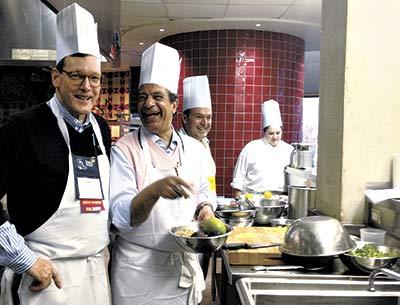
King Hussein, center, was the benevolent leader of Laura Donnelly’s team during a Culinary Institute of America boot camp recently. With him was Ken Koch, left, another South Fork participant in the program.
Laura Donnelly
At the Culinary Institute of America campus in San Antonio
By
Laura Donnelly

I recently attended a C.I.A. boot camp, and golly did I learn a lot. And no, I’m not talking about the spy agency next to the house I grew up in in McLean, Va. It was the Culinary Institute of America campus in San Antonio, started in 2009.

Our group of club managers and hospitality professionals was randomly divided into two smaller groups. My foursome was put on the New Orleans Cajun and Creole food team. Having made enough étouffée, gumbo, popcorn rice, and bread pudding in my lifetime, I asked to be moved to the Latin cooking group, which they allowed. Each group was divided into smaller teams and tasked with a number of dishes that had to be ready for judging and sampling by 12:45 p.m. (We began this adventure at 8 a.m.) I was psyched; I just knew that my friend Ken’s and my team would win. Our team leader’s name was, I kid you not, King Hussein.

The New Orleans class was taught by Brannon Soileau, a real Louisianan chef. Our Latin team was led by Geronimo Lopez-Monascal, a chef from Venezuela. The New Orleans team was tasked with making crawfish étouffée, gumbo, fried oyster po’ boys, popcorn rice, and bread pudding. By my count, that’s five fairly simple dishes. The roux for étouffée does require some patience and finesse as it can take up to an hour to get the proper consistency, color, and flavor from the simple combination of flour and oil.

Our team made anticuchos de cordero, or lamb kebobs; arroz con pato, rice with duck; causa de cilantro y cangrejo, a Peruvian layered potato dish with crab meat and cilantro; shrimp ceviche with peanuts; traditional ceviche with leche de tigre; chupe de camarones, a thick, Peruvian crayfish stew; empanadas saltenas; solterito, a Peruvian fava bean salad; quinoa au gratin; salad de xuxu com palmito e laranja, made with chayote, hearts of palm, and orange, and tacu tacu, a bean and rice cake.

Now does that division of labor seem fair?

The two teams used two separate kitchens with cooking equipment located in between. Our team’s recipes hadn’t been Xeroxed yet, so we tried to work from one copy for about an hour and a half.

Restaurants and commercial kitchens use large containers of herbs and spices. A lot of us were using the same spices, but one person would take it to their station and hog it. I ever so helpfully filled up little “monkey dishes” (industry lingo for little cups for miscellaneous ingredients and condiments) and distributed them to each team.

We learned from our chef that the largest Japanese population outside of Japan resides in Peru, therefore having a great deal of influence on the cuisine, especially with ceviches that are seasoned more like sashimi and sushi. My task was to make the leche de tigre, a k a tiger milk sauce, for ahi tuna tiradito to be served on freshly fried yucca chips with a bit of mashed, salted avocado. Crikey, that sauce took me almost two hours to make! Rehydrated and drained bonito flakes, juiced limes, passion fruit, aji amarillo, and eight more ingredients. Maybe I’ve watched too many TV cooking competitions, but I was running around like a chicken with her head cut off.

King Hussein was a benevolent and patient leader; he calmly sliced the beautiful fresh tuna. Ken handled the quinoa gratinada all by himself. Nothing like dousing a healthy ingredient with cream, butter, and two kinds of cheese to make it taste better.

Once in a while I checked the other kitchen to see if they were scrambling and scurrying about like we were. No, they were chatting, steaming the rice, relaxing, tasting the roux, all while Chef Brannon regaled them with tales of the Bayou. Their kitchen was bigger and brighter and cleaner than ours, too. Gosh, I was jealous.

There were so many unusual ingredients and flavor combinations in our dishes. The condiments for an Ecuadorean shrimp ceviche were popcorn, peanuts, red onion, cilantro, and plantain chips. For some reason I never found out why the empanadas saltenas (Northern Argentine and Bolivian style) were made with expensive beef tenderloin.

When we were close to being finished with our dishes and ready to garnish for presentation, I snuck back over to the other team’s kitchen. At this point, they had flubbed up the creme Anglaise sauce for the bread pudding twice, and had started drinking the bourbon provided to flavor the sauce. Now I was doubly jealous.

The time came for the two teams to present and describe their dishes. The New Orleans group’s dishes were absolutely delicious. Who doesn’t like a fresh Gulf oyster deep-fried and slath­ered with remoulade sauce? But their food was essentially brown and tan and white, with a sprinkling of slivered scallions for a touch of green.

Our presentation, on the other hand, was a staggering array of colors and textures and flavors. I did mention that we made 10 dishes, right? Carved pineapples were pierced with lamb kebabs marinated in aji panco, rice cakes were topped with creamy crab meat, the salads of chayote and fava beans and hearts of palm sparkled with citrus brightness.

Which team won? Well, it seems that the whole team-building-competition aspect of the day got forgotten somewhere along the line, but I’m pretty sure it was King Hussein’s industrious little group. Here are a few of the recipes from this wonderful, educational, but totally unfairly divided Latin Cooking Boot Camp.

Click for recipes


Running With Rum at Parrish

Running With Rum at Parrish

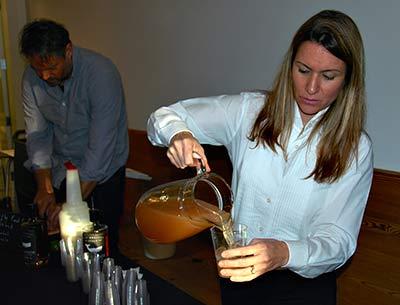
Cristina Mello, the manager of the East Hampton Golden Pear store, poured out the rum and drink samples before and after the “Distill Life” panel discussion at the Parrish Art Museum on Friday night.
Jennifer Landes
New York State has become a nexus for craft distillers, and rum, with a rich history traced to the earliest colonies, is tied to this area in many ways
By
Jennifer Landes

Typically, when one orders a daiquiri or a mojito, it is not preceded by a call brand the way a Grey Goose martini or a Jack and coke is. With the advent of premium small-batch rums over the past few years, however, that should change.

New York State has become a nexus for craft distillers, and rum, with a rich history traced to the earliest colonies, is tied to this area in many ways. Whether it was the first colonists who discovered their own from the natural fermentation of molasses by air-borne yeast, the whalers who brought back barrels of it from their Caribbean sojourns, or the rumrunners bringing it to our shores during Prohibition, rum could be called our most traditional drink.

In recognition of this history and connection to the area, the Parrish Art Museum and Edible East End magazine brought some rum makers together with a “locavore” mixologist on Friday night to discuss rum and how alcoholic beverages in general have benefited from the “slow food” movement.

Brian Halweil, the editor of Edible East End and the moderator of the panel, said that “Although Prohibition ended 80 years ago, the intense regulation of alcohol persisted for a long time.” As a result, only the largest producers of alcohol were allowed until the passage of the state’s farm distillery law in 1999, which opened up distilling in the way that the farm brewery and winery acts before it loosened more restrictive laws in the state.

Since then, New Yorkers have contributed to more than 60 craft distilleries nationally that have begun offering their take on classic spirits. A law passed last year has relaxed regulations even further to allow distillers to serve their product on premises as a mixed drink instead of a quarter-ounce sample, which was the previous rule. The Wall Street Journal noted that this recent legislation has made New York State one of the most attractive places in the country for farm distillers.

Jason Laan, a former Murph’s bartender, has been aging rum he has sourced in the Caribbean for a couple of years. He infuses it with fruit juice and spices, and then puts it in bourbon barrels to create an amber-style “sipping rum” he bottles under the name Sag Harbor Rum. “We don’t make rum. It’s more like rum-running. We bring it here and age it, like whalers bringing back rum” in the old days. While other companies offer different liquor styles or variations on a core brand, Mr. Laan said not to expect a catalog of brands from him. “I had one vision I wanted to bring to life.”

Leslie Marinoff represented Owney’s Rum, which was named after a bootlegger and speakeasy operator in New York City during Prohibition. It distills its non-aged white rum in Brooklyn using New York water, molasses that is not genetically modified, and a proprietary yeast strain. She said of the fermentation process, “Yeast can’t control themselves. They reabsorb all this ethanol and die of alcohol poisoning. But if you make them happy, treating them like Kobe beef and massaging them, they develop this will to live and they’ll produce incredible flavors for you,” including the smokiness that is Owney’s signature.

The recent explosion of craft distillers in the state and region has made Richard Scoffier’s job much more interesting. He is the food and beverage director for Honest Man Restaurants, the parent company of Nick and Toni’s, Rowdy Hall, Townline BBQ, and La Fondita. On his honeymoon in 2010, he said he discovered a distillery in the Finger Lakes that was producing sophisticated bourbon, grappas, a London dry-style gin, and cassis. After years of finding local and regional produce for the restaurant, he had a revelation, “Why can’t we do this at the bar?” Now the various restaurant bars reflect the region’s produce in the way their menus do. This ethos extends to using things like raspberries from Nick and Toni’s garden to create a homemade syrup or drink base.

Mr. Scoffier brought a drink to the talk and tasting that will be available on tap at Town Line BBQ in Sagaponack soon. He calls it the Keep on Wine-in, for its inclusion of Channing Daughters Winery’s gewurztraminer grapes. The grapes are put in a mixture of sugar and vinegar known as a shrub, a once common farm-made blend of seasonal produce preserved in drink form that is regaining popularity, in part due to Mr. Scoffier’s use of shrubs in drinks at Nick and Toni’s and the other restaurants. The drink also has Dutch’s Spirits Sugar Moonshine, Dutch’s Colonial Cocktail Bitters, and lemon juice.

It was tart and complex and is now being carbonated in a keg for future use. It might also age well. Yes, you read correctly. Mr. Scoffer said barrel aging of cocktails “rounds out the rough corners” of a drink in a process he calls magical in its way of transforming them. The restaurants also bottle cocktails for similar reasons.

With the return of “cocktail culture” in full force and the interest in artisanal and locally sourced drinks at a level The Atlantic described last year as its “heady early Internet phase,” it is likely, as it noted, that many will enter the market with inferior products, which could dampen the enthusiasm for them in general. Similarly, Ms. Marinoff said that one of the largest liquor companies is taking matters into its own hands by building and staffing small distilleries in different cities and hiring local “cool kids” to lay claim to the companies as a marketing ploy.

Still, with the devotion this area has to slow food production and its related offshoots, here, the trend is likely to stay.

Jason Laan’s Sag Harbor Rum Old Fashion

    2 oz. Sag Harbor Rum

    2 dashes Angostura Bitters

    1 splash of water

    1/2 tsp. sugar

    Cubed ice

Garnish with orange peel.

Leslie Marinoff’s NegrOwney

    2 oz. Owney’s NYC Rum

    1 oz. sweet vermouth

    .75 oz. Campari

Stir with ice.

News For Foodies: 03.19.15

News For Foodies: 03.19.15

Local Food News
By
Joanne Pilgrim

With the snow mounds melting and the days now longer, the restaurant roulette wheel is spinning as new ventures rev for the coming summer season and others who already have a foothold in the local eating scene try something new.

Matthew Guiffrida, the chef and owner of Muse in Sag Harbor, will reportedly expand this year to Montauk and open a second restaurant in the space most recently occupied by Coast.

Winston Lyons, a chef who has worked at a number of East Hampton spots, including Bostwick’s, East Hampton Grill, and Turtle Crossing, has been sprucing up the former Nichol’s restaurant building here and will open Winston’s, a seafood and steak grill with a Caribbean flavor, in mid-April. He plans to serve breakfast, lunch, and dinner year round, and will offer weekly specials. Tuesday nights will be Montauk night, with dishes centered on Montauk-sourced ingredients; Sundays will bring Caribbean-style suppers, and on Thursday nights there will be specials on Red Stripe beer and a variety of types of wings, including Asian and Caribbean style.

Prix Fixes

Winter specials continue at Le Charlot in Southampton, the East End version of an Upper East Side, Manhattan, bistro. A $25 prix fixe is available at lunch or brunch, and a dinner prix fixe for $35 is offered from 5 to 6 p.m. Both include three courses.

The restaurant has recently expanded its hours and is open Thursdays for dinner, and Fridays through Mondays for lunch (or brunch) and dinner.

In Montauk

Sammy’s restaurant at the Montauk docks has opened for the season and has designated Thursday as pasta night and Sunday as the night for prime rib. In honor of St. Patrick’s Day, corned beef and cabbage is being served this week.

The Montauk Yacht Club will offer a free shuttle to and from downtown Montauk and the Montauk train station after the St. Patrick’s Day parade on Sunday for those who would like to dine or imbibe. The restaurant at the club is open on weekends, serving breakfast, lunch, and dinner on Saturdays and Sundays, and dinner on Friday nights. A $29 prix fixe menu is available on Fridays and Saturdays. Those who march in the parade this weekend will be offered a free buffet.

Restaurant Week

Hamptons Restaurant Week begins on Sunday and runs through March 29. At participating restaurants — a list of which can be found at hamptonsrestaurantweek.com — diners can order a three-course prix fixe for $27.95. The special will be offered only until 7 p.m. on Saturday, March 28.

Seasons by the Sea: Hearty Fare for Winter

Seasons by the Sea: Hearty Fare for Winter

Eastern European food goes well with L.I. vodka.
A diet of root vegetables, cheap meats, and dairy products was born out of necessity, climate, and poverty
By
Laura Donnelly

You know how when you order food in a restaurant and you wait and wait and wait and it’s been like 45 minutes, so then you get up to use the loo and lo and behold, your food arrives at the table? That’s what this column is about. Eastern European food. The hearty, heavy, frigid-weather cuisine that keeps the Georgians and Hungarians and their neighbors fortified during long miserable winters. Because if I write about this, it is a guarantee that the icicles will be melting, perhaps some mountain snowdrops will pop out of the ground, and at least the potholes will begin blooming all over the East End.

Most of us think of Eastern European food as a lot of beets and potatoes and vodka, and that would be accurate. But there is also the lighter and brighter traditional dishes of coastal Croatia influenced by Italy, such as squid ink risotto, grilled fish with chard, garlic, parsley, and olive oil, and brudet, a tomatoey fish stew served over polenta. Even truffles grow in Istria!

One of my grandparents’ dearest friends was a Russian fellow named Vladimir Orloff. He taught them how to make tefteli, a rich meatball dish smothered in sour cream sauce. Our mother made it frequently, and we called it Vladimir’s meatballs. It gave all three of us kids indigestion every time. So some Eastern European dishes are indeed heavy and dense.

The diet of root vegetables, cheap meats, and dairy products was born out of necessity, climate, and poverty. Presumably the vodka is used to cut through the saturated fat and drown misery. If any vegetarians or gluten-intolerant people live in Poland or the other Slavic countries they may be hard pressed to find adequate food. Noodles and breads are prominent, as are pork, chicken, and beef.

Lithuanian cuisine shares similarities with that of Poland, Scandinavian countries, Hungary, and Romania. Potatoes, mushrooms, beets, cabbage, radishes, and cucumbers are grown and are popular, as are apples, plums, pears, cranberries, and lingonberries. And in spite of the richness of the diet — with such dishes as blynai (similar to blinis), kibinai (pastry with mutton), didzkukuliai (potato dumplings), desra (pork sausage), and spurgos (doughnuts) — obesity is very low in Lithuania.

Many Russian dishes may sound more familiar to us. There is the cabbage soup called shchi, meat kebabs called shashlyk, pirozhki, similar to pirogies, pastries stuffed with meat and onions, or rice, eggs, and dill, or mashed potatoes with green onions. Blinis, the thin little pancakes often made with buckwheat flour, are a treat topped with melted butter, sour cream, and caviar, or fruit jam. Olivier, or Russian salad, is delicious when made with fresh ingredients and homemade mayonnaise. It is a combination of finely diced boiled potatoes, hardboiled eggs, peas, and carrots bound with mayonnaise. Vodka is the best known beverage out of Russia, made with grains or most often with potatoes.

The foods of Croatia sound like the healthiest and most diverse to me, combining the influences of Greece, Italy, Turkey, and France. One traditional dish is called ispod peke, actually more of the method of cooking than the dish itself. Lamb, octopus, or veal are paired with seasoned potatoes and cooked in a stone oven under a heavy cover. Hot coals are piled on top and food cooks slowly. According to Travel Adriatics website, “you are awarded with a tender rhapsody of flavors.” Crni rizot, literally “black risotto,” is a Dalmatian dish similar to Italy’s cuttlefish risotto, however the Croatians top theirs with grated cheese, a no-no in Italy. Homemade pastas and polenta are topped with truffles grown in Istria and foraged by trained dogs.

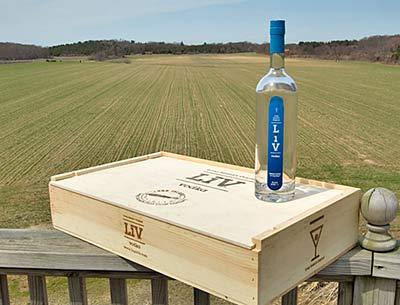
As we eagerly wait for the snow to melt and spring to arrive, we could indulge in some Eastern European-inspired cooking. How about some Long Island potatoes with Long Island’s own LIV vodka? And as things turn green and promising, break out the grill and cook some fish with herbs and chard on the side, a la Croatia.

Click for recipes

News For Foodies: 03.12.15

News For Foodies: 03.12.15

Local Food News
By
Joanne Pilgrim

Wine Bar at Michael’s

Michael’s restaurant at Maidstone Park in Springs has reopened after a short hiatus during which some interior renovations took place. Michael’s now features an expanded wine bar, with over 40 wines by the glass. An interior wall has been removed, affording more space for the bar area. Michael’s is now open seven days a week.

Monthly Pig Roast

The monthly pig roast dinner at Topping Rose House in Bridgehampton will take place on Friday, March 20, at 6 p.m., with a menu that includes head cheese crostini, local micro greens, homemade bratwurst, and a spit-roasted whole pig. Courses will be paired with Paumanok Vineyards wines. Reservations are required, as space is limited. The cost is $95 per person plus tax and gratuity.

The next Topping Rose cooking class will take place on Wednesday at 5:30 p.m. with the restaurant’s chef de cuisine, Kyle Koenig, and pastry chef, Cassandra Shupp. After learning how to prepare each dish in a three-course menu while sipping a Topping Rose House cocktail, students will partake of the meal, paired with wine. Special room rates are available for those who wish to stay overnight at the hotel after the class. The cost of the class is $175 plus tax and gratuity. Advance reservations are required

Dining Coupons

A book of discount coupons for dining at East End restaurants, issued annually as a fund-raiser for East End Hospice, is now available. The cost is $100. The booklet contains 31 coupons for a buy-one-get-one-free entree deal at different restaurants. Among them are Almond, the American Hotel, Babette’s, Fresh Hamptons, Townline BBQ, Rowdy Hall, the Lobster Roll, and Topping Rose House. Other participating restaurants are farther afield, including on the North Fork. Booklets can be purchased through East End Hospice.

Local Spirits

“Distill Life: An Ode to Spirits,” a panel discussion about the resurgence of locally produced spirits, will take place tomorrow at 6 p.m. at the Parrish Art Museum in Water Mill. Moderated by Brian Halweil, the editor of Edible East End, participants will include Jason Laan of Sag Harbor Rum, Richard Scoffier, the food and beverage director of Honest Man Restaurants, and Leslie Merinoff of Owney’s NYC Rum in Brooklyn. They will bring samples to taste. Admission is $20 or $10 for museum members.

Prime Rib Night

Thursdays are prime rib nights at the Bell and Anchor in Noyac. Prices vary for a menu including a choice of appetizer and an entree of prime rib with vegetable, potatoes, and jus, depending on how much meat is ordered. Dessert will be an additional $5.

Pasta Night

Pasta lovers might choose Tuesdays to go to the Harbor Grill, when a $17 special includes a choice of pasta with clam sauce, meatballs, Bolognese sauce, or sausage, broccoli, garlic, and olive oil. It comes with a cup of soup or small house salad, and garlic bread. Tax and gratuity are extra.

For St. Paddy’s Day

St. Patrick’s Day will bring not only luck for the Irish, but Irish food and drink specials at Rowdy Hall in East Hampton, both on Tuesday, the holiday, and on March 21 and 22, the weekend of the Montauk St. Patrick’s Day parade. A lunch and dinner prix fixe on Tuesday will include an appetizer and entree, or entree and dessert, for $25. Menu choices include potato leek soup, corned beef and cabbage, bangers and mash, shepherd’s pie, and Irish whiskey chocolate cake.  A la carte specials will be offered at lunch and dinner on the March 21 weekend.

Beer Tap Takeover

Townline BBQ in Sagaponack has given over its beer taps to Long Island brews for the entire month of March. One beer per day will be featured during happy hour for $4 per pint and $15 per pitcher. Beers will include Spider Bite Funder Session I.P.A., Montauk Red Ale, Great South Bay Lager, Long Island Pale Ale, and Greenport Harbor Otherside I.P.A.

Sen Chef at Wolffer

The Sunday cooking class series at the Wolffer residence at Sagaponack’s Wolffer Estate will feature Ryunosuke Jesse Matsuoka of Sen this week. On the menu are usuzukuri, a dish of thinly sliced raw white fish, double pork ramen, and mochi, along with Wolffer wine. The cost is $75.

Time for Farm Products

Balsam Farms has announced the availability of this year’s community-supported agriculture memberships, through which produce will be distributed between May 29 and Nov. 20.

Four levels of membership are available, as are add-ons that would entitle members to fruit, flowers, fresh mozzarella, or bread, in addition to their weekly share of produce. 

Membership fees cover the farm’s costs for planting and harvesting. Those who join by April 1 will receive a free Balsam Farms T-shirt or trucker cap. Information is available at balsamfarms. com.

Specials Match the Name

At the downstairs tavern at the 1770 House in East Hampton, entree specials are offered for $17.70 on Thursday nights.

Seasons by the Sea: The Humble Nut

Seasons by the Sea: The Humble Nut

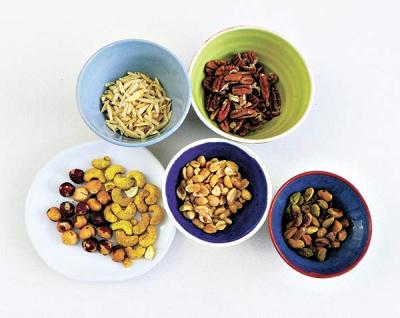
Nuts have gotten a bad rap for being fattening, but they can be very good for you.
Mark Segal Photos
Nut fats and oils can be good for you, some extremely good
By
Laura Donnelly

My friends Cindy and Jimmy have a huge glass jar filled with pistachios on their kitchen counter. When I say huge, I mean it. It is the size of a Southern church lady’s iced tea dispenser. And it’s always full.

I find this comforting . . . and tasty. When I remarked on it the other day, Jimmy asked, “Why haven’t you ever written about nuts? They’re good for you!”

So thank you, Jimmy, here it is.

Not that long ago, nuts were vilified for the mere fact that they’re fattening. Yes, some of them are, but as we have discovered (or realized) more recently, nut fats and oils can be good for you, some extremely good. Under the strictest definition, only acorns, hazelnuts, beech, and chestnuts are true nuts — that is, an edible seed surrounded by a hard shell. But coconuts, pine nuts, and numerous seeds also fit into this category of ancient nutritious foods. Because most do not require cooking to be edible, they have been a valuable food source since prehistoric times.

Walnuts, hazelnuts, pine nuts, and chestnuts have been around longer than other food plants, over 60 million years, according to Harold McGee’s “On Food and Cooking: The Science and Lore of the Kitchen.” They are the richest food we eat, with 50 percent or more oil, 10 to 25 percent protein, vitamin E, and folic acid. Because of their high oil content, they become rancid very quickly, so proper storage is important. Most can be kept sealed in a glass jar in a cool, dark, dry place, but many can be kept frozen for several years. Considering how expensive they are, it is good to heed this advice.

Raw nuts are relatively tasty, but toasting, roasting, or frying them brings out marvelous flavors. Nuts and seeds taste good with everything from fish to salads to desserts and drinks. We’re all familiar with the different kinds of nut oils, sunflower, peanut, coconut, and more. Walnut, hazelnut, and pistachio oils are popular in Europe as flavors for salads and breads. Toasted sesame oil is common in Asian cooking.

Nut pastes such as tahini, almond, and peanut are common in many cultures: tahini to make hummus and baba ghanoush in the Middle East, almonds for soups in Spain, and we’ve all seen plenty of peanut butter in our lives. Almonds are also made into marzipan, a sweetened paste popular in Europe for making pretty little confections. Leonardo da Vinci made sculptures of marzipan for the Milanese court of Ludovico Sforza and apparently “observed with pain that they gobbled up all the sculptures I give them, right to the last morsel.” I didn’t know “gobble” was a word in 1470!

Nut milks are popular these days and are especially helpful for those on a vegan diet, as they can be made into ice creams, sauces, soups, and more.

I don’t know anyone who is crazy about Brazil nuts; they always seem to be the last ones at the bottom of a mixed nut bowl. This is a shame because Brazil nuts contain the highest amount of selenium of any food. Cashew nuts are related to poison ivy, and that is why you’ve never seen them sold in the shell. Cashews and chestnuts are among the more starchy nuts, which makes them good thickeners.

Coconuts are the largest of nuts and are used in many tropical cuisines, either as the thick coconut milk or shredded and toasted. Coconut water is a popular (and somewhat expensive) fad right now, and while it does contain some potassium and electrolytes, it is not considered to be anything very special by nutritionists. Better than soda pop, but not much better than water for rehydration, unless you’re playing at Wimbledon or running a marathon.

Even macadamia nuts are no longer considered bad for you, eaten in moderation, of course! They are mostly monounsaturated fat, which can help reduce bad cholesterol, according to the American Heart Association.

Pecans and walnuts are a softer nut and contain unsaturated fatty acids. They are very perishable but can be kept frozen for a long time. Pecans and walnuts are great in salads and baked goods, and crushed pecans make a tasty coating for fish and chicken.

Remember when pistachios had a red dye on them that would stain your fingers? This is because they were harvested and sun-dried before hulling, which gave them a mottled red color. Manufacturers would dye them more so they’d have a uniform color. Now they are hulled before drying, and that’s why you don’t see those ghastly red ones anymore. Pistachios and pumpkin seeds are the only nuts that contain chlorophyll, which gives them their green hue.

Flaxseed is another super seed, very popular today. Once just used to make linen fiber, flaxseeds contain 30 percent oil and 30 percent protein, and the oil is more than half linolenic acid, an omega-3 fatty acid.

Poppy seeds are related to the same plant that produces opium, and while we usually only see them on a seeded bagel, if you eat a piece of lemon poppy seed cake or other pastry filled with the seeds, you will test positive on a drug test. Have you ever noticed that some poppy seeds look blue? This is actually an optical illusion. They are brown but are covered with tiny crystals that create prisms.

Pumpkin seeds contain 35 percent protein and are popular for snacking, oils, and as a thickener for soups and stews. Sunflowers were originally only enjoyed as a decorative plant. They originated in the American Southwest and were taken to Europe around 1510. They started being grown as a crop in the 18th century and are now one of the top oil crops in the world. Sunflower seeds have a lot of phenolic antioxidants and vitamin E.

I love nuts and seeds and always have a pretty good variety around the house. When I don’t have time to eat or forget to, a handful of almonds and dried fruit are a pretty decent way to tide me over. I keep sunflowers for sprinkling on salads, cashews, naughty Marcona almonds, and pistachios for “company,” peanuts for everything, pine nuts for pesto and salads, and tahini for hummus.

For those who are not allergic, nuts are an excellent and delicious way to get many healthy vitamins and fats. Enjoy them without guilt, in moderation.

Click for recipes

News For Foodies: 03.05.15

News For Foodies: 03.05.15

Local Food News
By
Joanne Pilgrim

March Weekends

The Montauk Yacht Club will be open on weekends this month, before opening daily for the season on April 1. Breakfast and lunch are served on Saturday and Sunday, and dinner is served on Friday and Saturday nights, when there is live music. The dinner menu is a la carte, with a $29 prix fixe.

Michaels’ Wine Bar

Michaels’ restaurant at Maidstone Park in Springs has closed for a few weeks in order to make some interior renovations. The changes are designed to accommodate a new wine bar concept, where homemade gelato or sorbet for dessert will be available as well as wine.

Restaurant Week Soon

Foodies are marking their calendars for the 13th annual Hamptons Restaurant Week, which takes place from March 22 to 29 this year. During the week, participating eateries will offer three-course prix fixe menus for $27.95. The special will be available during limited hours on Saturday, March 28.  


Restaurateurs who would like to participate can sign up online at hamptonsrestaurantweek.com, where diners will also find a list of places to go for the deal.

At Fresh

Fresh Hamptons in Bridgehampton serves brunch on Saturdays and Sundays from noon to 4 p.m., featuring an a la carte menu. Thursday is pizza night at Fresh, starting at 5, with a three-course, build-your-own-pie dinner offered for $18 plus tax and gratuity. It starts with a Caesar salad, followed by a chance to choose toppings — some at an additional $1 or $2 premium — for a 12-inch organic whole-wheat pizza with mozzarella and tomato sauce.

A six-session cooking class with Todd Jacobs, the owner and chef at Fresh, begins tonight and will continue on Thursdays from 6:30 to 9 p.m. Those interested may attend individual sessions for $125, or the series for $650. The first 20 students to sign up will receive a discount.

Wolffer Classes

Chef-led cooking classes at the Wolffer residence at the Sagaponack winery continue throughout March. On Sunday, Christian Mir of the Stone Creek Inn will lead the session, and on March 22, it will be Colette Connor of the Inn Spot on the Bay.

Classes feature a demonstration and lunch, which will include complementary wine. The sessions begin at 12:30 p.m. and cost $75.


Seasons by the Sea: Menus and Stories They Tell

Seasons by the Sea: Menus and Stories They Tell

This menu book "has more exclaimation points than a teenage girl's diary," but is full of menus and the memories behind them.
Laura Donnelly
A definite narrative arc
By
Laura Donnelly

I used to keep a menu book. No one seems to know what those are anymore. If you Google them, all you get are restaurant supply stores offering you big leather-bound menu covers, or books like “7-Day Menu Planner for Dummies” and “Dinner: The Playbook — a 30 Day Plan for Mastering the Art of the Family Meal.” In other words, all you find are books for people who hate to cook, or don’t have time, and probably don’t even want to sit down to dinner with their family and friends. One friend asked, “Isn’t that something socialites used to do?” Probably. But for the 10-year span I kept a menu book, I was a hippie-dippy type working at National Public Radio and then NBC News as Roger Mudd’s researcher. I just loved to cook for friends.

I found this menu book recently and discovered as I read through it that there is a definite narrative arc. It spans 10 years and all 160 pages are filled. My husband and I lived together for five years, before we got married. The book begins one year after we got married (1985) and ends in 1995, when we were separated and on the verge of divorce. The last entry of May 14, 1995, was three weeks before I was to have surgery and discover that I had ovarian cancer. But here I am now, 20 years later, alive and well. (I served glazed chicken Germaine, by the way, with pickled carrots and steamed rice.)

It’s too bad my handwriting is so atrocious. If I’d been paying attention in penmanship class, this book would be quite lovely. Alas, my scribbles look like rat tracks, there are more exclamation points than a teenage girl’s diary, and my “wine notes” show a complete lack of understanding of how to read a label, a problem I have to this day. I was definitely enamored of Patricia Wells’s “Bistro Cookbook” and Lee Bailey’s “Country Weekends.”

I repeated some recipes so many times that two friends visiting from California, eight years apart, remarked “Haven’t we had this dish before?” Mortified, I consulted my menu book and there it was: “Drew and Barbara here from California — butternut squash with ginger and rosemary.” Isn’t that one of the points of menu books, so you don’t repeat the same foods? By the way, that dish is so good, I’ve already published it twice in this column.

There are plenty of historic tidbits in the menu book. Such as the dinner party of Dec. 7, 1991, the 50th anniversary of Pearl Harbor Day. Menu: anchoiade, lamb shanks with black beans, roast Provencal tomatoes, butter lettuce with dill and toasted almonds, plum torte with vanilla ice cream, Saintsbury pinot noir. Or more significantly, Jan. 11, 1992: My brother, John, in town to attend a Washington Redskins playoff game against the Detroit Lions and the ’Skins won! Like I said, lots of exclamation points. Menu: homemade chicken liver paté, chicken with mustard and capers, gratin of zucchini, peppers, and potatoes, salad Bressane, and cinnamon vanilla souffle. I repeated that souffle many times and it never came out correctly. It was always a flat, very cinnamony, chewy thing with a bit of crunch from granulated sugar. I didn’t even know then that souffles are meant to be airy and light.

Looking back at the guest lists, I gotta say, I’m impressed. One dinner had the actor Bruce McGill (“Animal House,” “Silkwood,” “Family Guy,” “Miami Vice,” “Lincoln”) and Bob Mondello, then a brand-new arts and film critic at NPR. When we lived in Dallas, a little pipsqueak named Scott Pelley was a frequent guest and look at him now, anchor of “CBS Evening News.” Nathan Lane came once. He was part of a comedy team with our friend Pat Stack. I think we all know who he is. There are also quite a few guests who are no longer with us: Jack Kehoe, my cousin Kathleen, E.J. Mudd, Laurie Stack, Mary Martin, and, saddest of all, my ex-husband, who died last March.

A frequent entry was what I called the Friday Night Bachelor Club. Every Friday night it seemed to be yours truly with a bunch of men. Boo hoo! The charter member was my college classmate from Kenyon, Matthew Smith. He was working for George H.W. Bush and had a secret source for authentic key limes, which he delivered every time he came. I am positive they were from some big cheese in the White House, but he never fessed up. We ate a lot of key lime pies! As you can see, I have learned to tame my enthusiasm for the exclamation point.

I felt I really had to step up my game for some guests, such as Daniel Zwerdling, then and now a fine reporter for NPR, and his wife, Barbara Rothschild. They are superb cooks themselves and wrote the second-tier restaurant reviews for The Washington Post. Phyllis Richman would get the Citron (Michel Richard) and Jean Louis (Palladin) reviews, and Danny and Barbara would get the obscure Vietnamese pho shops in Arlington. Sample menus showing off for my foodie friends: salmon with garlic confit in parchment, beet and radish salad, raspberry tart. Alsatian onion tart, lobster salad with basil, that damned butternut squash again, brandysnap cups with Grand Marnier mousse. Trout with vermouth and orange zest, leg of lamb, potato with celery root and Gruyere pancake, creme brulee with berries.

There are many birthdays and goodbye dinners and my son’s christening party. Some dinners were at a friend’s farm in LaPlata, Md., some in East Hampton, a few in Dallas, and most in Virginia. On Oct. 8, 1994, our Catahoula dog, Gumbo, ate all the brownies. On Sept. 4, 1985, the police came knocking on the door because a neighbor had reported that “a bad smell was coming from next door, we think it could be a decomposing body.” I was barbecuing bluefish on the back porch. One entry says “March 1, 1992, what the heck happened here?” Apparently, I marked the date but forgot the menus and who came.

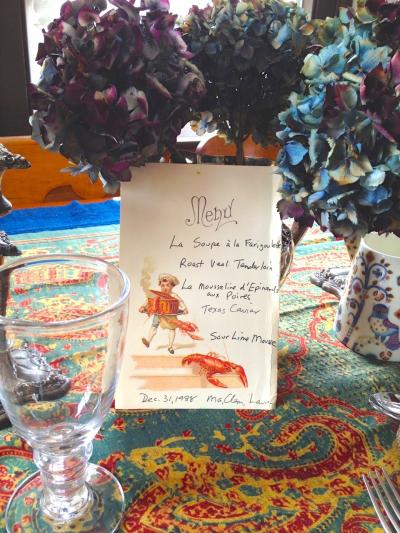
My father died just before Christmas in 1988. In an effort to cheer up our mother on New Year’s Eve I prepared an all-French menu. (She had spent most of her youth in France.) Menu: la soupe a la farigoulette, roti de file de veau, mousse de chaux sur. It was just the three of us — my husband, Clem, mother, Honoria, and myself, a really bereft trio. She adored my father, and I wanted so badly to take her out of her grief, if only for a three-course meal.

They say that taste is our strongest sense memory. I can still remember the first lettuce from our community garden, May 7, 1992. Dec. 4, 1991, homemade peach pie lovingly and laboriously made the previous summer. Craig Claiborne’s veal meatballs with tarragon, March 19, 1994. And so many more. It’s a bittersweet 10-year record of a wonderful period of our lives, ending when life suddenly wasn’t so wonderful.

I am grateful and glad I still have this menu book, this culinary diary. Exclamation point, exclamation point, exclamation point!

Click for recipes