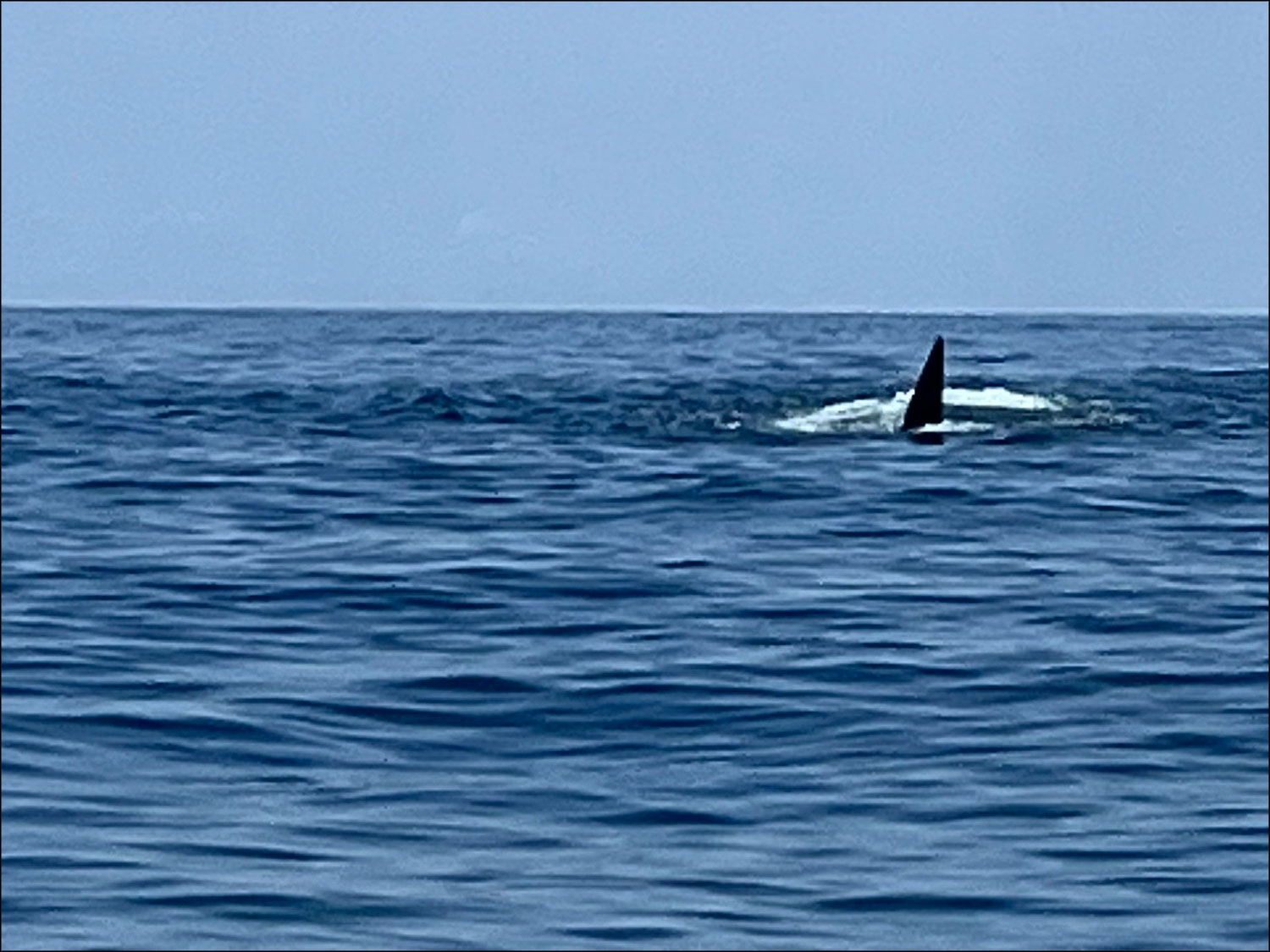
A widely circulated social media post last week from Craig O’Connell, host of Shark Week on the Discovery Channel, and founder of the O’Seas Conservation Foundation in Montauk, raised the possibility that an orca, colloquially known as a killer whale, was spotted 10 nautical miles off the tip of Long Island.
If so, it would be the first such sighting that close to the hamlet in decades.
“I’m 100 percent certain it was an orca,” Mr. O’Connell said in a phone call Monday. “I saw its body and coloration. I’ve worked with them on the West Coast. It was 100 percent an orca.”
The New York Post reported that it was the somewhat legendary orca known as Old Thom, but Mr. O’Connell said that was unlikely, since that animal was spotted in the Bay of Fundy, between Maine, Nova Scotia, and New Brunswick, the day after his orca sighting.
“To move that distance over the span of 24 hours is insane,” he said. “I think I saw a different orca. It’s just that whenever you see a giant male orca on the East Coast, it’s typically Old Thom. He hangs out.”
Mr. O’Connell was out with a boat full of high school students for the Shark Camp he leads. “I’ve spent 13 years out here in Montauk almost every day in the summer and I’ve never seen anything like this,” he said. “It was super unique and exciting. We were looking for sharks and we found an orca.”
“Orcas do show up here, they’re just extremely rare,” he continued. “You’re more likely to see them in the cooler waters of the upper Northeast, off the coast of Nova Scotia or Maine. The day I observed it though, we were in a weird body of water that I don’t typically see in that area. It was a little cooler, with a strange thermal. There was a prolific mass of tuna, common dolphins, and humpback whales. There’s a very big possibility that the combination of water mass, temperature, and abundance of prey led that orca to that site.”
Not everyone was convinced.
“I’m open to the possibility of this being an orca, but am still skeptical for a multitude of reasons,” Artie Kopelman, the co-founder, senior scientist, and president of the Coastal Research and Education Society of Long Island, said in a text.
He added that he’s seen just one in 39 years of whale watching, and that was 75 miles south of Montauk.
“It also might be the fluke [tail] of a finback whale that has rolled onto its side at the surface. The images and videos don’t convince me. Also, the fact that this one seems to be alone. It’s definitely not Old Thom. He’s still up north.”
“Even though their occurrence is not that frequent, there are more people out there looking. That added effort is producing more sightings,” said Rob DiGiovanni, founder and chief scientist of the Atlantic Marine Conservation Society, who said a few have been sighted off of Martha’s Vineyard in just the last five years.
Their nickname, he said, is a bit of a misnomer. “We call pilot whales pothead whales, and the humpback whale isn’t as humpy as you’d think. They got the name ‘killer whale’ because they go after larger prey [in some cases other whales] that people see more readily.”
Orcas are found in every ocean on the planet, making them the most widely distributed whale, according to Whale and Dolphin Conservation — North America, an advocacy group.
They’re the largest member of the dolphin family with a six-foot-tall dorsal fin, according to the group. Males can weigh up to 22,000 pounds, and females can live up to 80 years. A pod can cover nearly 100 miles in one day. They eat a wide range of sea life: fish, seals, dolphins, sharks, whales, even sea birds.
Sadly, most people’s experience of an orca isn’t like Mr. O’Connell’s; instead, it’s through the thick glass of an aquarium tank. In North America, 16 orcas are contained in tanks. Worldwide, 53 are held in captivity (most in China); 20 of them were captured in the wild and 33 were born in captivity.
When held in tanks, they swim in circles, causing “dorsal fin collapse” in nearly 100 percent of captive males. In the wild, only one percent of whales suffer from this affliction. The oldest surviving orca in captivity is Corky, who lives at SeaWorld in San Diego. She was captured in 1969. None of her seven offspring have survived.
Back on our shores, “There’s an abundance of life out there right now,” said Mr. O’Connell. “We’ve protected and cleaned up the waters and they’re full of Atlantic menhaden. We call them the fuel of the New York Bight, which is the body of water between Montauk and Cape May. Sometimes they get so close and dense you can see dolphins, sharks, and whales. We’re in a boat, but you can sometimes see them all [when you’re] just literally laying on the beach.”