
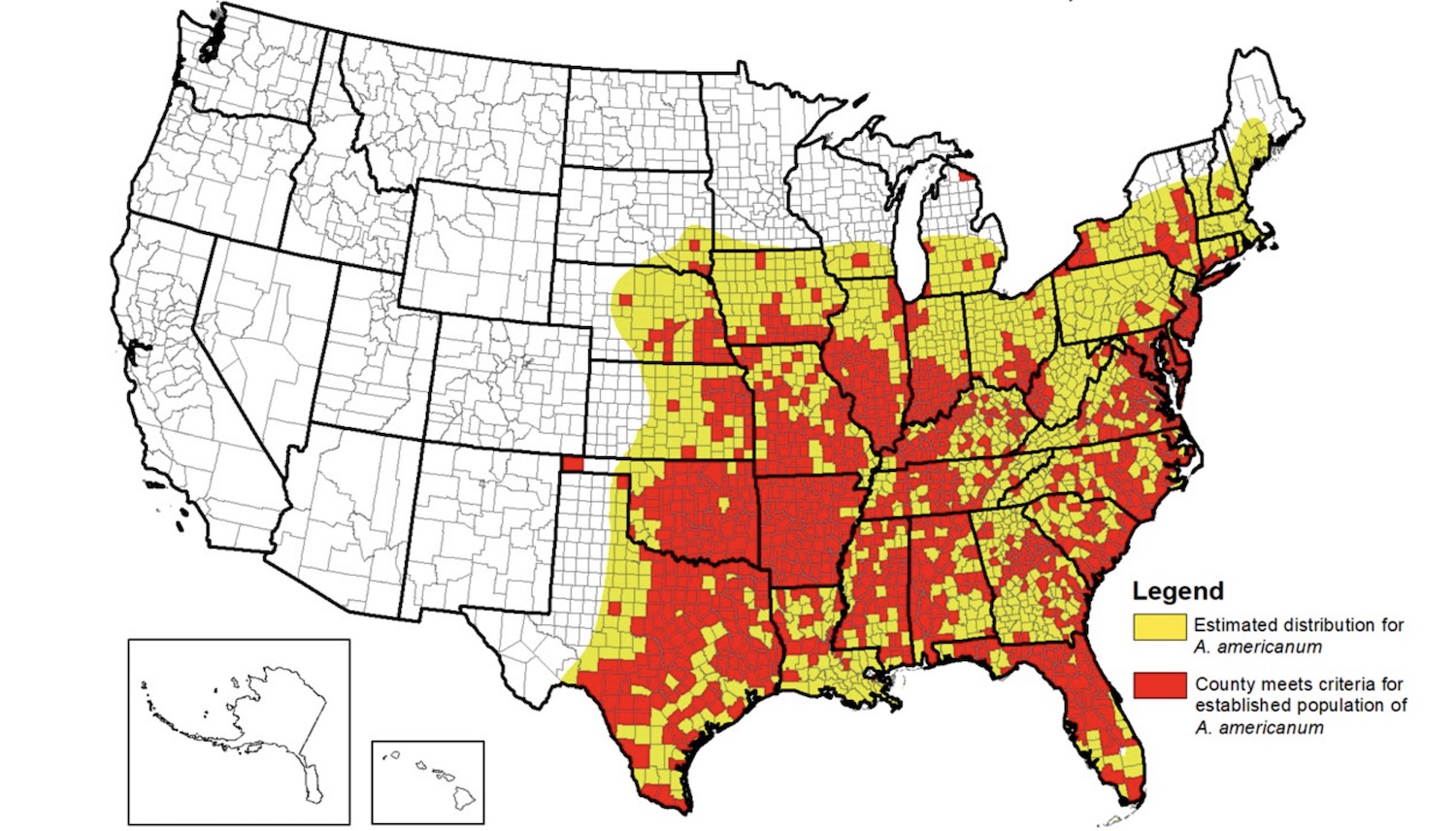
The Bourbon virus, a potentially deadly tick-borne disease first discovered in 2014 in a man from Bourbon County, Kansas, has recently shown up in New York State, and the most common tick on the East End, the lone star tick, can spread it.
That is disconcerting news to say the least, but the virus is still almost beyond-belief rare. As of early this year there were only six known human cases.
It’s possible, however, that it is more prevalent and just going undiagnosed. There is no commercial blood test as yet that allows for diagnosis. The only way it can currently be ferreted out is if a doctor sends a blood sample to the State Department of Health, which has a laboratory equipped to identify it.
Either way, the arrival of Bourbon adds complexity to diagnoses for more common tick-borne illnesses.
“There are a lot of lone star ticks in New York, and in the northeast we have dense populations, and when someone is infected with Bourbon virus symptoms, they are similar to other tick-borne infections,” wrote Luis Marcos, a medical doctor, professor in the Departments of Medicine and Microbiology and Immunology at the Renaissance School of Medicine at Stony Brook University, and the director of the Tick-Borne Diseases Clinic, who confirmed the first case on Long Island in a recent paper.
The patient, a 67-year-old man, was bitten in Shirley about five years ago and recovered. His infection was discovered when Dr. Marcos examined lab results from 107 patients who had shown symptoms of tick-borne illnesses between 2019 and 2024. The man showed symptoms similar to Lyme disease, but failed to improve with the standard doses of antibiotics.
Dr. Marcos said his study “highlights the need for expanded viral surveillance and clinical testing.”
“Unlike Lyme disease, which often presents with the distinctive erythema migrans rash, Bourbon virus does not have a hallmark skin finding that allows clinicians to recognize it clinically,” Dr. Marcos wrote in a follow-up email. “Diagnosis therefore relies on maintaining a high index of suspicion and performing specialized laboratory testing.”
“Without identifying the cause of an infection, the chances of developing accurate diagnostic tests or effective treatments are minimal. That is why it is so important to first understand the true impact of the virus in high-risk areas.”
Because the virus is still so rare, Dr. Marcos wrote that there is “not enough data” to judge if its effects are worse than those of other tick-borne illnesses.
“Only a handful of confirmed Bourbon virus cases have been reported in the medical literature, so it is not possible to accurately estimate the true mortality rate, frequency of severe disease, or risk of long-term complications.”
George Dempsey, the medical director of East Hampton Family Medicine, has worked for years collecting blood samples and adding them to the Bay Area Lyme Disease Foundation’s biobank.
“This is a real opportunity for the biobank to look for co-infections,” he said in a phone call last week. “I would love to see how much Bourbon, Powassan, and Heartland virus may be in our samples. For all of those viruses, we don’t have a test. So the only way to detect them is by sending samples to the state laboratory. Dr. Marcos’s paper raises the question, ‘Are there mild forms of these viruses we’re just not aware of?’ It’s an area of much-needed study.”
New York’s senior senator, Chuck Schumer, made clear at a recent press conference that he’d like more federal dollars assigned to research tick-borne illness, after Suffolk County logged 3,152 cases of Lyme disease in 2025. “That’s the most of any county in all of New York State,” he noted, “and there are 62 of them.”
Representative Nick LaLota, a member of the House Appropriations Committee, said in a statement that he’d “made sure the fiscal year 2027 Labor, Health and Human Services, Education, and Related Agencies Appropriations bill increased funding for the C.D.C.’s Lyme and tick-borne disease programs so they can continue monitoring these diseases and strengthening prevention and control efforts for diseases that affect so many Long Islanders. With my support, the bill passed committee on June 9, 2026.”
Dr. Dempsey said he hasn’t seen many patients with tick-borne illnesses this year, but attributed that in part to changes to the way health care is provided on the East End.
“I’ve had to drop some insurance, and I now have an emergency room in my backyard. People go online and call their doctors in the city for a dose of doxy,” he said. “You can’t take an antibiotic to prevent or treat the Bourbon virus or the meat allergy, though. People think they can take an antibiotic and avoid getting sick, but in many cases, they’re taking a lot of doxy for nothing.”
The real measure of how many people are falling ill with tick-borne illnesses this year would come from Scott Campbell, director of the Suffolk County arthropod-borne disease program, said Dr. Dempsey. However, according to Ryan DeFilippis, a spokesman for the county’s Department of Health Services, that data comes from the state and is delayed.