The East Hampton Historical Society will reopen the Mulford Farmhouse, at 10 James Lane, on Saturday, coinciding with America’s observance of its semiquincentennial, or 250th anniversary. Independence Day will also see a walking tour of the village’s Main Street focusing on the Revolutionary War.
A ribbon-cutting at the Mulford Farmhouse will happen at 11 a.m. on Saturday, with tours ongoing until 4 p.m. Visitors can also tour the site using the historical society’s digital guide on the Bloomberg Connects arts and culture app or via the new “augmented reality” tour available on the 1776AR smartphone app. The latter is narrated by Hugh King, East Hampton Town and Village historian, said Steve Long, executive director of the Historical Society.
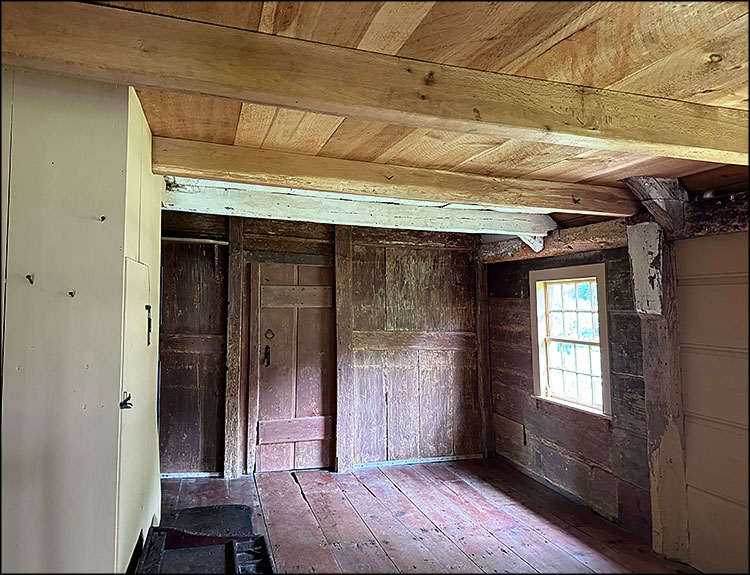
The farmhouse, which recently underwent an extensive renovation that recreates how it appeared during the Revolutionary War, is one of the most significant and intact English Colonial farmsteads in the country, offering a look at life in East Hampton in 1776. Col. David Mulford, a militia commander, and enslaved men and women were among the people who lived there at that time.
“We’re excited to have, after all these many months, completed the restoration and reinstalling of the furnishings,” Mr. Long said on Monday. “We will be ready to go.”
Both the exterior and interior layout of the farmhouse remain largely unchanged from how they looked in 1776. According to the Suffolk County census, the Mulford Farmhouse was home to 16 people at that time, including Mulford, his wife, Phebe, and their six children. The remaining residents were enslaved people of color, among them Acca, Daniel, Jack, and Phyllis, whose lives and labor were integral to the household and its operation.
According to the historical society, Mulford was both commander of a militia regiment — Long Island’s equivalent of the Minutemen of Revolutionary War times — and the region’s largest slaveholder. His story reflects what the historian Edmund Morgan called the American paradox: how many of the nation’s leading advocates for liberty and freedom also upheld and participated in chattel slavery.
The restoration, the first comprehensive interior renewal since the historical society acquired the property in 1948, entailed carpentry, plasterwork, and painting overseen by the preservation consultant Robert Hefner. The work was based on an in-depth paint analysis of the interior finishes, an investigation having revealed how Mulford had painters apply an expensive Prussian Blue pigment alternating with a copper acetate on the parlor’s woodwork, illustrating his wealth and status.
To commemorate the semiquincentennial and the reopening of the Mulford Farmhouse, Hugh King, East Hampton Town and Village historian, will lead a walking tour of Main Street on Saturday at 3 p.m. Those taking part will learn where the colonial militia drilled, understand how the British occupied East Hampton, and see the residences of American patriots and Revolutionary War veterans.
The tour will include the former site of the historic 1717 church, approximately where Guild Hall stands today; the Captain Thomas Wickham House; the Huntting Inn; the Gardiner-Brown House, which today serves as the headquarters for the Ladies Village Improvement Society; the 1770 House, and Clinton Academy, Mr. King said. Those planning to participate have been asked to meet at the Home, Sweet Home Museum, at 14 James Lane.
The Mulford Farmhouse will be open from Thursday to Monday from 11 a.m. to 4 p.m. throughout the summer.