During the American Revolution, songs and hymns were commonly written in the colonies as frustrations with the British crown grew. Unlike essays, these writings offered people a less formal manner to express their feelings about current events, while also creating a common voice for the independence movement.
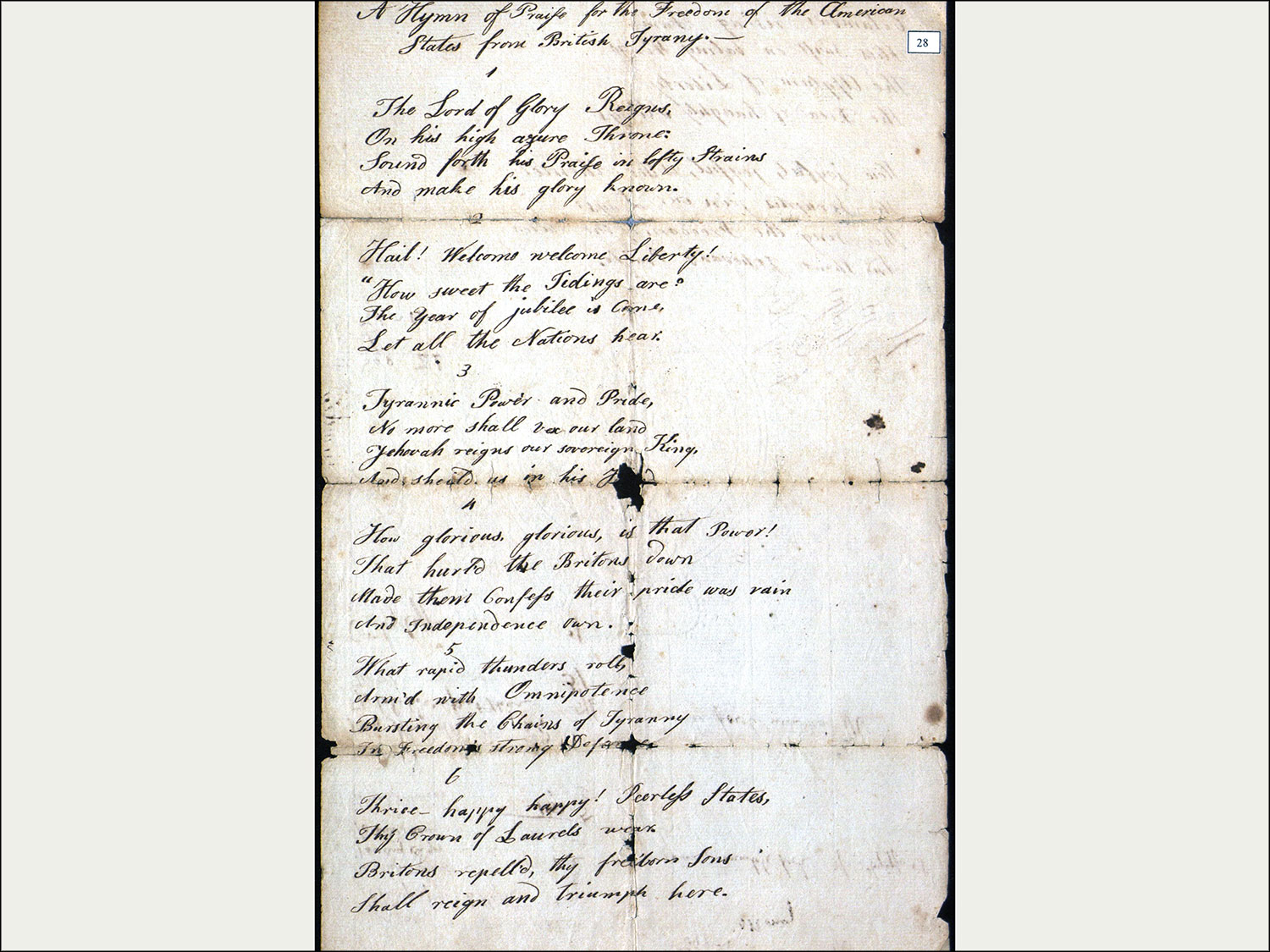
William Hedges (1737-1815), an East Hampton resident, wrote the hymn seen here, possibly with a little help from his daughter, Jane (1782-1823), in April 1789. He served in the Suffolk County Militia under Capt. John Dayton (1728-1825) during the Revolution, returning to East Hampton after the war.
His hymn praised America’s new freedom from Britain, welcoming liberty and the end of British rule with the verse “Tyrannic Power and Pride / No more shall vex our land.” After years of hearing that the American “experiment” would surely fail, William Hedges rejoiced at seeing his new government evolve toward something more sustainable.
The hymn specifically criticized how the British mistreated Americans and refused to acknowledge the United States as an independent country in the verse “How glorious, glorious is that Power! / That hurled the Britons down / Made them confess their pride was vain / And Independence own.” The wording also reflected the years of British laws designed to keep the colonies dependent on England, restricting development before the Revolution.
The hymn was written at a hopeful point after years of instability under the young nation’s Articles of Confederation, when it struggled through an influx of immigrants and a fragile economy. William’s voice is clearly optimistic, likely reflecting the events of the prior two months. On March 4, 1789, the first federal Congress met, reaching a quorum in early April, which allowed it to certify the election of President George Washington.
To learn more about the American Revolution here, visit the Long Island Collection’s pop-up exhibition “The American Revolution in the Hamptons,” opening on July 8 at 4 p.m. and running through July 11.
—
Kristen Ahearn is a librarian and archivist in the Long Island Collection.