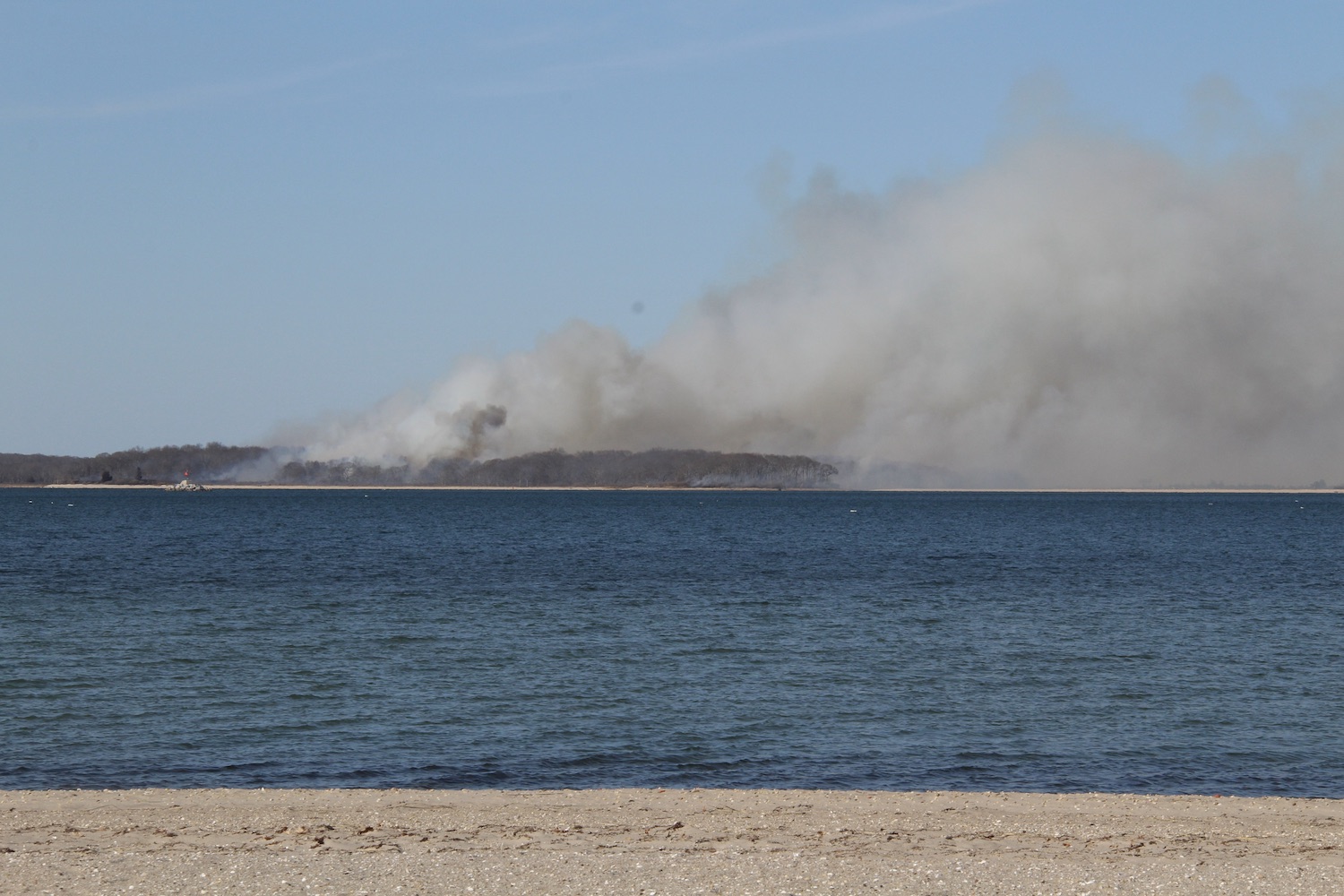
The Nature Conservancy conducted two controlled burns this week at the Mashomack Preserve on Shelter Island, one on Sunday and a second on Thursday.
“This is the culmination of a few years of effort,” May Yeung, a spokesperson for the Nature Conservancy, said by phone Thursday morning. “Fires have been going on at Mashomack for many years but there was a pause taken over 10 years ago.”
The pause in 2011 was due to a need to mitigate the deer population in the area. Until then controlled burns had been conducted regularly at the preserve beginning in 1980.
Making sure wildlife is protected during burns is a priority for the preserve. According to the Mashomack stewardship team, “burn windows are also set outside of nesting season for most birds in the area so they are either not yet nesting or it is early enough in the season that they will renest.”
Additionally most animals will move out of the way instinctively, and burrowing animals will not be affected as the fire cannot reach deep soil. The only potential impacts are on bald eagle nests, but precautions are taken to make sure they are protected, including clearing a fire barrier around the nests, according to the Nature Conservancy.
In the first controlled burn on Sunday, 100 acres were cleared safely by the end of the day. On Thursday the team aimed to clear another 70 acres.
“Historically burns are very beneficial for forest health,” Ms. Yeung said, “particularly for forest oak.”
The burns help the oak by removing understory vegetation and reducing invasive species. To measure success, the team has set up monitoring plots to watch the height and abundance of oak seedlings, understory vegetation, and canopy cover. These will continued to be monitored to watch if the seedings begin to grow and if canopy cover changes.
In terms of safety to the preserve and surrounding communities, Ms. Yeung said that “every precaution is taken” before a burn begins. Permission for the burn is not even granted by the state until the day before.
“We monitor weather reports,” Ms. Yeung added, “and the call is made after the National Weather Projection report is made for the next day.”
The most detailed information usually comes out at around 3 p.m. and the call to proceed with the burn the next day is made after that.
The Mashomack stewardship team does “not anticipate any impacts on the surrounding communities” from the smoke, the conservancy said Thursday. Weather conditions that are taken into account include air temperature, humidity, wind speed and direction, and the number of days since it has rained and how much rain there was. If these criteria are not met, the burn will not happen.
In advance of making the final decision to proceed, the burn plan has to go through multiple levels of approval and review, including through the New York State Department of Environmental Conservation, a fire ranger and forester from the Nature Conservancy, and Bryan Gallager, a Shelter Island resident and burn boss with the D.E.C.