It really doesn’t matter how the fish ended up in Thea (pronounced tay-uh) Giovannini-Torelli’s Montauk living room. We’ll never know and we don’t need to know.
It wasn’t important what type of fish it was. Some said mackerel, a Montauk fisherman said shad, and who could disagree with him? But again, not important.
What was important was that on an early September morning, after a very usual early-early morning, Ms. Giovannini-Torelli, hearing a sound like rustling paper, walked out of her bedroom and found the fish, covered in a thin layer of soot, flop, flop, flopping on her living room floor, relatively uninjured, a couple of feet from her fireplace.
Whatever it had been before, it was now reborn a “chimney fish.” Inescapable. To be dealt with.
“I approach it like it was a message, I’m not going to say from God, but from the outside world trying to break into this safe haven I’ve built,” said Ms. Giovannini-Torelli, a 37-year-old design and events curator. “It said to me, you have to let some things in.”
After a few minutes of observing the fish and taking a photo, Ms. Giovannini-Torelli scooped it up with a dustpan and ran it off into the dunes, hoping to reach the ocean. That’s when she was attacked by a squabble of gulls.
“That’s the hardest part of the story to tell, the part where I have to admit I killed the fish,” she said.
In a panic, she tossed it into the dunes. “If I was a braver and better person I could have reached the water.”
However, as the chimney fish, née mackerel or shad, was being torn apart by the gulls, it was again reborn. That was the most important part of the chimney fish situation. After releasing the fish into the dunes, Ms. Giovannini-Torelli got busy.
“The rest of my day was spent telling people the story and getting their interpretations,” she said. “I love talking to strangers. I once talked to a stranger every day for a year.”
Turns out, perhaps like that chimney fish, Ms. Giovannini-Torelli is a bit of a cosmic adventurer. She speaks of “banana studies” and “perpetual stews.”
“Every day there’s a challenge that you’re going to fail,” she said, describing the banana study. “Like, you may have to offer someone a bite of your banana. They’re going to say no. The idea is that eventually you learn it’s okay to fail.”
“The perpetual stew is a medieval tradition. It’s soup left stewing in a large central pot. Peasants gather scraps and throw them in, but the broth is never finished. Every day something new is thrown in. I think it’s a beautiful metaphor for life.”
“The world we built right now is focused on perfection,” she said. “How do we get messier and be more human and more like soup?”
From that question a lecture series titled “Soup Can Save the World and So Can You” was born.
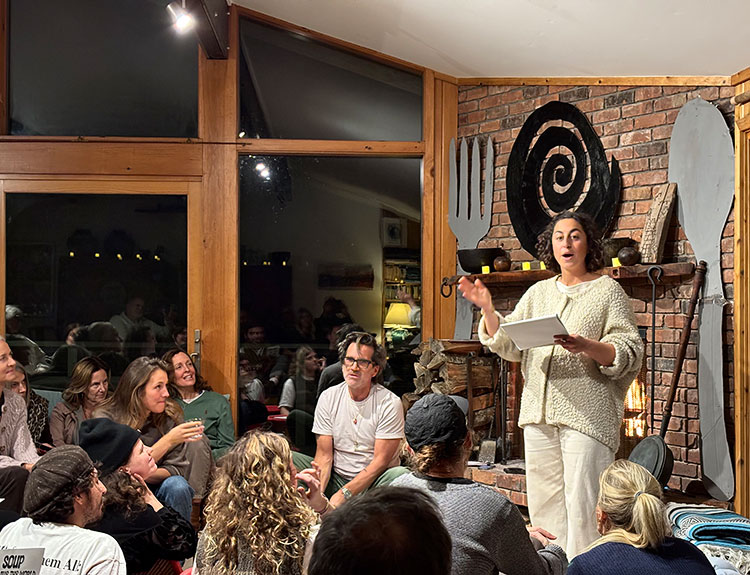
And so, on Nov. 16, there were 50 people in Ms. Giovannini-Torelli’s living room, seated on the floor where the fish improbably appeared, slurping soup and listening to Jeffrey Sheehan, a death doula, acupuncturist, and practitioner of Taoist death medicine.
“The way we die in a death-phobic culture is by not dying,” Mr. Sheehan told the crowd. “We try to get more time. But it’s more time spent not dying. More time not accepting the . . . fact of what’s happening, which is a hard thing to accept.”
“The thing we talk about in Taoist medicine is, ‘Where’s the center?’ Part of death phobia is not having a center. How do we find and hold the center?” he asked.
There are many deaths along the way to the Big Death.
“Moving, loss of job, loss of partner, loss of some identity you were holding onto. What part of you has remained through those flickerings in and out of these different identities?” he asked. “Might that be something to cultivate a deeper relationship with? Because that might be the thing that doesn’t die.”
What did people fear most about dying?
“I don’t want to be fed,” one woman said.
“I’m afraid of it happening when I’m alone, somewhere,” said a young man who had hiked solo through Hither Woods that day.
“The regret of the inaction during my living time. That is the fear,” said another.
Mr. Sheehan listened and said thoughtfully, “Start to develop some facility in getting underneath these fears.”
Statistics, he said, show a disparity in how people want to die versus how they die: 34 percent are in severe pain, yet 90 percent receive “heroic doses” of pain medications; 80 to 90 percent want to die at home, yet only 30 percent do.
“This happens because we don’t plan for what we want,” he said.
People shared stories of death.
A man recounted his last moments with his father, alone. “The chemical reactions happening in my brain. It felt like some sort of primal thing happening,” he said.
Another woman told the story of her mother’s death. She had been in and out of consciousness when she appeared to fully wake up.
“She opened her eyes and she looked at me and then she closed her eyes and she died. I sat with her and felt the warmth of her face and realized that was the last warmth I would ever feel from her body,” she said. “What happened was, this is the point of the story, I was sitting there with her and this thing happened in the world, which was like this incredible presence. Like it was the golden light, but it wasn’t visual light. It was like this incredible energy came into the room. And I don’t know — was that her? Was that actually her soul?”
A young lady attended her grandmother’s last days. Her grandmother loved to be surrounded by her female grandchildren when they were younger, stripped down to their underwear and having dance parties. Now in their 20s, they surrounded her death bed and had one more impromptu dance party.
“My cousin is like this really brazen young woman who was in her underwear and suddenly dancing. I was like, ‘Oh, my God,’ and she got up on the hospice bed. My grandmother just looked up at her with this face of pure joy and pointed to each of us.” They all joined in.
“She couldn’t even talk. She died the next day. But as I was leaving that night, she brought me close and quietly said the only words I heard her say for two days, ‘Thank you for the beautiful party.’ That kind of broke me, actually.”
Somewhere, a stone’s throw from that living room in the dunes below the windows, being blasted by relentless November winds, the bones of the chimney fish lay.
Across the room, Ms. Giovannini-Torelli, dressed in all white, watched as her own beautiful party unfolded.
(A version of this story first appeared in Paul Lukas’s Substack, “Inconspicuous Consumption.”)
The next “Soup Can Save the World” meeting is scheduled for Jan. 11 and will feature as speaker Ellie Duke, a writer, on the theme of “god.” Details can be found at souuup.com.